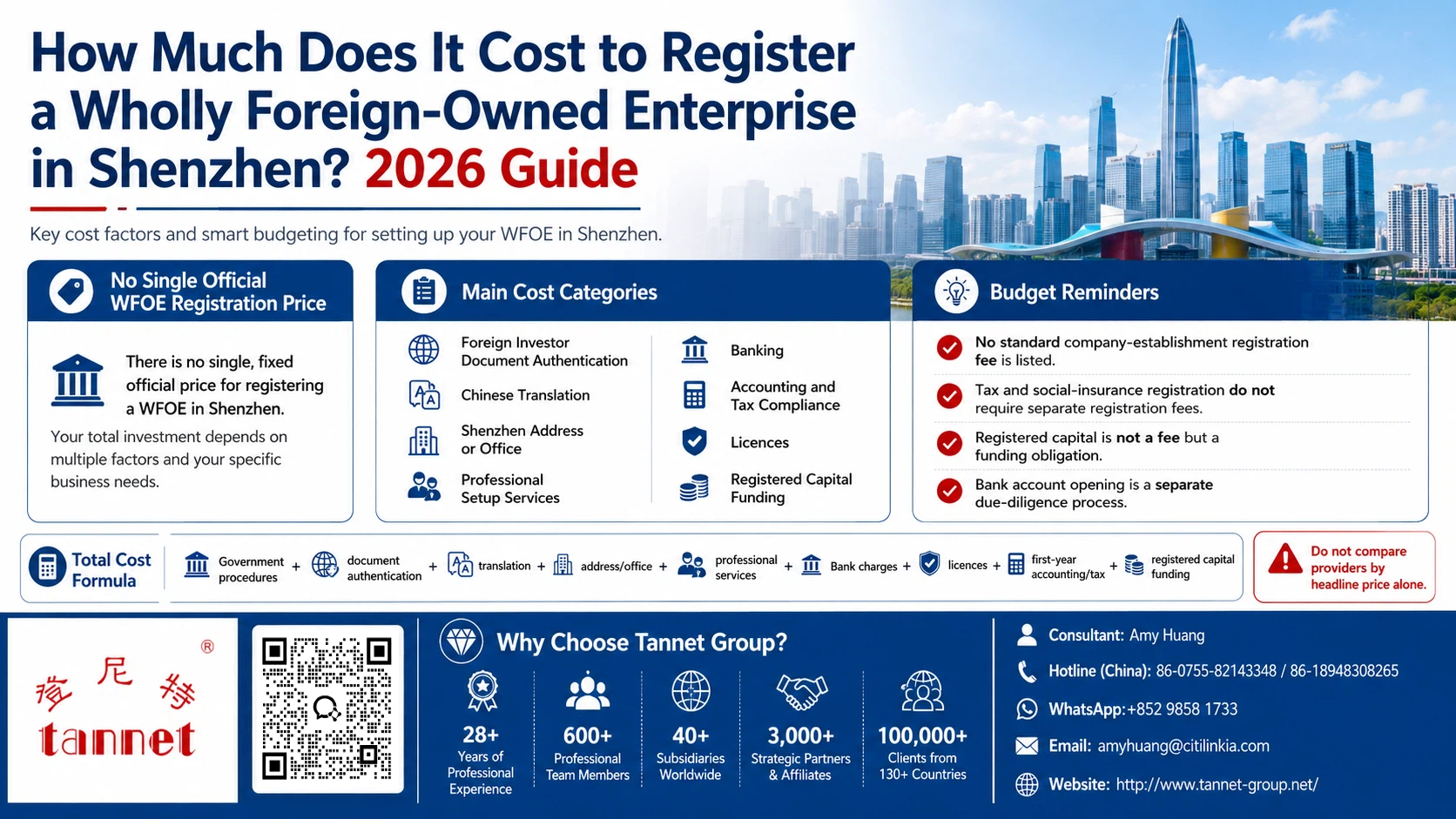
Key Takeaway
There is no single official “WFOE registration price” in Shenzhen.
The real budget is driven by investor-document authentication, Chinese translation, a lawful Shenzhen address or office, professional services, bank charges, accounting and tax compliance, licences, and registered capital. Registered capital is not a fee, but it is a real funding obligation.
Separate government procedures from business costs
A China WFOE budget has several layers.
Some items are government procedures. Others are third-party or professional costs. Registered capital is shareholder funding rather than a service charge.
A low “registration fee” can therefore be misleading if it excludes the items needed to make the company operational.
Is there a government company-registration fee?
Shenzhen’s current market-regulator administrative-fee directory does not list a standard company-establishment registration fee.
Regulated industries can still involve separate approval, inspection, testing, or licence costs.
The absence of a standard company-registration fee does not mean total setup cost is zero.
Tax and social-insurance registration
Tax and social-insurance registration do not require separate registration fees.
A July 2026 State Taxation Administration response confirms that these registrations are integrated into the business-licence framework.
This does not remove later bookkeeping, tax filing, payroll, or social-insurance obligations.
Cost category 1: foreign investor document authentication
This is one of the most variable costs.
A foreign corporate shareholder may need local notarisation, an Apostille, or Chinese consular legalisation.
If the investor’s country is an Apostille Convention member and the Convention applies with China, an Apostille generally replaces Chinese consular legalisation.
Non-member jurisdictions generally continue to use notarisation plus consular legalisation.
Charges depend on the investor’s home country and can include registry extracts, notary fees, Apostille or consular charges, and courier costs.
Cost category 2: Chinese translation
Foreign-language investor documents normally need Chinese translations.
The cost depends on document volume, language, certification requirements, and the number of corporate records.
Translation quality matters because an inconsistent investor name, address, or registration number can trigger rework.
Cost category 3: Shenzhen address or office
The registered address can be the largest practical cost.
Shenzhen uses an address declaration system with a unified address code. A standard filing may not require a lease at the first submission stage.
However, the applicant must have lawful use of the address and may need supporting evidence if the address is verified.
Founders with their own premises may have little extra address cost. Founders without premises need to budget for a lawful office or another compliant address arrangement suitable for the actual business.
Costs vary by district, building, size, and use.
Cost category 4: professional setup services
Foreign investors often use professional support because the process crosses corporate, foreign-investment, language, banking, and tax requirements.
A scope may include:
- Investor-document review
- Name and business-scope preparation
- Articles of Association
- Company filing
- Translation coordination
- Foreign investment information reporting
- Beneficial-owner filing
- Bank-account preparation
- Tax and accounting onboarding
There is no government-set professional fee.
Compare quotations by deliverables and exclusions.
Cost category 5: banking
Bank account opening is a separate due-diligence process.
Banks may review ownership, source of funds, business model, customers, suppliers, expected transactions, and the legal representative.
Opening and maintenance fees vary by bank and account type.
Bank approval should never be treated as automatic after incorporation.
Cost category 6: accounting and tax compliance
A WFOE has ongoing bookkeeping, tax, invoice, annual-report, and corporate-record obligations.
The cost depends on transaction volume, taxpayer status, payroll, import-export activity, related-party transactions, and the level of tax support required.
Separate one-time setup costs from recurring annual compliance costs.
Cost category 7: licences
A business licence is not always the final operating licence.
Regulated activities may require additional permits or approvals.
The Foreign Investment Negative List can also affect whether a foreign investor may enter a sector and under what conditions.
Check this before signing a long lease or committing substantial capital.
Registered capital is not a fee
Registered capital is a shareholder funding commitment.
For a standard limited liability company, it generally does not need to be fully paid on the registration date.
Under the revised Company Law, shareholders of a newly established limited liability company generally must complete subscribed capital contributions within five years from establishment.
There is no universal statutory minimum for ordinary limited liability companies unless another law or industry rule provides one.
Choose an amount based on real operating needs and funding capacity.
A practical WFOE budget formula
Calculate:
Government procedures
+ overseas document authentication
+ Chinese translation
+ address or office
+ professional services
+ bank charges
+ licences
+ first-year accounting and tax compliance
+ registered capital funding
This is more useful than asking for one headline number.
A simple company with an existing lawful Shenzhen address and straightforward investor documents may have a relatively low setup spend.
A corporate-shareholder structure with overseas authentication, paid premises, licences, and professional coordination can cost materially more.
Common Mistakes
- Treating registered capital as a government fee.
- Comparing providers only by headline price.
- Forgetting overseas notarisation, Apostille, legalisation, and courier costs.
- Using an address that cannot withstand verification.
- Assuming free seals are available regardless of filing method or timing.
- Ignoring accounting and tax costs after the licence is issued.
- Signing a lease before checking foreign-investment access and licences.
- Assuming bank account opening is guaranteed.
Frequently Asked Questions
Q1. Must registered capital be paid immediately?
Generally not for a standard limited liability company, but the subscribed amount normally must be paid within five years, subject to special rules.
Q2. How much registered capital should I choose?
There is no single correct amount. It should match operating needs, licensing, contracts, and shareholder funding capacity.
Q3. Does the address add cost?
It can. Founders without lawful Shenzhen premises need to budget for a compliant address or office.
Q4. Is bank account opening included in company registration?
No. Banking is a separate due-diligence process with bank-specific fees and requirements.
Q5. Do I need accounting before I have revenue?
Yes. The company has bookkeeping and filing obligations even during a low-activity period.
Q6. Why do WFOE quotations vary so much?
Different quotations include different services. Check authentication, translation, address, banking, licences, tax onboarding, accounting, and post-registration work.
When Tannet May Be Suitable
Tannet may assist foreign investors who want one coordinated scope covering Shenzhen WFOE registration, investor-document review, translation coordination, registered-address support, beneficial-owner and foreign-investment reporting, bank-account preparation, accounting, tax, and later work-permit support.
A written fee scope should separate government items, third-party charges, professional services, recurring compliance, and excluded costs.
Sources
- Shenzhen Administration for Market Regulation, One Window for Business Start-up and current registration guidance.
- Shenzhen Public Security Bureau, free-seal guidance for newly established enterprises.
- State Taxation Administration, 2026 guidance on tax and social-insurance registration fees.
- State Administration for Market Regulation, 2026 Standardised Materials for Business Entity Registration.
- SAMR, Measures for the Implementation of Company Registration Administration.
- Ministry of Foreign Affairs of the PRC, Apostille and consular legalisation guidance.
- NDRC and Ministry of Commerce, Foreign Investment Negative List (2024 Edition).
- China Briefing, 2026 WFOE Setup Guide, secondary process reference.
Written by: Tannet Business Services Team
Reviewed by: Consultant Amy Huang
First published: 18 August 2026
Last reviewed: 18 August 2026
Jurisdiction: Mainland China
————————————————Simplifying Business, Empowering Entrepreneurs————————————————