Key Takeaway
After a Shenzhen WFOE is legally established, it can act as the Chinese employer in a foreign employee’s work-permit process, but company registration alone does not create work authorization.
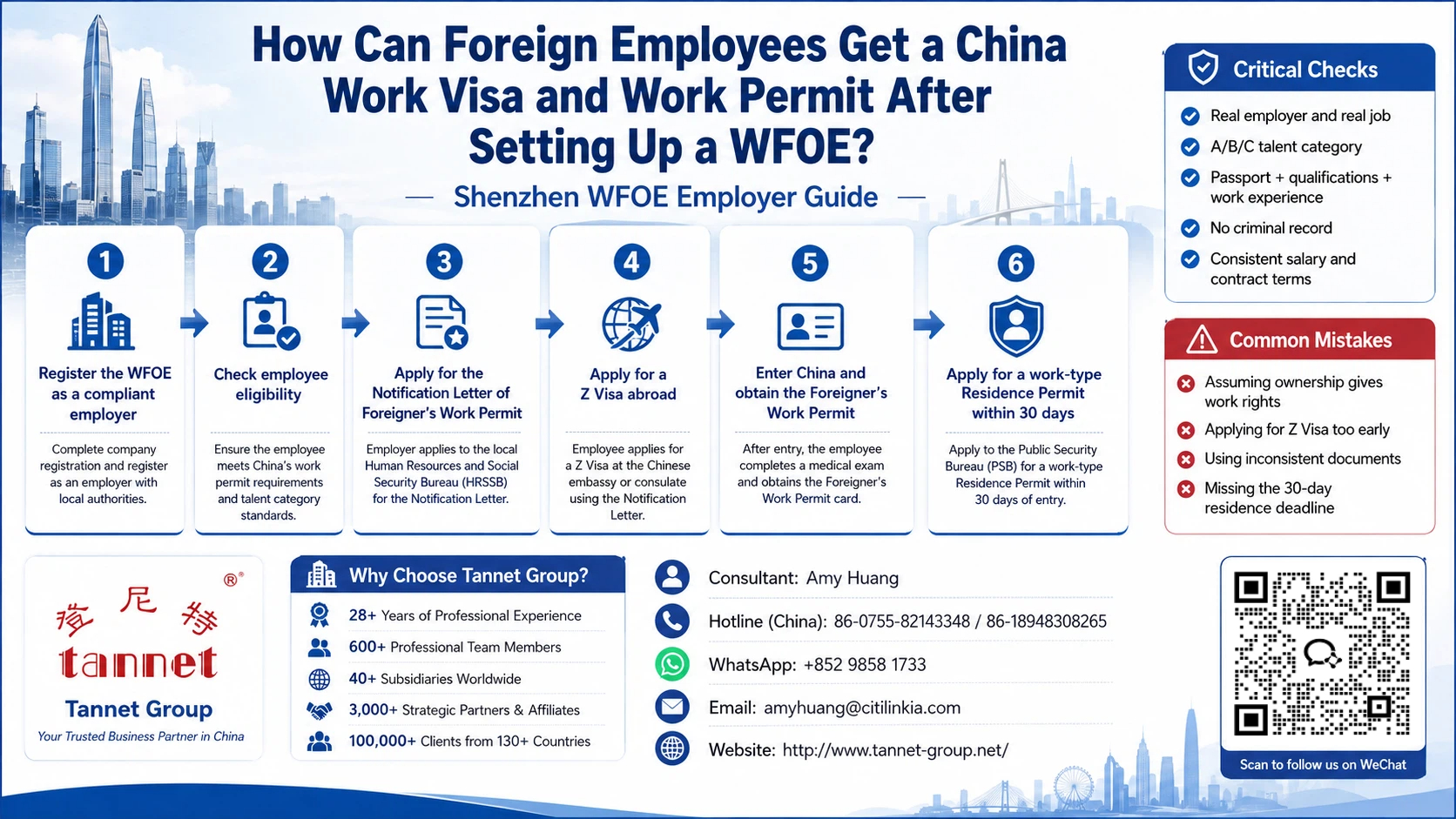
For most foreign employees planning to work in China for more than 90 days, the practical sequence is: register the employer in the foreigner work-permit system, obtain the Notification Letter of Foreigner’s Work Permit, apply for a Z Visa abroad, enter China, obtain the Foreigner’s Work Permit, and then obtain a work-type Residence Permit.
The main caution is that the job, employer, qualifications, documents, salary, and actual work must be genuine and consistent.
What the WFOE must have before sponsoring a foreign employee
A newly established WFOE must first be able to act as a compliant employer.
Shenzhen Government Online states that an employer hiring foreigners must be legally registered and must not have a record of serious legal violations or serious breach of trust. If the industry requires prior approval before employing foreign talent, that approval should be obtained first.
The employer normally registers an account in the Service System for Foreigners Working in China. Core employer evidence includes the business licence or unified social credit code certificate, authorised-person information, and industry approvals where applicable.
A foreign shareholder, director, or legal representative does not receive work rights merely because of the corporate title. The applicable work-permit rules still apply.
Step 1: Check whether the foreign employee qualifies
The Shenzhen work-permit guidance requires the applicant to be at least 18, in good health, without a criminal record, employed by a Mainland Chinese employer, and to possess the professional skills or knowledge needed for the position.
Foreign employees are managed under Categories A, B, and C.
Category A
Category A covers high-end foreign talent, including certain scientists, leading technology talent, international entrepreneurs, and other urgently needed high-level talent.
Category B
Shenzhen’s current guidance describes Category B foreign professionals as generally holding at least a bachelor’s degree, having at least two years of relevant work experience, and being no more than 60 years old.
Exceptions may apply under specific talent and policy routes.
Category C
Category C covers other foreign personnel who meet labour-market needs and relevant national policies. Quotas or additional controls may apply.
Step 2: Prepare the core work-permit evidence
For a work period of more than 90 days, the employer normally applies first for the Notification Letter of Foreigner’s Work Permit.
Common materials include:
- Application Form for Foreigner’s Work Permit
- Passport information page
- Relevant work-experience evidence
- Highest degree or professional qualification evidence where required
- Certificate of no criminal record
- Health examination evidence or permitted undertaking
- Employment contract or employment certificate
- Applicant photo
- Employer registration and licensing materials
- Supporting documents for the relevant talent category
The employment contract should accurately state the workplace, position, job responsibilities, salary, work duration, and signing information.
Verification, translation, and validity requirements depend on the document and issuing jurisdiction. Shenzhen authorities may independently verify authenticity.
Step 3: Obtain the Notification Letter of Foreigner’s Work Permit
The WFOE submits the online application through the Service System for Foreigners Working in China.
If approved, the system generates the Notification Letter of Foreigner’s Work Permit.
The Notification Letter is a pre-entry document. It is not the final Foreigner’s Work Permit.
Step 4: Apply for the China Z Visa
The employee normally uses the Notification Letter to apply for a Z Visa through the Chinese embassy, consulate, or authorised visa application centre serving the applicant’s location.
Chinese embassy guidance describes the Z Visa as the visa issued to people who intend to work in China. For many long-term work cases, the Notification Letter of Foreigner’s Work Permit is the key supporting document.
Consular requirements vary by jurisdiction. Check the relevant Chinese diplomatic mission before filing.
Step 5: Enter China and apply for the actual Foreigner’s Work Permit
After entering China with the appropriate Z Visa, the employee and WFOE complete the post-entry work-permit stage.
Shenzhen’s current service guide states that an applicant who has obtained the Notification Letter and entered with a Z Visa can directly apply for the Foreigner’s Work Permit.
The local work-permit review commitment is seven working days after formal acceptance. Preparation, supplementary requests, visa processing, and residence procedures are separate.
Step 6: Apply for a work-type Residence Permit
The Z Visa is primarily an entry visa for work. It should not be treated as the employee’s long-term residence document.
If the visa indicates that a residence permit is required after entry, the foreign employee must apply within 30 days of entry to the local exit-entry authority.
For a work-type Residence Permit, the applicant generally needs the Foreigner’s Work Permit, an employer letter, passport, photos, and other required evidence.
Shenzhen Government Online lists a five-working-day commitment time for first-time residence-permit applications for foreign employees, subject to acceptance and case circumstances.
What should the WFOE do after the permits are issued?
The company should keep the employment relationship consistent with the permit.
Changes to employer, position, passport, or other registered details may require action.
Shenzhen guidance says a work-permit extension should generally be applied for at least 30 days before expiry. If the foreign employee changes employer, the new employer normally needs to complete the applicable work-permit process.
Common Mistakes
- Assuming a foreign shareholder or legal representative can work without a permit.
- Applying for a Z Visa before obtaining the required work-permit notification.
- Using a job title that does not match the employee’s qualifications or actual duties.
- Submitting inconsistent salary, employment, education, or work-experience records.
- Treating the Z Visa as the final work and residence authorisation.
- Missing the 30-day post-entry residence-permit deadline.
- Waiting until the work permit is close to expiry before preparing an extension.
Frequently Asked Questions
Q1. Can a newly registered Shenzhen WFOE sponsor a foreign employee?
Potentially, yes. The WFOE must be legally registered, complete the employer registration process, meet any industry requirements, and submit a compliant work-permit application.
Q2. Does the foreign owner of the WFOE automatically qualify for a work permit?
No. Ownership or legal-representative status does not replace the foreigner work-permit requirements.
Q3. Do I need a bachelor’s degree and two years of work experience?
That is the general Category B standard stated in Shenzhen guidance, but exceptions may apply depending on the applicant’s talent category and applicable policies.
Q4. Can I enter China first and then apply for a work permit?
Certain applicants may qualify for an in-China application. Shenzhen lists specific eligible situations. Applicants who do not fall within those situations generally need to follow the overseas application process.
Q5. How long does the Shenzhen work-permit review take?
Shenzhen lists a seven-working-day review commitment after formal acceptance. Total project time is longer because preparation, verification, visa processing, entry, and residence-permit steps are separate.
Q6. Can I start working as soon as I enter with a Z Visa?
Do not treat the Z Visa alone as the complete authorisation. Chinese law requires foreigners working in China to obtain the required work permit and work-type residence permit.
Q7. What happens if the foreign employee changes employer?
A change of employer generally requires work-permit procedures with the new employer. The residence documentation may also need to be updated.
When Tannet May Be Suitable
Tannet may assist Shenzhen foreign-invested companies that need to coordinate WFOE establishment with employer registration, work-permit document preparation, Z Visa process planning, post-entry work-permit procedures, and work-type Residence Permit coordination.
This is particularly relevant where the foreign founder is also expected to work for the Shenzhen company, or where several foreign employees need a consistent onboarding process. Approval remains subject to the competent authorities.
Written by: Tannet Business Services Team
Reviewed by: Consultant Amy Huang
First published: 19 August 2026
Last reviewed: 19 August 2026
Jurisdiction: Mainland China
Official Reference Links
————————————————Simplifying Business, Empowering Entrepreneurs————————————————