Key Takeaway
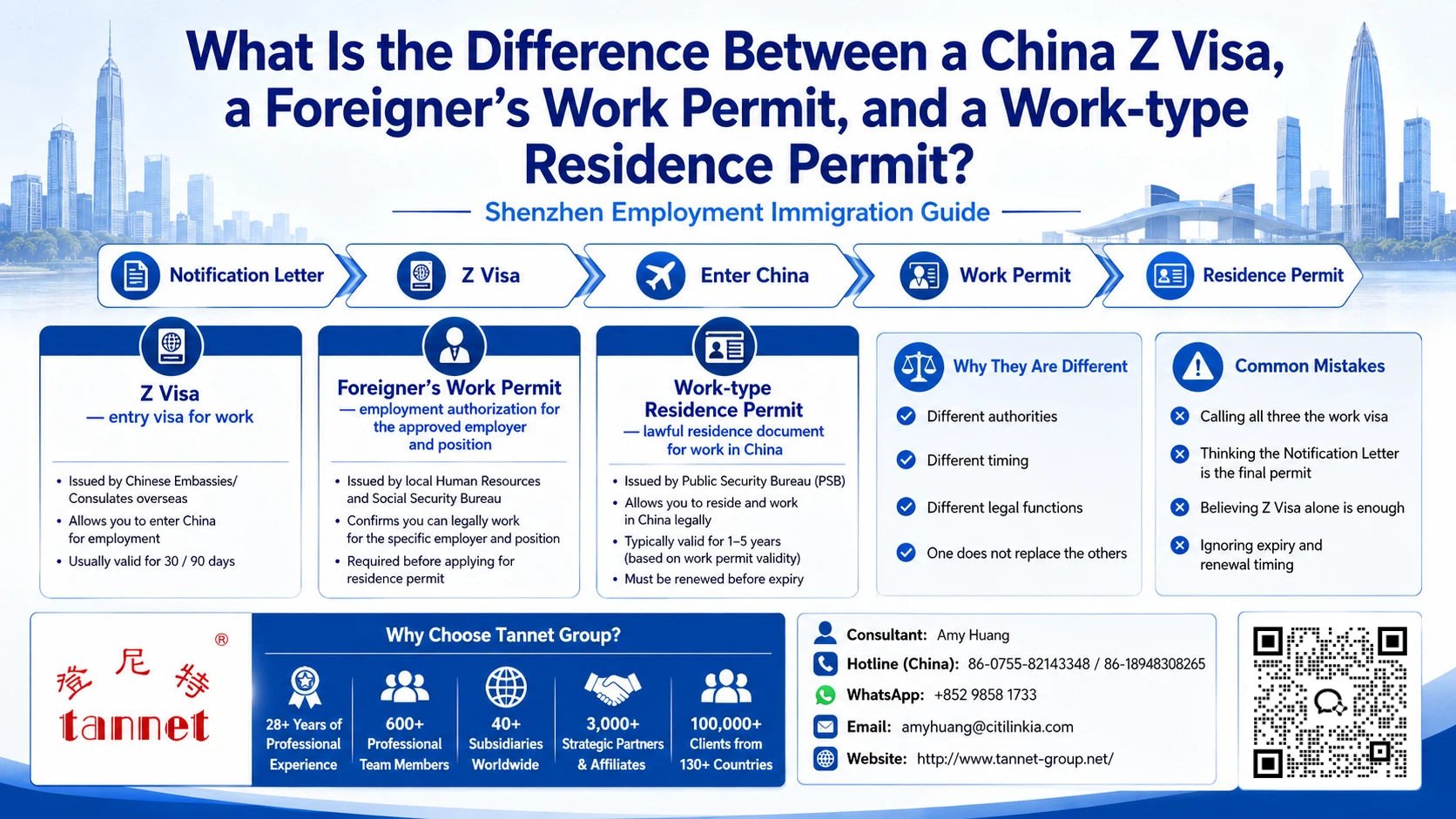
A China Z Visa, Foreigner’s Work Permit, and work-type Residence Permit serve three different legal functions.
The Z Visa is normally the entry visa used by a foreign national coming to China for employment.
The Foreigner’s Work Permit is the employment authorisation issued through the foreigner work-permit system and is linked to the Chinese employer and approved job.
The work-type Residence Permit is the immigration residence document issued after entry by the public-security exit-entry authority.
Foreign employees and WFOEs should plan the three as one sequence, because obtaining one document does not automatically replace the others.
The simplest way to understand the three documents
For a typical foreign employee working in Shenzhen for more than 90 days, think of the process in this order:
- Notification Letter of Foreigner’s Work Permit
- Z Visa
- Entry into China
- Foreigner’s Work Permit
- Work-type Residence Permit
The Notification Letter is a pre-entry approval document. The Z Visa supports entry for work. The Work Permit authorises the employment. The Residence Permit supports lawful residence in China for the approved work purpose.
What is a China Z Visa?
The Z Visa is a Chinese visa category for foreign nationals who intend to work in China.
Chinese diplomatic missions generally require the applicant to provide the Notification Letter of Foreigner’s Work Permit or another qualifying work document, depending on the case.
The Z Visa is normally obtained outside Mainland China before entry, unless the foreign national qualifies for a permitted in-China route or another specific policy.
What the Z Visa does
It allows the holder to enter China for the stated work purpose, subject to the visa conditions.
What the Z Visa does not do
It is not the final Foreigner’s Work Permit.
It is also not the long-term work-type Residence Permit. For long-term work cases, the employee must complete the post-entry work and residence procedures.
What is the Foreigner’s Work Permit?
The Foreigner’s Work Permit is the employment authorisation for a foreign national working for an approved Mainland Chinese employer.
In Shenzhen, the employing company applies through the Service System for Foreigners Working in China.
The employer and employee must satisfy the relevant requirements. Shenzhen states that the employer must be legally registered and the foreign employee must generally be at least 18, healthy, free from a disqualifying criminal record, and qualified for the position.
The Work Permit is linked to the employment
The permit is not a general open permission to work for any company.
Employer, job, workplace, talent category, salary basis, and other registered information can affect the permit.
A change of employer normally requires work-permit procedures with the new employer.
What is a work-type Residence Permit?
The work-type Residence Permit is an immigration residence document for foreigners residing in China for work.
It is issued by the exit-entry administration of the public-security authority, not by the work-permit authority.
National Immigration Administration guidance states that a foreigner whose visa requires a residence permit after entry should apply within 30 days of entry.
For a work-type Residence Permit, a Z Visa entrant generally submits the Work Permit and an employer certification letter, plus the other required residence materials.
Why the three documents are often confused
They are part of the same employment journey, so applicants sometimes use “work visa” as a general label for the entire process.
That shorthand creates mistakes.
The authorities, timing, legal function, and application materials are different.
Z Visa
Purpose: entry for work.
Typical authority: Chinese embassy, consulate, or visa application channel abroad.
Timing: before entry in the standard overseas route.
Foreigner’s Work Permit
Purpose: authorisation to work for the approved Chinese employer and position.
Typical authority in Shenzhen: the competent foreigner work-permit authority, with applications processed through the national service system.
Timing: pre-entry notification stage and post-entry permit stage.
Work-type Residence Permit
Purpose: lawful residence in China for work.
Typical authority: local public-security exit-entry administration.
Timing: after entry, usually within the required post-entry period.
How the standard Shenzhen process works
Step 1: The WFOE registers as an employer
The Shenzhen company prepares its business licence or unified social credit code evidence and other employer information.
Step 2: The company applies for the Notification Letter
The application includes employee qualifications, employment information, passport, and other required evidence.
Step 3: The foreign employee applies for a Z Visa
The applicant uses the Notification Letter and other documents required by the relevant Chinese diplomatic mission.
Step 4: The employee enters China
The entry date becomes important because post-entry deadlines begin to run.
Step 5: The WFOE completes the actual Work Permit
Shenzhen’s published guidance states that a person who obtained the Notification Letter and entered with a Z Visa can apply directly for the Foreigner’s Work Permit.
Step 6: The employee applies for the work-type Residence Permit
If required by the visa, the residence-permit application should be filed within 30 days from entry.
Which document expires first?
There is no universal answer.
The Work Permit and Residence Permit each have their own validity period. They should be monitored separately.
The employment contract, passport validity, talent category, employer status, and authority decision can affect the validity granted.
Do not assume that extending the employment contract automatically extends the Work Permit or Residence Permit.
Common Mistakes
- Calling all three documents the “work visa.”
- Believing the Notification Letter is the final Work Permit.
- Believing the Z Visa allows indefinite work and residence.
- Missing the 30-day residence-permit deadline after entry.
- Changing employer without updating the work-permit position.
- Letting the Work Permit and Residence Permit expire because only the employment contract was monitored.
- Submitting different job titles, salaries, or employment dates to different authorities.
Frequently Asked Questions
Q1. Is the Z Visa the same as the Work Permit?
No. The Z Visa is an entry visa for work. The Work Permit is the employment authorisation.
Q2. Is the Work Permit the same as the Residence Permit?
No. The Work Permit concerns employment. The work-type Residence Permit concerns immigration residence for the work purpose.
Q3. Do I need all three?
For a standard long-term overseas hire, the process normally involves a Z Visa, a Foreigner’s Work Permit, and a work-type Residence Permit, with the Notification Letter before the Z Visa.
Q4. Can I work on a tourist or business visa?
Foreigners should not perform employment in China without the required work authorisation and work-type residence status. A commercial M Visa is not a substitute for a Work Permit.
Q5. Can the Z Visa be converted directly into a Residence Permit?
The post-entry residence application generally requires the Work Permit or other qualifying work evidence. The exact sequence depends on the applicant’s route and local processing.
Q6. How quickly must I apply for the Residence Permit after entering China?
Where the visa requires a residence permit after entry, the application should be filed within 30 days of entry.
Q7. If I own the Shenzhen WFOE, do I still need these documents?
Yes, if you will work in China and are not otherwise exempt. Corporate ownership does not itself create foreigner work authorisation.
Q8. What if I change jobs?
A change of employer normally triggers work-permit procedures and may require an update to residence documentation.
When Tannet May Be Suitable
Tannet may assist foreign-invested companies and employees who need to map the correct sequence between the Notification Letter, Z Visa, Foreigner’s Work Permit, and work-type Residence Permit.
Support may also include WFOE registration, employer account preparation, document coordination, work-permit extensions, and cross-border onboarding planning. Each approval remains subject to the competent authority.
Written by: Tannet Business Services Team
Reviewed by: Consultant Amy Huang
First published: 19 August 2026
Last reviewed: 19 August 2026
Jurisdiction: Mainland China
Official Reference Links
————————————————Simplifying Business, Empowering Entrepreneurs————————————————