TL;DR: China corporate restructuring can make sense even when a foreign-owned company is profitable. Changes in ownership, business activities, registered capital, operating costs, or entity structure can create inefficiencies that are better addressed early, before they develop into larger compliance or operational problems.
Key Takeaways
- A corporate structure that worked at market entry may no longer suit a company that has expanded, changed investors, or diversified its operations.
- Restructuring can involve amendments, ownership changes, consolidation, mergers, capital adjustments, or closure depending on the business’s goal.
- Tax, employees, contracts, licences, banking, assets, and compliance obligations should be assessed before choosing a restructuring route.
- Companies should compare the long-term cost of maintaining an inefficient structure against the cost and disruption of reorganizing it.
Foreign-owned company in China need not be losing money for restructuring worth considering growth, investors, expansion reveal weaknesses. China corporate restructuring should be treated as a strategic business decision focused on whether original structure fits operations.
This review is increasingly relevant as China’s corporate framework evolves with the 2024 Company Law and 2025 transition. For foreign investors, these changes make it timely to reassess their structure before inefficiencies or compliance issues begin to affect performance.
When China Companies Outgrow Its Structure
Many foreign-owned companies are structured around the needs they had at market entry. Over time, they may gain new investors, expand into multiple offices, hire more staff, diversify revenue streams, and operate through several related entities.
Even profitable companies can become inefficient, duplication, tax exposure, outdated registrations, requiring capital review under revised Company Law. A corporate review is therefore useful even when nothing appears obviously wrong.
Signs Your China Company Needs Restructuring
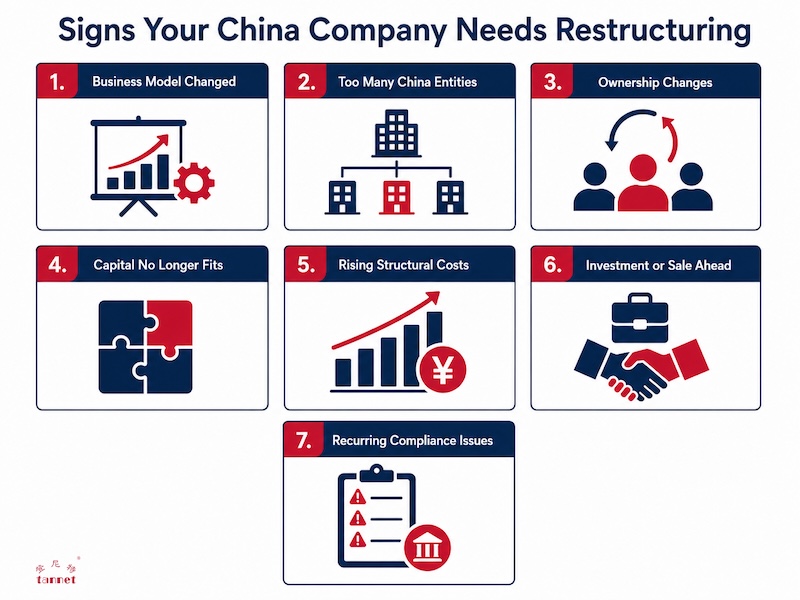
1. Your Business Model Has Changed
A company established for one service may expand into new products, channels, or activities beyond its original scope. When this happens, management should assess whether current entity activities licences contracts and arrangements still align with operations.
In some cases, a simple registration update may be enough to address the change. In others, the shift is significant enough that broader restructuring becomes the more appropriate solution.
2. Too Many China Entities
Expansion often creates corporate clutter when foreign groups establish separate companies across cities, projects, partners, and business lines. Although each decision made sense initially, it gradually leads to overlapping employees, accounting, management, contracts, and suppliers.
Costs extend beyond registration fees because each company adds accounting, tax, payroll, audit, governance, banking, and compliance obligations ongoing. In such cases, consolidation may be worth exploring when multiple entities perform overlapping work inefficiently.
3. Changing Shareholders or Investors
A planned investment, shareholder exit, internal transfer, joint venture, acquisition, or ownership change naturally prompts company reassessment process. The revised Company Law regulates equity, capital, governance, mergers, divisions, requiring more than shareholder agreements.
Foreign investment rules can add complexity, as ownership changes may limit activities or trigger extra regulatory requirements. It is best to confirm the final ownership structure before starting any transfer.
4. Registered Capital No Longer Fits
Registered capital now requires closer attention under the current Company Law framework. Newly established limited liability companies must pay subscribed capital within five years, and older firms may face review.
Companies with unrealistic capital commitments should not assume the issue can be ignored. Management may need to reassess contribution timing, funding plans, capital requirements, or consider formal capital adjustments depending on the company’s situation.
5. Rising Costs, No Added Value
Not every high cost calls for restructuring, but recurring structural costs deserve closer investigation. When several entities maintain separate finance teams or intercompany transactions create little commercial value, the issue may point to a deeper structural inefficiency.
In some cases, multiple rounds of expansion make the ownership chain hard to manage and coordination more complex. Management should compare restructuring costs with long-term maintenance costs, since today’s cheapest option may not remain economical ultimately.
6. Preparing for Investment or Sale
Potential investors and buyers tend to scrutinize issues that internal management may have overlooked for years. These include unclear ownership, capital commitments, related-party arrangements, tax risks, outdated records, employee liabilities, and misassigned contracts issues.
Restructuring a deal can make a business easier to review and transact, but timing is critical. China continues refining business reorganization rules, tax consequences should be assessed before choosing restructuring routes, not after deal structure is set.
7. Recurring Compliance Issues
Repeated compliance problems often signal a deeper structural issue within the company. Recurring issues across tax filings, licenses, employee arrangements, contracts, corporate records, or shareholder decisions may not be solved by addressing them individually.
A structural review shows whether the company needs stronger internal controls or a change in its legal and operational setup. This distinction is important because the right solution depends on whether the problem is procedural or structural.
Restructure, Amend, Merge, or Close: Know the Difference
Once a structural problem has been identified, management still needs to choose the right response.
Amend the Existing Company
An amendment may be enough when the underlying entity still works well. Changes to certain registered information, governance arrangements, capital, or other corporate details can sometimes be handled without rebuilding the wider operation.
Reorganize the Existing Operation
A broader restructuring may make sense when ownership, management, functions, assets, financing, and operations need to be redesigned together. This requires coordination across tax, accounting, contracts, HR, banking, permits, and internal controls.
Merge or Consolidate Companies
Groups with overlapping China entities may consider consolidation to reduce duplication and improve efficiency. China’s Company Law provides mechanisms for mergers and divisions, requiring company decisions, creditor protection, registration, and deregistration procedures.
Close and Rebuild a Better Structure
Sometimes the existing entity is no longer useful when business changes, so compare restructuring with closure or alternatives. This typically happens when:
- business model has shifted
- ownership or investors changed
- expanded into new products, services, or regions
- compliance or tax has become complex
- multiple entities or functions are redundant
Closure should not be treated as a shortcut, as tax clearance, employees, creditors, assets, contracts, and deregistration all still need to be properly addressed.
Restructuring Costs Beyond Filing Fees
One of the biggest mistakes in a restructuring review is comparing options only by professional or registration costs. The more important questions are operational:
- Will employees need to move between entities?
- Can customer and supplier contracts be transferred?
- What happens to licences and permits?
- Will assets change ownership?
- Are there tax consequences?
- Will bank arrangements need to be changed?
- Could the process interrupt normal trading?
A proper restructuring analysis should assess the entire business rather than treating the company’s registration as an isolated document.
Clear End Goal for China Corporate Restructuring
Before changing anything, management should define what the China operation is supposed to look like after the restructuring. That may sound obvious, but it prevents businesses from making several disconnected changes without fixing the underlying problem.
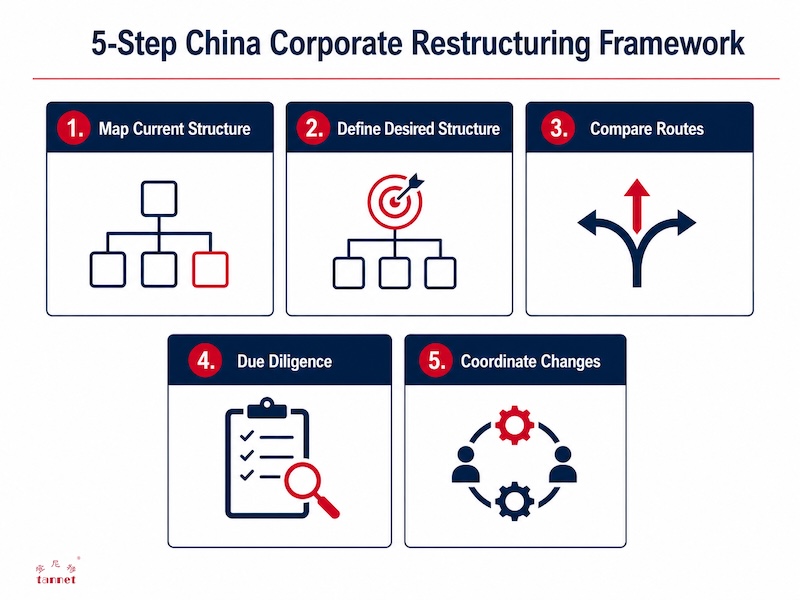
Step 1: Map the Current Structure
Review shareholders, entities, registered capital, governance, employees, assets, contracts, licences, debt, tax status, and existing compliance issues.
Step 2: Define the Desired Structure
Decide what needs to be improved. The goal could be lower overhead, simpler ownership, new investment, stronger governance, consolidation, expansion into new activities, or preparation for a transaction.
Step 3: Compare Several Routes
A restructuring plan should normally consider alternatives rather than beginning with one predetermined solution. Compare the likely cost, tax impact, regulatory work, implementation time, operational disruption, and future compliance burden of each option.
Step 4: Due Diligence Before Changes
Historic problems do not disappear simply because an asset, employee, or business function moves elsewhere. Reviewing liabilities and compliance before implementation can prevent old issues from being carried into the new structure.
Step 5: Coordinate Changes Properly
Corporate, tax, accounting, HR, banking, contractual, and licensing workstreams may depend on one another. That sequencing is often where restructuring becomes difficult, as even a sound corporate decision can cause disruption if tax, HR, permits, or banking are addressed too late.
Sometimes Restructuring Isn’t the Answer
A structural review should not assume change is necessary, as many issues can be resolved internally without reorganization. If China operation lacks future, restructuring to preserve it may not justify; goal is choosing structure next stage.
Tannet in China Corporate Restructuring
Tannet Group provides corporate structuring and restructuring support for China businesses, including M&A, compliance, tax, and governance services. Its broader advisory model also covers corporate governance, operational planning, and cross-border structures.
For foreign investors, the practical advantage is coordination. A restructuring decision can touch several areas at once, so having corporate, financial, compliance, and operational workstreams reviewed together can reduce the risk of solving one issue while creating another.
Is Your China Structure Still Working?
If ownership has changed, costs are rising, your business model has evolved, or your China entities have become harder to manage, your company does not need to be in trouble before its structure deserves another look.
Contact Tannet Group today!