Key Takeaway
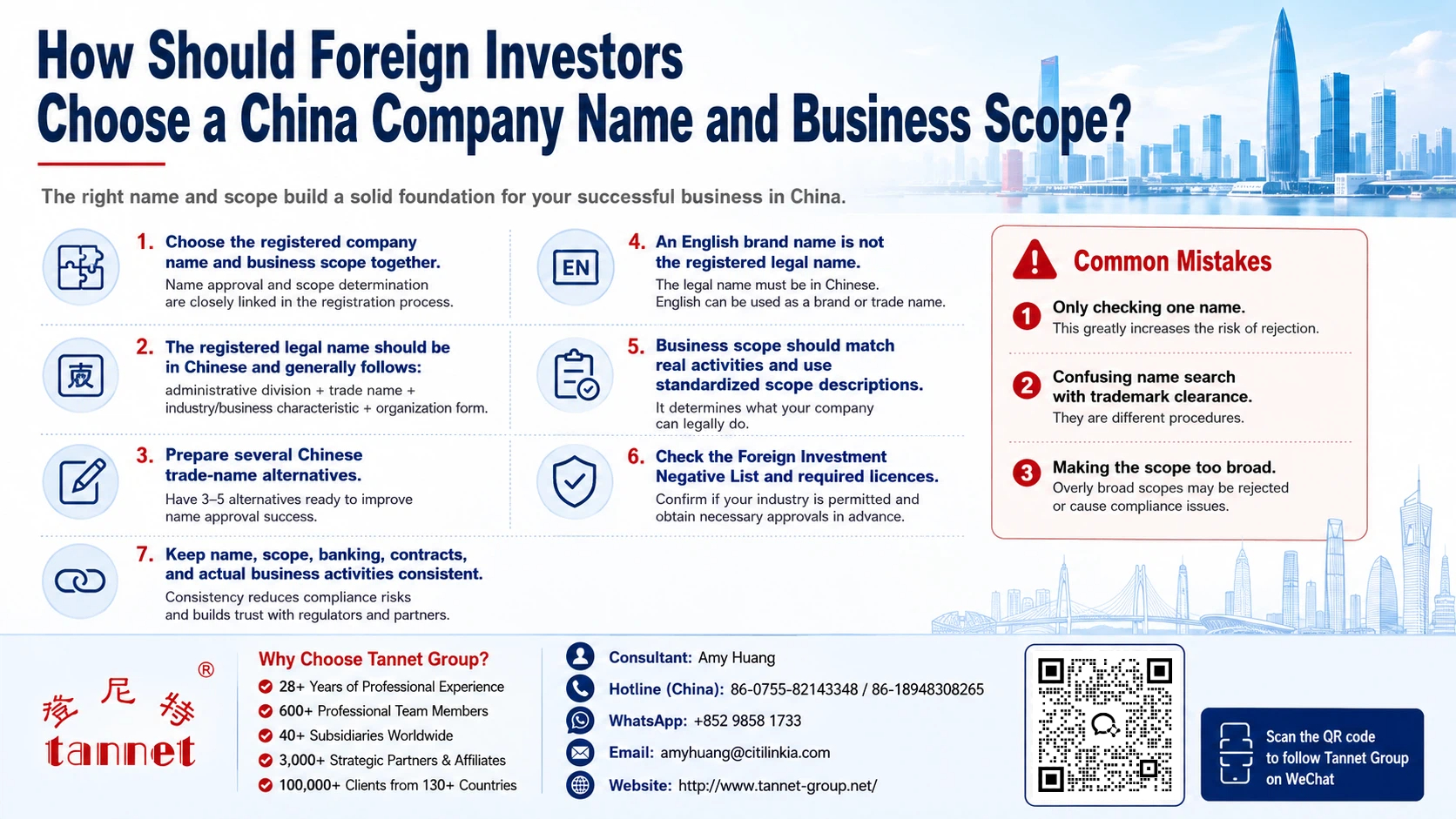
A China WFOE should choose its registered company name and business scope together because both describe what the company is and what it intends to do.
This is especially relevant to foreign investors preparing service, trading, technology, sourcing, consulting, or cross-border businesses.
The main caution is that a name is not only a branding choice, and a business scope is not merely marketing text.
The registered name must follow China’s enterprise-name rules, while the business scope must fit market-access rules, foreign-investment restrictions, and required industry licences.
Start with the legal role of the company name
China’s enterprise-name rules require a registered enterprise name to use standardized Chinese characters.
Under the 2023 SAMR implementation measures, a company name generally contains an administrative division, trade name, industry or business characteristic, and organizational form. Exceptions exist for qualified companies, but foreign founders should normally plan around this basic structure.
The industry or business-characteristic wording should reflect the company’s main business. The organization form must also match the company’s legal structure, such as “有限责任公司” or “有限公司” for a limited liability company.
The trade name must be distinctive
The trade name, or字号, should generally contain at least two Chinese characters and should be distinctive.
The enterprise-name system compares proposed names with restricted terms and similar existing names. Prepare several Chinese trade-name alternatives instead of relying on one preferred choice.
Do not treat an English brand as the registered legal name
China’s current enterprise-name rules focus on the Chinese registered name.
SAMR states that an enterprise needing a foreign-language translation of its name may translate and use it according to applicable translation principles. That commercial translation does not replace the registered Chinese name used on the business licence, bank account, chops, contracts, and official records.
Special rules apply when using “China” in the name
Using “China,” “Chinese,” “National,” “Central,” or similar terms is restricted.
The 2023 SAMR implementation measures state that enterprise names beginning with certain national-level terms are subject to strict review and approval rules.
For a foreign-invested enterprise using “(China)” in its registered name, the trade name must correspond to the foreign investor’s name or its translated trade name and comply with the applicable rules.
Do not assume that adding “China” to a global brand is automatically available.
Check earlier rights, not only name availability
A business-name search is not the same as a trade mark clearance.
SAMR requires applicants to respect prior lawful rights and avoid confusion. Foreign investors should separately consider trade mark searches for key Chinese and English brands because a company name and a trade mark protect different interests.
Build the business scope around real activities
The business scope appears on the business licence.
SAMR’s Company Registration Management Measures, effective from 10 February 2025, require the scope to comply with the Market Access Negative List. Foreign-invested companies must also comply with the special foreign-investment access measures.
The 2024 Foreign Investment Negative List took effect on 1 November 2024. It sets out restricted or prohibited foreign-investment sectors. Areas outside the list generally receive national treatment for market access, subject to other applicable rules and licences.
Use standardized business-scope descriptions
China has moved toward standardized business-scope descriptions.
SAMR requires registration systems to use its standardized catalogue and interface so applicants can search for and select standardized operating items.
This reduces free-form drafting and helps connect registration items with licence requirements. List the actual revenue-generating activities first, then map them to the standardized terms used by the local system.
Separate general items from licensed items
A business licence does not automatically grant every operational licence.
SAMR’s company-registration measures state that registration can be refused when the proposed scope contains an activity requiring pre-registration approval and the applicant has not obtained that approval.
Other licensed activities may be registered first but cannot begin until the separate permit is obtained. Identify licensing before signing leases, hiring regulated professionals, or launching regulated operations.
Avoid making the scope unnecessarily broad
A broad business scope may seem safer, but more text is not always better.
The scope should support the intended business model without adding unrelated activities that create licence, bank KYC, or tax questions. Different sectors may need very different wording.
Focus on what the company expects to do during the first operating stage, while leaving reasonable room for planned growth.
Make the name and scope tell the same story
The company name, business scope, registered address, bank application, contracts, invoices, and actual activities should be coherent.
A mismatch may create avoidable questions later. Consistency is useful for registration, banking, tax, licences, and future corporate changes.
A practical selection process
Step 1 – Define the first 12 months of activity
List customers, services, products, sales channels, suppliers, employees, and regulated activities.
Step 2 – Check foreign-investment access
Review the current Foreign Investment Negative List and sector-specific rules.
Step 3 – Map the activity to standardized scope terms
Use the registration authority’s system and standardized catalogue rather than inventing free-form wording.
Step 4 – Prepare several Chinese names
Check the administrative division, trade name, industry wording, and organization form.
Step 5 – Run brand and name checks separately
Step 6 – Review licence consequences
Identify which scope items require approval before registration and which require permits before operations.
Step 7 – Keep the operating documents consistent
Use the final name and scope consistently in incorporation documents, banking preparation, contracts, tax onboarding, and licence applications.
Common Mistakes
- Choosing the English brand first and treating the Chinese registered name as an afterthought.
- Submitting only one preferred trade name with no alternatives.
- Assuming a name search also protects the trade mark.
- Copying another company’s business scope without checking the actual business model.
- Adding regulated activities without checking required approvals.
- Using an overly broad scope that does not match the company’s real operations.
- Ignoring the Foreign Investment Negative List when selecting activities.
Frequently Asked Questions
Q1. Can a WFOE use an English company name on its China business licence?
The registered enterprise name is governed by China’s enterprise-name rules and uses standardized Chinese characters. An English translation can be used commercially where appropriate, but it should not be treated as a substitute for the registered Chinese name.
Q2. Can I reserve a China company name before completing the full registration?
Yes. Under the enterprise-name self-declaration system, qualified names can be retained for a defined period. The 2023 SAMR measures generally provide a two-month retention period, or one year where pre-registration approval is required.
Q3. Can I put “China” in my WFOE name?
Sometimes, but special rules apply. Foreign-invested companies using “(China)” must satisfy the applicable name requirements, including consistency with the foreign investor’s name or translated trade name.
Q4. Can my business scope include several unrelated businesses?
It may be possible to include multiple items, but the scope should remain commercially coherent and comply with market-access and licensing rules.
Q5. Does a broad business scope mean I can operate any listed activity immediately?
No. Some activities require separate approvals or licences before operations begin.
Q6. Can I change the business scope after incorporation?
Yes, subject to applicable corporate decisions, registration procedures, foreign-investment rules, and any required licences.
Q7. Should the business scope match the bank-account application?
It should be consistent with the business model presented to the bank. Banks may ask how the registered scope relates to expected transactions.
When Tannet May Be Suitable
Tannet may assist foreign investors that need to coordinate Chinese company-name planning, business-scope mapping, foreign-investment access review, incorporation documents, registered address, banking preparation, accounting, tax, or later corporate changes.
Final registration and licensing decisions remain with the competent authorities.
Written by: Tannet Business Services Team
Reviewed by: Consultant Amy Huang
First published: 20 August 2026
Last reviewed: 20 August 2026
Jurisdiction: Mainland China
Official Reference Links