Key Takeaway
There is no single nationwide “WFOE registration time” for the whole China market-entry project.
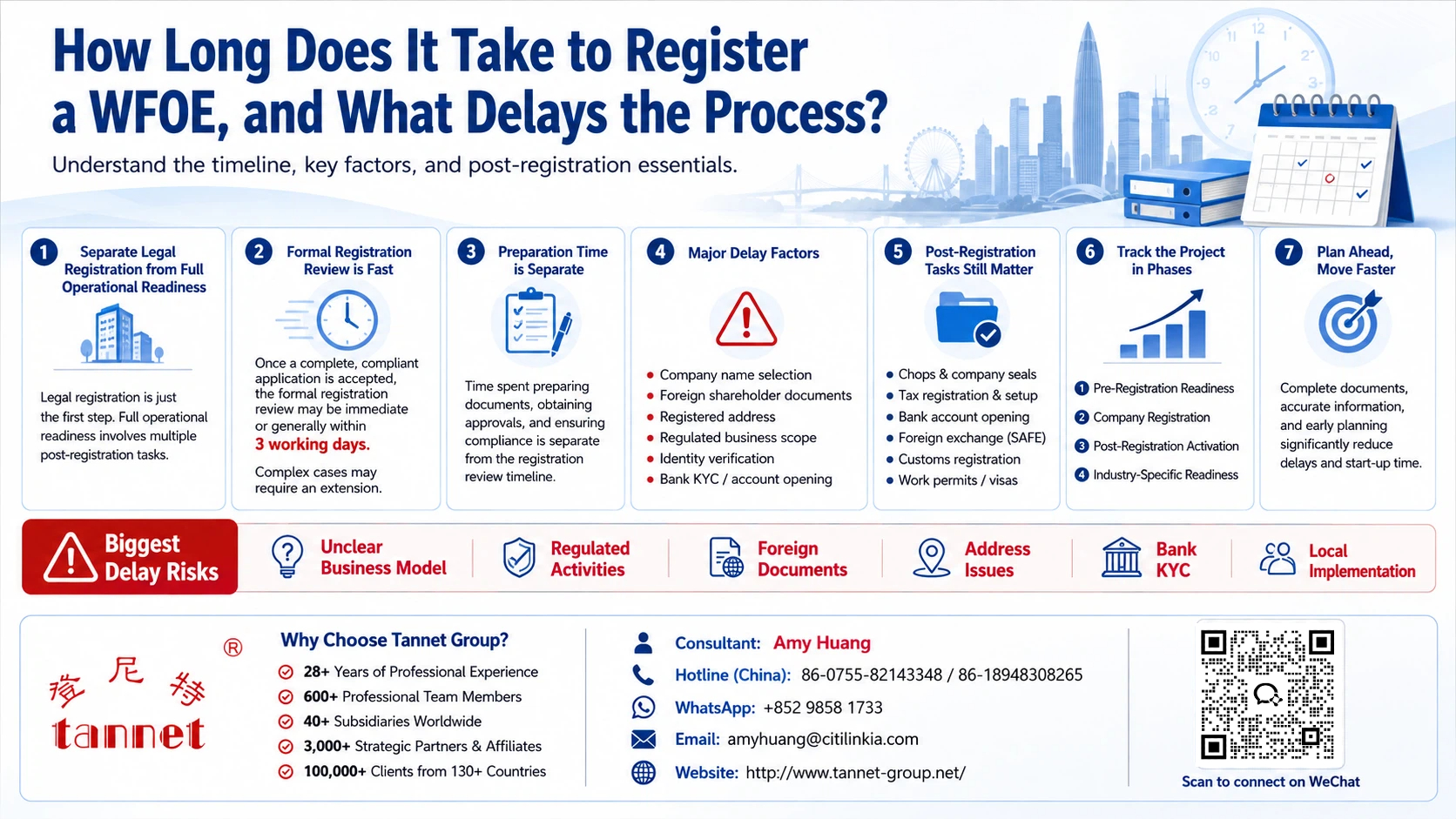
The legal registration review can be fast once a complete application reaches the authority, but extra time may be needed for name selection, foreign shareholder documents, registered address, sector approvals, identity checks, seals, tax onboarding, bank accounts, foreign exchange, customs, and work permits.
This guide is for foreign investors planning a new Mainland China company.
The key caution is to separate the statutory registration clock from the longer timeline required to become operational.
First separate registration from operational readiness
The business licence establishes the company. It does not automatically mean banking, tax setup, customs, work permits, licences, or other operating steps are complete.
Use several milestones rather than one promised completion date.
The legal registration review can be short
China’s Market Subject Registration Regulation sets a formal registration standard.
Where application materials are complete and in the required legal form, the registration authority may confirm and register the application on the spot.
If it cannot complete registration immediately, it should generally register within three working days. For complex cases, the period may be extended by another three working days with approval.
This rule covers the authority’s review after a compliant application is submitted, not preparation time.
2026 registration standards make document preparation more important
SAMR issued new Registration Document Standards and Submission Material Standards in January 2026.
From 1 May 2026, local registration authorities use the 2026 versions for registration and filing matters.
The update supports more standardized and electronic processing. Foreign investors should use the current requirements rather than old checklists. Outdated forms or incomplete identity and shareholder evidence can create rework.
Name selection can delay the starting point
A proposed name is self-declared through the enterprise-name system but remains subject to restrictions and similarity checks.
The 2023 rules require standardized Chinese characters and generally follow the administrative-division, trade-name, industry, and organization-form structure. Prepare several alternatives.
Restricted words, similar prior names, or use of “(China)” can add review before filing.
Business scope can create regulatory delays
SAMR requires the business scope to comply with the Market Access Negative List. Foreign-invested companies must also comply with the Foreign Investment Negative List.
If a proposed activity requires approval before company registration, the registration authority will not process that part of the establishment without the required approval.
Regulated sectors can therefore add substantial time before the file is complete.
Foreign shareholder documents are a major variable
Foreign shareholder documents often determine the preparation timeline.
Requirements depend on whether the investor is an individual or legal entity, the issuing country, local authority, and verification method.
Names, passport details, registry extracts, authorized signatories, and Chinese translations should be consistent. Mismatches can lead to clarification or resubmission.
The registered address can block filing
A company needs a compliant registered address or domicile under local rules.
Address rules vary by city and district. An address acceptable for one business may not support another regulated activity.
Confirm the address before finalizing the name, scope, lease, and incorporation documents.
Identity verification and signatures can affect foreign investors
SAMR’s 2026 standards emphasize real-name confirmation and electronic signatures or online confirmation where supported.
Verification methods can differ by nationality, local system capability, and whether the person is in China. Build time for identity checks instead of assuming every investor can sign remotely in the same way.
After the business licence, the operational timeline continues
Company chops and tax setup
The company normally needs official chops and should establish accounting records, tax onboarding, and filing arrangements.
Corporate bank account
Banks conduct independent KYC and may review beneficial ownership, source of funds, transactions, office arrangements, customers, suppliers, and the legal representative.
Foreign-exchange and capital arrangements
Foreign-invested companies may need banking and foreign-exchange steps for capital injection and cross-border payments.
Customs and import-export
Trading businesses may need customs consignee/consignor filing and other operational registrations.
Work permits
A foreign founder working in China needs the applicable foreigner work authorization and residence process. Corporate ownership alone does not replace immigration requirements.
What usually causes the biggest delays?
Delay 1 – Unclear business model
If the founders cannot explain what the WFOE will sell, who will pay it, and where it will operate, name, scope, banking, and tax decisions become harder.
Delay 2 – Regulated activities
Pre-registration licences or sector restrictions can pause the company filing.
Delay 3 – Foreign documents
Authentication, translation, inconsistent names, or missing corporate authorization can add rework.
Delay 4 – Address problems
A lease or address that does not satisfy local registration or licensing rules can force a change.
Delay 5 – Bank KYC
The bank account is a separate approval process and should not be included casually in a “three-day registration” claim.
Delay 6 – Local implementation
City and district workflows, verification tools, and sector practice can differ.
A realistic planning method
Phase 1 – Pre-registration readiness
Confirm foreign-investment access, shareholder structure, registered capital, proposed name, business scope, address, legal representative, directors, and licence requirements.
Phase 2 – Company registration
Submit the current forms and supporting documents to the competent market-regulation authority.
Phase 3 – Post-registration activation
Complete chops, tax/accounting setup, bank KYC, capital arrangements, employment setup, and other operational registrations.
Phase 4 – Industry-specific readiness
Complete customs, sector licences, platform permits, environmental approvals, or other regulated requirements where applicable.
Track each phase separately. A business licence can be fast even when operational readiness is not.
Common Mistakes
- Quoting the three-working-day registration rule as the total WFOE setup time.
- Using an old document checklist instead of the 2026 SAMR standards.
- Waiting until filing to discover the sector is restricted or licensed.
- Preparing only one company name.
- Signing a lease before confirming address suitability.
- Leaving bank KYC preparation until after the licence is issued.
- Assuming every city uses identical foreign-investor verification procedures.
Frequently Asked Questions
Q1. Can a WFOE really be registered in three working days?
The legal registration review may be completed on the spot or within three working days after a complete and compliant application is accepted. Complex cases may receive a further three-working-day extension. Preparation time is separate.
Q2. How long should a foreign investor budget for the full project?
There is no reliable national number. The total depends on documents, sector, city, bank KYC, licences, tax, customs, and immigration needs.
Q3. Does a difficult business scope make registration slower?
It can. Restricted or licensed activities require additional analysis and may need approval before registration.
Q4. Can I open the bank account immediately after receiving the licence?
You can begin the bank process, but the bank conducts independent due diligence. Timing depends on the bank and the case.
Q5. Do foreign shareholder documents cause delays?
They often can. Cross-border verification, translation, name consistency, and corporate authorization should be checked early.
Q6. Does registering in a different city change the timeline?
Potentially. National rules are common, but local processes, electronic systems, address practice, and sector implementation can differ.
Q7. What is the fastest way to reduce delays?
Complete the access review, documents, name alternatives, scope, address, and banking evidence before filing.
When Tannet May Be Suitable
Tannet may assist foreign investors that need to coordinate a China WFOE timeline across name selection, business scope, shareholder documents, registered address, incorporation, company chops, accounting and tax, bank-account preparation, customs, or foreign employee procedures.
Government, bank, tax, customs, and licensing decisions remain with the relevant authorities.
Written by: Tannet Business Services Team
Reviewed by: Consultant Amy Huang
First published: 20 August 2026
Last reviewed: 20 August 2026
Jurisdiction: Mainland China
Official Reference Links