Key Takeaway
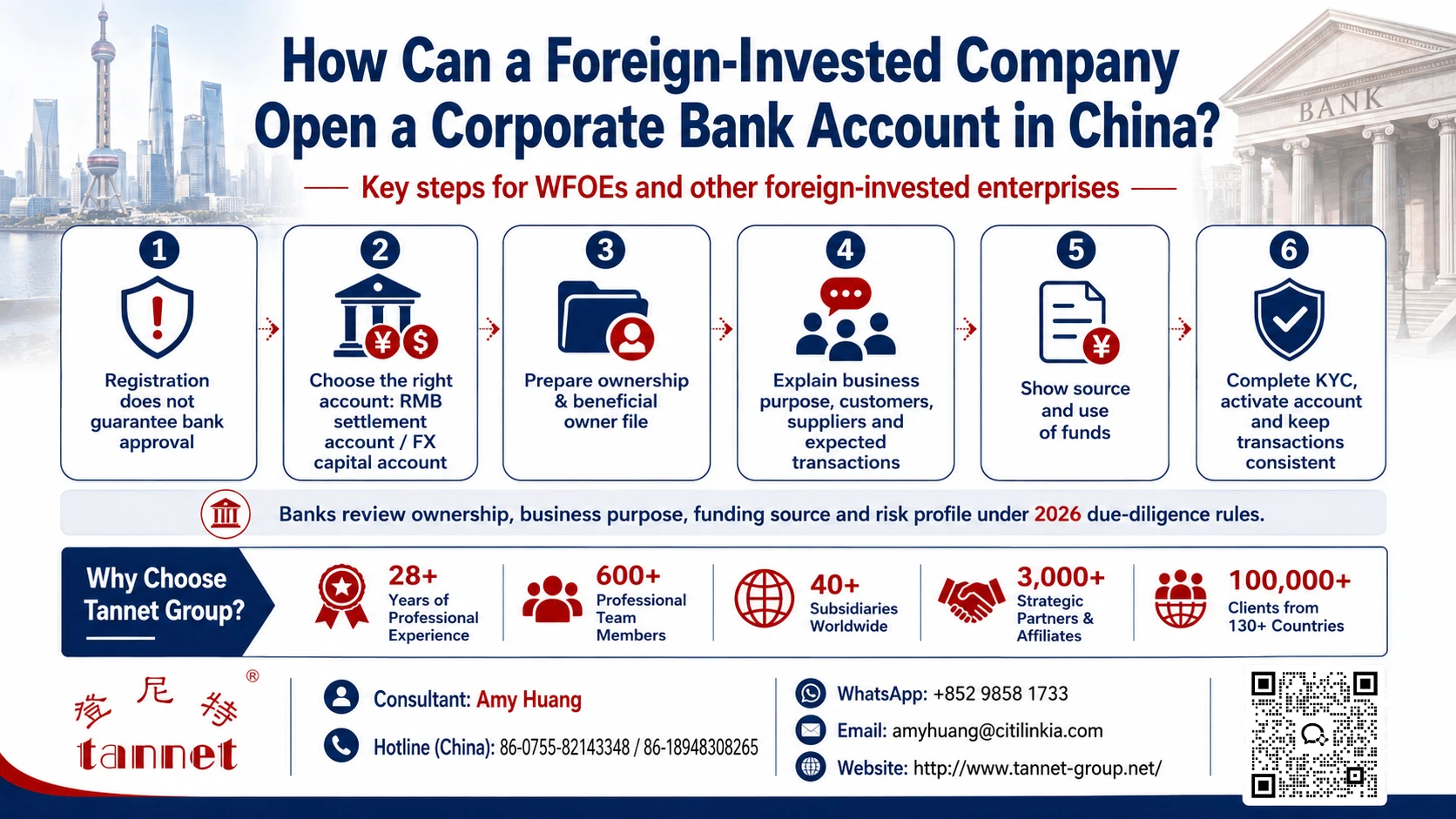
A foreign-invested company can open corporate bank accounts in China after completing legal registration, but incorporation does not guarantee approval by a bank.
The bank must conduct customer due diligence, verify the company and its beneficial owners, understand the purpose of the account, and assess expected transactions, funding sources and risk.
Most operating companies need an RMB settlement account, while foreign-invested companies receiving foreign-currency capital may also need a capital account under foreign-exchange rules.
This guide is for newly established WFOEs and other foreign-invested enterprises.
The most important preparation is consistency across ownership, business scope, contracts, funding and expected account activity.
Understand What the Bank Is Actually Approving
A Chinese business licence proves that the company legally exists. It does not require a commercial bank to accept the company as a customer.
From 1 January 2026, updated customer-due-diligence rules require financial institutions to verify customers, understand the business relationship, assess risk and identify beneficial owners.
Banks must also continue reviewing the relationship after opening, so the onboarding transaction profile matters later.
Decide Which Accounts the Company Actually Needs
RMB settlement account
A newly established company normally needs an RMB corporate settlement account for local receipts and payments.
China has replaced the former approval model for enterprise bank accounts with a filing model. The People’s Bank of China no longer issues a separate enterprise account-opening licence for a basic deposit account.
The bank opens the account after its checks and reports required account information through the banking-account system.
Foreign-currency capital account
A foreign-invested enterprise receiving foreign-currency capital may need a foreign-exchange capital account.
SAFE’s capital-account guidance allows banks to handle direct-investment registration and capital-account opening, receipt and use under the applicable rules.
The capital account is not a substitute for the normal operating account.
Other accounts
A company may later need payroll, tax, foreign-currency current-account or other permitted accounts.
The right structure depends on revenue, suppliers, employees and shareholder funding.
Step-by-Step Corporate Account Opening Process
Step 1 – Complete the company’s legal records
Make sure the company’s business licence, articles, legal representative information, registered address, shareholders and business scope are current.
If the ownership structure has changed, update the relevant corporate and beneficial-owner information before approaching the bank.
A bank can request additional verification when corporate information is inconsistent or incomplete.
Step 2 – Prepare the ownership and beneficial-owner file
Prepare a clear ownership chart showing every layer from the Chinese company to the ultimate natural-person owners or controllers.
Under the 2026 rules, a beneficial owner can be a natural person who ultimately owns more than 25%, enjoys more than 25% of income or voting rights, or otherwise exercises actual control.
Banks may compare their findings with the national beneficial-owner information system.
Step 3 – Prepare the business-purpose file
The bank needs to understand what the company will do.
Prepare a short business description covering products, customer and supplier countries, monthly transaction volume, currencies, typical payment size and the reason for the China entity.
Where available, include contracts, purchase orders, supplier quotations, website materials or a business plan.
A new company can still apply without transaction history, but the projected activity should be credible.
Step 4 – Prepare the people who will control the account
Banks commonly verify the legal representative, account operators, major shareholders and beneficial owners.
Prepare valid IDs, authorizations and required seal arrangements.
If an interview is required, the attendee should understand ownership, business and expected transactions.
Step 5 – Explain the source and use of funds
The bank may ask where the initial capital and operating funds will come from.
Prepare evidence linking the investor, remitter and planned capital contribution. Foreign direct investment should also follow SAFE registration and account rules.
Avoid unexplained transfers from unrelated third parties.
Step 6 – Submit the bank application and complete KYC
The bank reviews the legal entity, ownership, business purpose, source of funds and transaction profile.
China’s 2026 CDD rules are risk based. Higher-risk cases can face enhanced checks on funding, transaction purpose, operating status and beneficial owners.
A bank may also request site verification or more evidence. No rule guarantees an account to every incorporated WFOE.
Step 7 – Activate the account and align payment controls
After approval, confirm online banking, payment limits, users, payroll and foreign-exchange features.
Keep actual transactions consistent with the onboarding profile. Large or unusual transactions may trigger further questions.
Documents Commonly Prepared for the Bank
A practical file can include:
- Business licence.
- Articles of association.
- Legal representative identification.
- Shareholder and beneficial-owner identification.
- Ownership chart.
- Registered-address evidence if requested.
- Company seals and bank authorization documents.
- Board or shareholder resolutions where relevant.
- Business contracts or transaction evidence.
- Source-of-funds and capital-contribution evidence.
- Expected transaction profile.
- Tax or regulatory documents where relevant.
- Foreign-investment and foreign-exchange documents for capital accounts.
The list varies by bank and risk profile.
Common Mistakes
- Assuming company registration automatically guarantees a bank account.
- Giving the bank an ownership chart that does not match corporate records.
- Being unable to explain the ultimate beneficial owners.
- Describing a business model that is inconsistent with the registered business scope.
- Providing no evidence for expected customers, suppliers or funding.
- Using unrelated third parties to remit initial funds without explanation.
- Ignoring post-opening KYC updates when shareholders, directors or business scope change.
Frequently Asked Questions
Q1. Can a WFOE open a bank account immediately after registration?
It can begin the bank application after the required corporate records are ready. The bank still performs independent due diligence, so registration alone does not determine approval time.
Q2. Does the foreign legal representative have to visit the bank in person?
Requirements differ by bank and case. Some banks may require in-person verification or an interview. Confirm the chosen bank’s process before scheduling travel.
Q3. Can a company open accounts at more than one bank?
A company can have different permitted corporate accounts, subject to Chinese account-management rules and bank acceptance. Account type and purpose should be planned before opening multiple accounts.
Q4. What if the foreign parent company has several ownership layers?
Prepare a complete ownership chart and supporting corporate documents that trace control to the ultimate natural-person beneficial owners.
Q5. Is a capital account the same as the normal business account?
No. A foreign-exchange capital account is used for permitted foreign-investment capital receipts and uses. The company normally also needs operating settlement arrangements.
Q6. Can a bank reject an account even if all company documents are valid?
Yes. Banks apply risk-based customer due diligence and can request enhanced checks or decline a relationship if they cannot satisfactorily complete due diligence or manage the risk.
Q7. Do KYC obligations end after the account is opened?
No. Banks must conduct ongoing due diligence and may request updated information when ownership, management, business scope or transaction patterns change.
When Tannet May Be Suitable
Tannet may assist foreign investors that need to coordinate company registration with bank-account preparation, ownership-chart review, beneficial-owner documentation, business-purpose materials, foreign-investment records, accounting setup and ongoing corporate updates.
This is especially relevant for cross-border ownership, foreign-currency capital or international trade. The final account decision remains with the bank.
Official and Regulatory Sources
Written by: Tannet Business Services Team
Reviewed by: Consultant Amy Huang
First published: 24 August 2026
Last reviewed: 24 August 2026
Jurisdiction: Mainland China
————————————————Simplifying Business, Empowering Entrepreneurs————————————————