Key Takeaway
Chinese banks do not use one universal KYC checklist for every foreign-owned company.
They apply risk-based customer due diligence and can request documents beyond the minimum corporate-registration file.
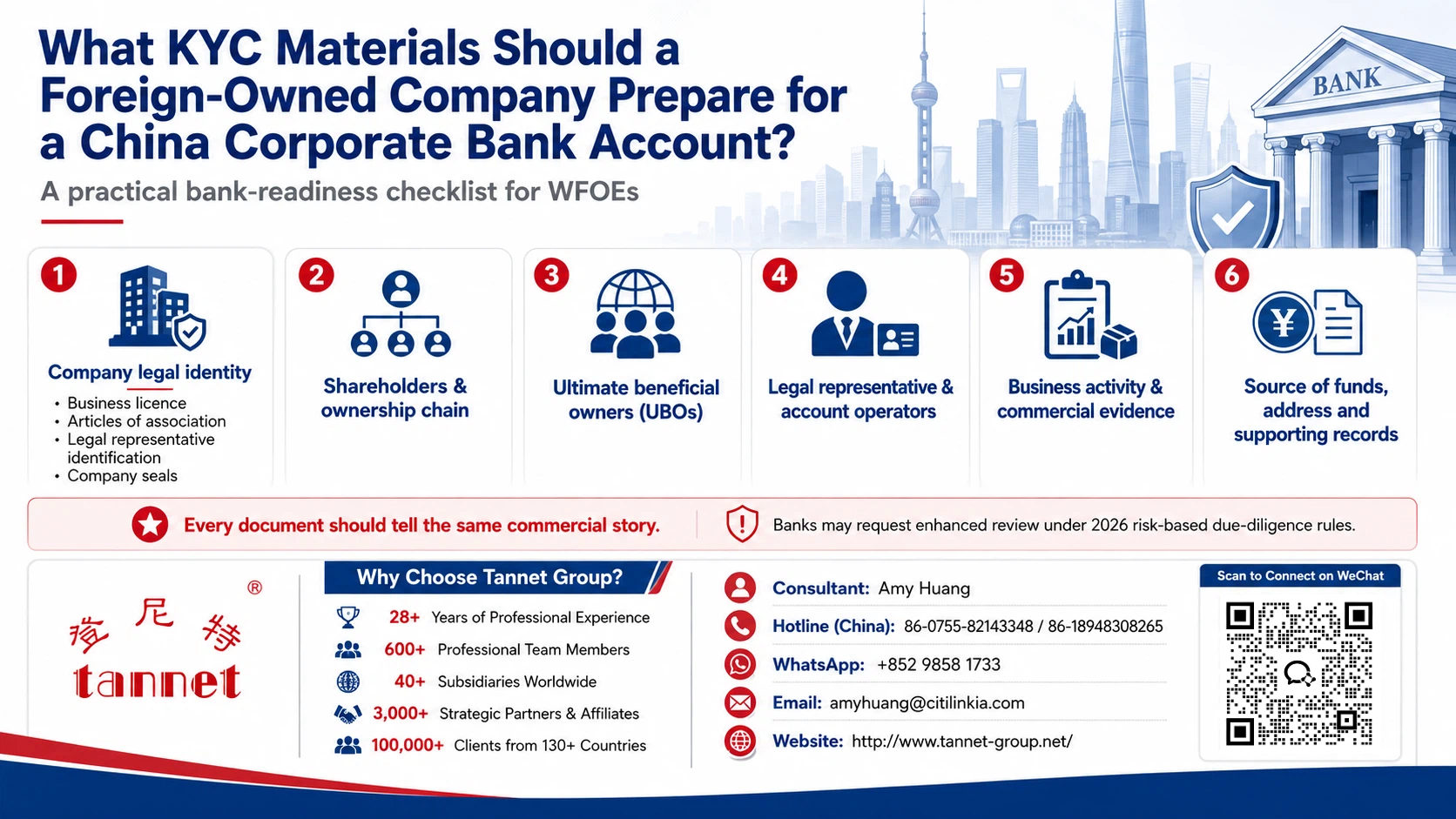
A practical WFOE bank package covers five areas: legal identity, ownership and beneficial owners, authorized persons, business activity, and source and use of funds.
From 2026, updated CDD and beneficial-owner rules place greater emphasis on understanding ownership, control, business purpose and transaction risk.
This guide is for foreign founders preparing a China corporate bank application.
The main caution is that every document should tell the same commercial story.
Why Banks Ask for More Than the Business Licence
The bank is not only verifying that the company exists.
From 1 January 2026, banks must verify the customer, understand the purpose and nature of the relationship, assess risk and identify beneficial owners.
Banks can use reliable government or independent sources and can request additional evidence. Higher-risk customers may face enhanced review of business purpose, funding and operations.
KYC Package 1 – Company Legal Identity
Prepare documents proving the Chinese entity and its governance.
Common documents include:
- Current business licence and articles.
- Company name and unified social credit code.
- Registered address and business scope.
- Legal representative details.
- Directors or managers where relevant.
- Company seals.
- Bank authorization or corporate resolution where required.
The bank may verify company information through government or market-regulation databases.
If the company has recently changed its name, legal representative, business scope or ownership, update the public and bank records before or during the application.
KYC Package 2 – Shareholders and Ownership Chain
For a simple individual-owned WFOE, the ownership file may be short.
For a company owned by an overseas parent, the bank may need registration evidence, shareholder records, articles, organizational charts and documents for intermediate holding companies.
The objective is to trace control to the final natural persons.
Foreign-language documents may require authentication. Registration documents do not automatically satisfy every bank’s KYC standard.
KYC Package 3 – Ultimate Beneficial Owners
Beneficial ownership is a central KYC issue.
China’s Beneficial Owner Information Measures require specified entities to file beneficial-owner information, subject to exemptions.
Separate PBOC rules took effect on 20 January 2026.
Who can be a beneficial owner?
For financial-institution identification, a natural person can qualify if the person:
- Ultimately owns more than 25% of equity, shares or partnership interests.
- Ultimately enjoys more than 25% of income or voting rights.
- Exercises actual control even without meeting the percentage thresholds.
If none of these tests identifies a person, the person responsible for daily operation and management can be identified under the rule.
What should the company prepare?
Prepare:
- Beneficial-owner names and IDs.
- Nationality and residence information.
- Ownership percentages.
- Voting or control rights.
- Ownership chart.
- Supporting corporate records.
- Filed beneficial-owner information where applicable.
The bank may compare findings with the national beneficial-owner system.
KYC Package 4 – Legal Representative and Account Operators
The bank needs to know who can act for it.
Prepare IDs for the legal representative and authorized account operators.
If another person attends the bank or manages online banking, prepare the authorization and the person’s identity documents.
Banks may verify the representative’s relationship with the company.
The person answering KYC questions should understand shareholders, products, customers, suppliers and funding.
KYC Package 5 – Business Activity and Commercial Evidence
Explain why the account will be used.
Prepare a business profile covering:
- Main products or services.
- Customer types.
- Supplier types.
- Sales and purchasing countries.
- Expected transaction currencies.
- Expected monthly inflows and outflows.
- Average and largest payment size.
- Main payment purposes.
Support the explanation with contracts, purchase orders, invoices, supplier quotations, website materials, licences or a business plan where available.
A newly incorporated company may lack operating history, but it should have a credible plan.
KYC Package 6 – Source of Funds and Capital
Banks may ask how the company will be funded.
For a foreign-invested enterprise, the file can include the subscribed capital arrangement, investor identity, expected remitting account, funding schedule and foreign-investment documentation.
If foreign currency is used for registered-capital funding, SAFE rules for direct-investment registration and foreign-exchange capital accounts become relevant.
The remitter should have a clear relationship with the investor or transaction. Third-party payments can require additional explanation.
KYC Package 7 – Tax, Address and Regulatory Evidence
The bank may also ask for:
- Tax information.
- Registered-address evidence.
- Lease or office information.
- Industry licence.
- Customs or import-export information.
- Employment or payroll information.
- Corporate website or local contact information.
These documents help the bank compare stated activity with the company’s legal and operational footprint. They are not universally required.
Why the Bank May Ask for Additional Documents
China’s 2026 CDD framework is risk based.
Banks can conduct enhanced review where risk is higher. Measures can include obtaining more information about the purpose and nature of transactions, source and use of funds, operating status, and beneficial owners.
The bank can also conduct site visits or other verification.
Additional questions mean the bank needs more evidence to complete its risk assessment.
Common Mistakes
- Submitting an ownership chart that stops at an overseas holding company.
- Using different shareholder percentages in corporate and bank documents.
- Naming a beneficial owner without evidence of ownership or control.
- Giving the bank vague descriptions such as “consulting” or “trading” with no transaction model.
- Forecasting large international transfers without contracts or funding explanation.
- Sending expired passports or outdated company records.
- Assuming every bank will accept the same document package.
Frequently Asked Questions
Q1. Does every Chinese bank ask for the same KYC documents?
No. Banks follow common legal and AML requirements but use their own risk policies and procedures.
Q2. Will the bank ask for the foreign parent company’s documents?
Often yes when the WFOE is owned by an overseas legal entity, especially if the bank needs to trace the full ownership chain.
Q3. Does the bank need information on every shareholder?
The bank needs enough information to understand ownership and control and identify the beneficial owners. It may request information on shareholders below the beneficial-owner threshold depending on structure and risk.
Q4. What if nobody owns more than 25%?
The bank still applies the control tests. A person exercising actual control may be the beneficial owner. If no one meets the tests, the daily operating manager can be identified under the applicable rule.
Q5. Do I need contracts if the company is brand new?
Not always, but commercial evidence makes the expected business model easier to verify. A credible business plan, supplier quotation, customer discussion or group support document can help explain a new company.
Q6. Can the bank ask where the foreign shareholder obtained its money?
Yes. Banks may request source-of-funds information, especially in higher-risk cases or for capital and cross-border transactions.
Q7. Can KYC continue after the bank account is opened?
Yes. Banks are required to conduct ongoing due diligence and can request updates when company information or transaction risk changes.
When Tannet May Be Suitable
Tannet may assist foreign-owned companies that need to prepare a bank KYC package, organize corporate and shareholder documents, trace beneficial ownership, create an ownership chart, align business descriptions with the registered business scope, and coordinate foreign-investment, accounting and compliance records.
This is especially useful for multi-layer ownership or cross-border capital and trade. Bank approval remains independent.
Official and Regulatory Sources
- PBOC, NFRA and CSRC, Measures for Customer Due Diligence and Preservation of Customer Identity and Transaction Records by Financial Institutions, effective 1 January 2026: https://www.shanghai.gov.cn/gwk/search/content/18143bfe9fd14a36b3bc422a2895d593
- PBOC and SAMR, Measures for the Administration of Beneficial Owner Information, effective 1 November 2024: https://app.www.gov.cn/govdata/gov/202405/01/514490/article.html
- PBOC, Measures for Financial Institutions’ Identification of Beneficial Owners, effective 20 January 2026: https://www.moj.gov.cn/pub/sfbgw/flfggz/flfggzbmgz/202605/t20260507_534571.html
- PBOC, Enterprise Information Network Verification System: https://xzxk.pbc.gov.cn/opal/zwfwqjd/zwfwqjd-news010.html
- SAFE, Capital Account Foreign Exchange Business Guidelines (2024 Edition): https://www.safe.gov.cn/liaoning/file/file/20241219/ec1f9d0f8de94bf29ade8cead9483cb5.pdf
- SAFE, 2025 cross-border investment and financing reform notice: https://m.safe.gov.cn/safe/2025/0915/26538.html
Written by: Tannet Business Services Team
Reviewed by: Consultant Amy Huang
First published: 24 August 2026
Last reviewed: 24 August 2026
Jurisdiction: Mainland China
————————————————Simplifying Business, Empowering Entrepreneurs————————————————