Key Takeaway
A China WFOE is taxed under the same national tax framework as other resident enterprises established in Mainland China.
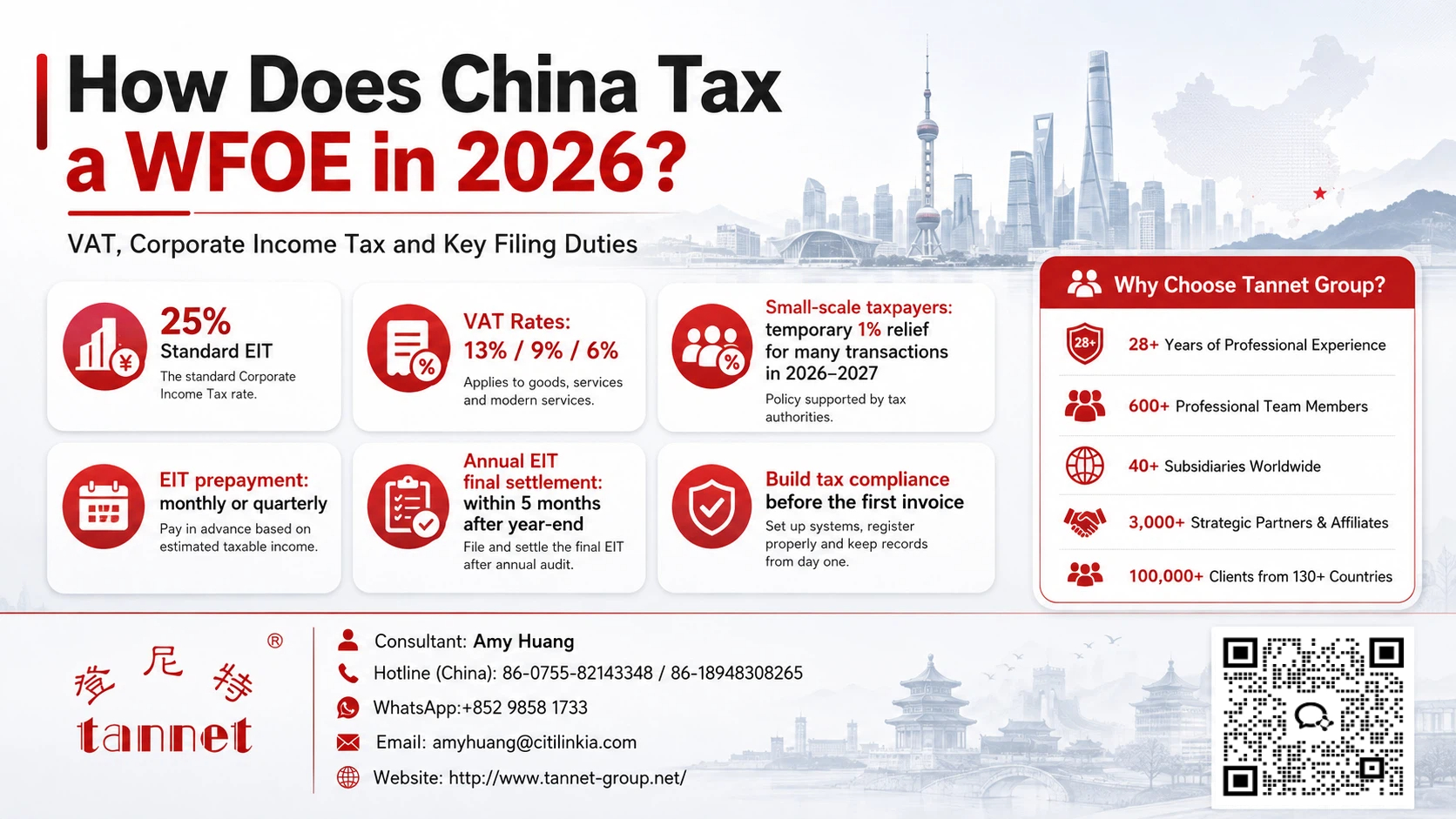
In 2026, the standard enterprise income tax rate is 25%.
The new Value-Added Tax Law is now in force, with main VAT rates of 13%, 9% and 6%, depending on the transaction.
Qualified small-scale VAT taxpayers may use simplified rules, including temporary 2026–2027 relief for many transactions.
Foreign investors should not plan tax from headline rates alone.
Activity, taxpayer status, invoices, deductions, cross-border payments and incentives determine the real compliance position.
A WFOE is not a separate tax category
“WFOE” is a commercial term for a wholly foreign-owned foreign-invested enterprise.
A WFOE incorporated in Mainland China is generally a resident enterprise for enterprise income tax purposes. Foreign ownership does not create a separate corporate tax rate.
Corporate Income Tax: the standard rate is 25%
The Enterprise Income Tax Law sets the standard enterprise income tax rate at 25%.
Taxable income is calculated under tax rules after permitted exemptions, deductions and allowable losses. Accounting profit and taxable income are not always identical.
When can a lower EIT rate apply?
Qualified high and new technology enterprises may be taxed at 15%.
Qualified small and low-profit enterprises can also receive preferential treatment. Through 31 December 2027, qualifying small and low-profit enterprises calculate taxable income at 25% of the actual amount and apply a 20% tax rate.
This produces an effective burden of 5% on qualifying taxable income.
The small and low-profit enterprise criteria include:
- Annual taxable income not exceeding RMB 3 million
- No more than 300 employees
- Total assets not exceeding RMB 50 million
- Activity not falling within a restricted or prohibited industry
A foreign-owned company can potentially qualify if it meets the same conditions.
VAT changed from regulations to a national law in 2026
China’s Value-Added Tax Law took effect on 1 January 2026.
The law applies to taxable transactions in Mainland China and the importation of goods.
For general taxpayers, VAT is normally calculated by deducting eligible input VAT from output VAT.
Main VAT rates in 2026
13% VAT
The 13% rate generally applies to sales of goods, processing, repair and replacement services, leasing of movable property and imported goods, unless another rate applies.
9% VAT
The 9% rate generally covers transportation, postal services, basic telecommunications, construction, leasing of immovable property, sales of immovable property, transfers of land-use rights and specified essential goods.
6% VAT
The 6% rate generally applies to other services and intangible assets not covered by the higher rates.
Zero-rated transactions
Exports of goods generally use a zero rate unless otherwise provided.
Specified cross-border services and intangible assets can also qualify for zero rating under applicable rules.
Zero rating should not be confused with exemption because input VAT treatment can differ.
General taxpayer vs small-scale taxpayer
The 2026 VAT Law defines a small-scale taxpayer as a taxpayer whose annual taxable VAT sales do not exceed RMB 5 million.
A small-scale taxpayer normally uses simplified calculation.
The statutory simplified collection rate is 3%.
However, from 1 January 2026 to 31 December 2027, many small-scale taxpayer transactions otherwise subject to the 3% rate are temporarily taxed at a reduced 1% rate, excluding specified real-estate and land transactions.
The same temporary policy provides a VAT threshold of RMB 100,000 monthly sales or RMB 300,000 quarterly sales for small-scale taxpayers.
The small-scale/general-taxpayer position affects invoices, input VAT recovery and customer requirements.
How often does a WFOE file VAT?
The VAT Law provides tax periods of 10 days, 15 days, one month or one quarter.
The tax authority determines the filing period.
Small-scale taxpayers are required to file VAT on a quarterly basis, whereas general taxpayers must file on a monthly basis.
For monthly or quarterly taxpayers, the VAT return is generally due within 15 days after the end of the tax period.
Imported goods follow customs procedures.
Enterprise Income Tax filing calendar
Enterprise income tax is calculated on a calendar-year basis from 1 January to 31 December.
EIT is prepaid monthly or quarterly.
The Enterprise Income Tax Law requires the prepayment return within 15 days after the end of the month or quarter.
The annual enterprise income tax return and final settlement are generally due within five months after the tax year ends.
Other taxes a WFOE may encounter
Depending on activity, a WFOE may also face:
- Individual income tax withholding on employee compensation
- Stamp tax on specified taxable instruments or transactions
- Urban maintenance and construction tax and education-related surcharges
- Property and land-related taxes
- Consumption tax for specified goods
- Customs duty and import VAT
- Withholding tax on qualifying China-source payments to non-residents
Treaty relief can affect cross-border payments, but eligibility should be checked before payment.
Cross-border service fees, royalties and dividends need separate review
Payments to foreign shareholders or related parties can create withholding, VAT, transfer-pricing and foreign-exchange issues.
A parent-company invoice alone does not prove a management fee is deductible. The WFOE should show a genuine service, business purpose and supportable pricing.
Dividend remittance requires an after-tax profit basis and supporting corporate, tax and banking documents.
Build tax compliance before the first invoice
A new WFOE should establish:
- Tax-account and e-tax bureau access
- VAT taxpayer status
- Invoice issuance procedures
- Bookkeeping rules and chart of accounts
- Expense-approval and evidence rules
- Payroll and IIT withholding
- Monthly or quarterly tax calendar
- Annual EIT settlement process
Tax compliance begins when the company starts having transactions, costs and payroll. It should not begin only after revenue becomes material.
Common Mistakes
- Assuming every WFOE pays only 25% corporate income tax.
- Applying one VAT rate to every product or service.
- Treating the temporary 1% small-scale VAT rate as the statutory standard rate.
- Claiming input VAT without valid supporting documents.
- Mixing shareholder expenses with company expenses.
- Paying overseas related parties without reviewing withholding and transfer pricing.
- Waiting until year-end to reconcile tax and accounting records.
Frequently Asked Questions
Q1. Does a foreign-owned company pay more corporate income tax than a Chinese-owned company?
Generally no. The standard enterprise income tax framework applies based on the company’s tax status and activity, not merely foreign ownership.
Q2. What is the standard corporate income tax rate for a WFOE?
EIT is 25%. Qualified enterprises may access lower rates or other incentives.
Q3. What VAT rate does a consulting WFOE normally use?
Many consulting and modern-service transactions fall under the 6% VAT category for general taxpayers, but the actual transaction must be classified correctly.
Q4. Can a WFOE use the 1% small-scale VAT rate in 2026?
Potentially. The company must qualify as a small-scale VAT taxpayer and the transaction must fall within the temporary 2026–2027 relief.
Q5. Does a WFOE with no profit still file tax returns?
Yes for enterprise income tax obligations. Official tax guidance states that taxpayers with no tax payable during a taxable period still file according to applicable rules.
Q6. When is the annual corporate income tax settlement due?
Generally within five months after the end of the calendar tax year.
Q7. Can a WFOE deduct all payments to its overseas parent company?
No. Deductibility depends on the nature, authenticity, business purpose, documentation, pricing and applicable tax rules.
When Tannet May Be Suitable
Tannet may assist foreign-invested companies that need to connect WFOE registration with tax-account setup, VAT classification, invoice processes, bookkeeping, payroll, periodic tax filing, annual EIT settlement, cross-border payment documentation and ongoing corporate compliance.
Where a transaction involves a specific tax incentive, treaty position, related-party arrangement or complex cross-border structure, the final tax treatment should be confirmed against the company’s facts and current authority requirements.
Official Sources
Written by: Tannet Business Services Team
Reviewed by: Consultant Amy Huang
First published: 25 August 2026
Last reviewed: 25 August 2026
Jurisdiction: Chinese Mainland
————————————————Simplifying Business, Empowering Entrepreneurs————————————————