Key Takeaway
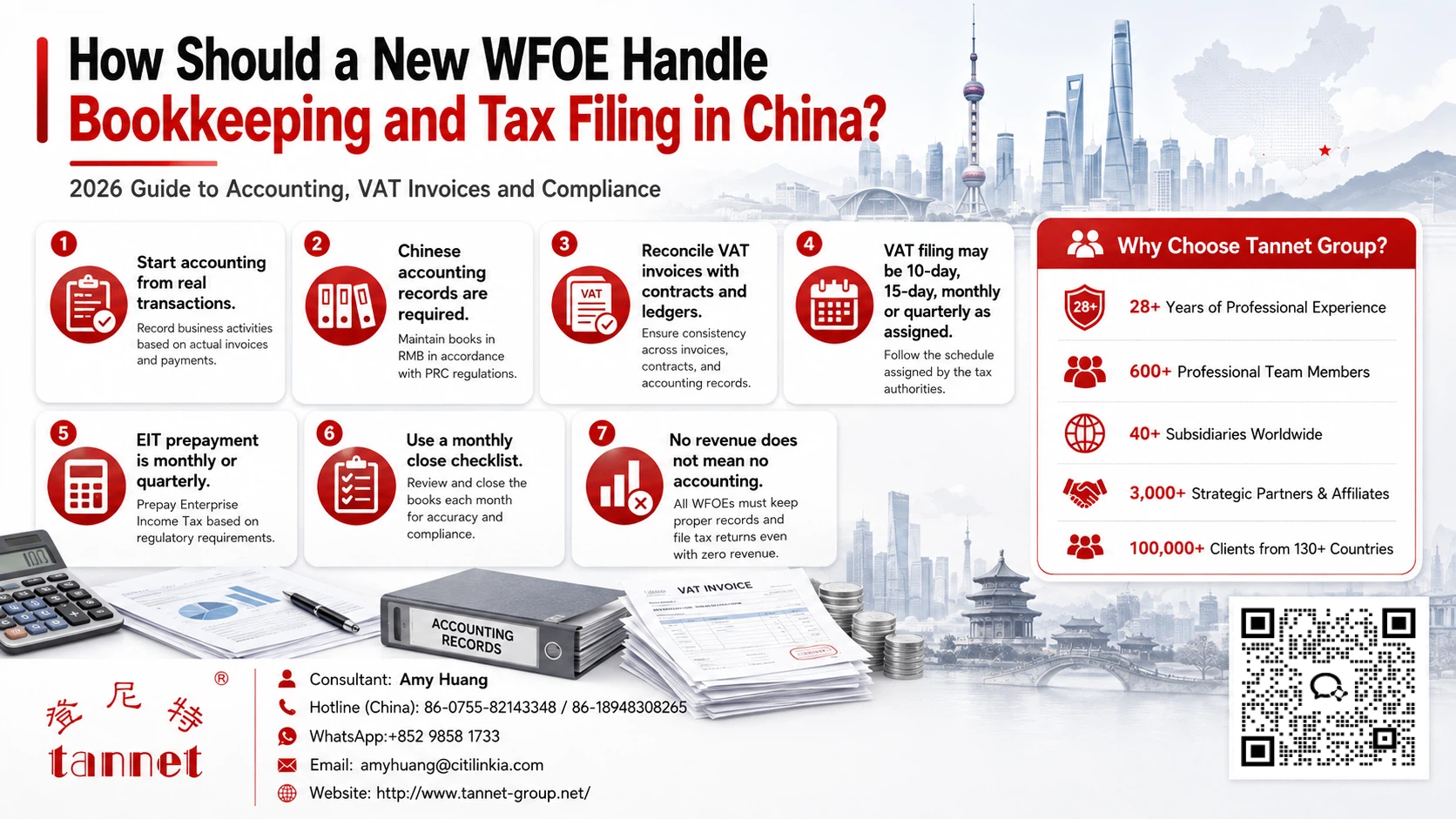
A China WFOE should establish accounting and tax processes as soon as the company begins to incur costs, receive capital, hire staff, issue invoices or conduct transactions.
Bookkeeping is not something to postpone until the first profitable year.
China’s Accounting Law requires companies to keep lawful accounting books based on actual economic transactions.
Enterprise income tax is normally prepaid monthly or quarterly and settled annually.
VAT is filed according to the tax period assigned by the competent tax authority.
The most important control is consistency: contracts, invoices, bank records, payroll, accounting entries and tax returns should describe the same real business activity.
Start accounting from the company’s real transactions
China’s Accounting Law applies to companies and enterprises established in Mainland China.
It requires units to establish accounting books and ensure accounting information is true and complete.
Accounting must be based on actual economic transactions. Companies must prepare accounting vouchers, register accounting books and compile financial reports.
A WFOE should record capital, setup costs, rent, professional fees, payroll, purchases, customer invoices and bank charges even before profitability.
Choose the accounting framework and reporting responsibilities
The company should determine which national accounting standards apply to its size and circumstances.
The Accounting Standards for Business Enterprises form the main framework for many companies, while eligible smaller entities may use applicable small-enterprise standards.
The chosen treatment should be consistent. Outsourcing bookkeeping does not remove management responsibility for truthful and complete accounting information.
Set up a practical chart of accounts
A chart of accounts should match the business.
A service WFOE may need separate accounts for consulting revenue, subcontractors, staff costs, rent, travel, software, professional fees and related-party charges.
A trading WFOE may additionally need inventory, cost of goods sold, customs duties, import VAT, freight and logistics accounts.
A manufacturing company needs stronger inventory, fixed-asset and production-cost controls. The accounting structure should support both management reporting and tax filing.
Build a source-document policy
Every accounting entry should have evidence.
Typical documents include:
- Sales contracts
- Supplier contracts
- VAT invoices and electronic invoices
- Customs documents
- Bank statements
- Payment approvals
- Expense claims
- Payroll records
- Employee agreements
- Fixed-asset documents
- Capital-injection records
- Related-party agreements
China’s Accounting Law requires accounting vouchers to be based on reviewed original documents.
Manage VAT invoices as part of accounting
China’s Value-Added Tax Law has been effective since 1 January 2026.
It recognizes both paper and electronic VAT invoices. Electronic invoices have the same legal effect as paper invoices.
For a general taxpayer, output VAT and eligible input VAT directly affect the VAT payable.
Invoice management is therefore part of the accounting close.
The company should reconcile:
- Sales ledger to issued invoices
- Purchase ledger to input VAT documents
- Invoice data to contracts
- VAT return to the general ledger
Understand the 2026 VAT filing cycle
VAT tax periods can be 10 days, 15 days, one month or one quarter.
The competent tax authority determines the specific period based on the taxpayer’s circumstances.
If the tax period is one month or one quarter, the VAT return is generally due within 15 days after the period ends.
Confirm the actual filing cycle in the company’s electronic tax account.
Set up enterprise income tax prepayments
The standard enterprise income tax rate is 25%, unless a valid preferential rate or incentive applies.
EIT is prepaid monthly or quarterly.
The prepayment return is generally due within 15 days after the end of the relevant month or quarter.
The tax year is the calendar year.
The annual EIT return and final settlement are generally due within five months after year-end.
Annual settlement adjusts accounting results for deductible costs, non-deductible items, incentives and tax-loss rules.
A company with no revenue still needs accounting
“No sales” does not mean “no accounting.”
A newly formed WFOE may already have:
- Shareholder funding
- Office rent
- Company-secretary or consulting expenses
- Bank charges
- Payroll
- Software subscriptions
- Equipment
- Pre-operating expenses
These transactions need accounting treatment. State Taxation Administration guidance also states that taxpayers with no EIT payable during a taxable period still file according to applicable rules.
Add payroll and IIT to the monthly close
Once the WFOE hires employees, payroll becomes part of tax compliance.
The company should reconcile employment contracts, attendance where relevant, gross salary, bonuses, allowances, social-insurance treatment and individual income tax withholding.
Payments in the bank should agree with payroll records and tax declarations.
Reconcile the bank every month
Bank reconciliation is one of the simplest compliance controls.
Every corporate-bank transaction should have an accounting explanation and supporting record.
Unexplained shareholder transfers, personal expenses or contract-free payments become harder to resolve later. Foreign-currency accounts also require correct conversion and accounting treatment.
Review cross-border related-party transactions early
A foreign-owned business frequently pays or receives money from affiliates.
Examples include management fees, software charges, royalties, loans, service fees and procurement.
These transactions can involve transfer pricing, VAT, withholding tax and foreign-exchange documentation.
Create the intercompany agreement before the payment process, not after a bank or tax authority asks for it.
Use a monthly close checklist
Monthly or periodic tasks
- Collect all sales and purchase documents.
- Record accounting entries.
- Reconcile bank accounts.
- Reconcile VAT invoices.
- Complete payroll and IIT.
- Review VAT and other periodic tax filings.
- Record accruals and fixed assets.
- Review related-party transactions.
Quarterly tasks
Review EIT prepayment, financial results, unusual balances and tax-incentive eligibility.
Annual tasks
Complete financial closing, EIT final settlement, required corporate annual reporting and any audit or statistical obligations that apply.
Common Mistakes
- Waiting for revenue before creating books.
- Using personal bank accounts for corporate transactions.
- Recording expenses without valid evidence.
- Treating VAT invoices as separate from the accounting ledger.
- Filing tax returns without reconciling the bank.
- Ignoring payroll and IIT in the accounting close.
- Preparing intercompany documents only after a payment is challenged.
- Assuming outsourced bookkeeping transfers legal responsibility away from management.
Frequently Asked Questions
Q1. Does a new WFOE need bookkeeping if it has no customers yet?
Yes. Setup costs, capital, bank charges, rent and other transactions still require accounting treatment.
Q2. Can a foreign-invested company keep its books only in English?
No. The Accounting Law requires accounting records to use Chinese. Foreign-invested enterprises may use a foreign language in addition to Chinese.
Q3. Does every WFOE file VAT monthly?
No. VAT periods can vary. The competent tax authority determines the taxpayer’s filing period.
Q4. When is corporate income tax filed?
EIT is generally prepaid monthly or quarterly, with annual settlement within five months after year-end.
Q5. Can we deduct an expense if we only have a bank payment record?
Not necessarily. Deductibility depends on the nature of the expense and proper supporting documentation.
Q6. Can our overseas accountant keep the China books?
An overseas finance team can support the process, but the China entity must meet Chinese accounting, tax, language and filing requirements.
Q7. Do zero-revenue companies still submit tax filings?
The filing position depends on the tax and taxpayer status. For EIT, official filing guidance specifically requires returns even where no tax is payable.
Q8. What should we prepare before the first invoice?
Confirm VAT status, invoice issuance, chart of accounts, bookkeeping process, bank controls, expense policy and tax-filing calendar.
When Tannet May Be Suitable
Tannet may assist foreign-invested companies that need bookkeeping setup, monthly accounting, VAT and EIT filing coordination, payroll and IIT support, annual EIT settlement, annual corporate reporting and cross-border transaction documentation.
This can be particularly useful where the shareholder finance team is overseas and needs a structured local reporting process. Tax treatment should still be confirmed against the company’s exact transactions and current local tax-account settings.
Official Sources
Written by: Tannet Business Services Team
Reviewed by: Consultant Amy Huang
First published: 25 August 2026
Last reviewed: 25 August 2026
Jurisdiction: Chinese Mainland
————————————————Simplifying Business, Empowering Entrepreneurs————————————————