Key Takeaway
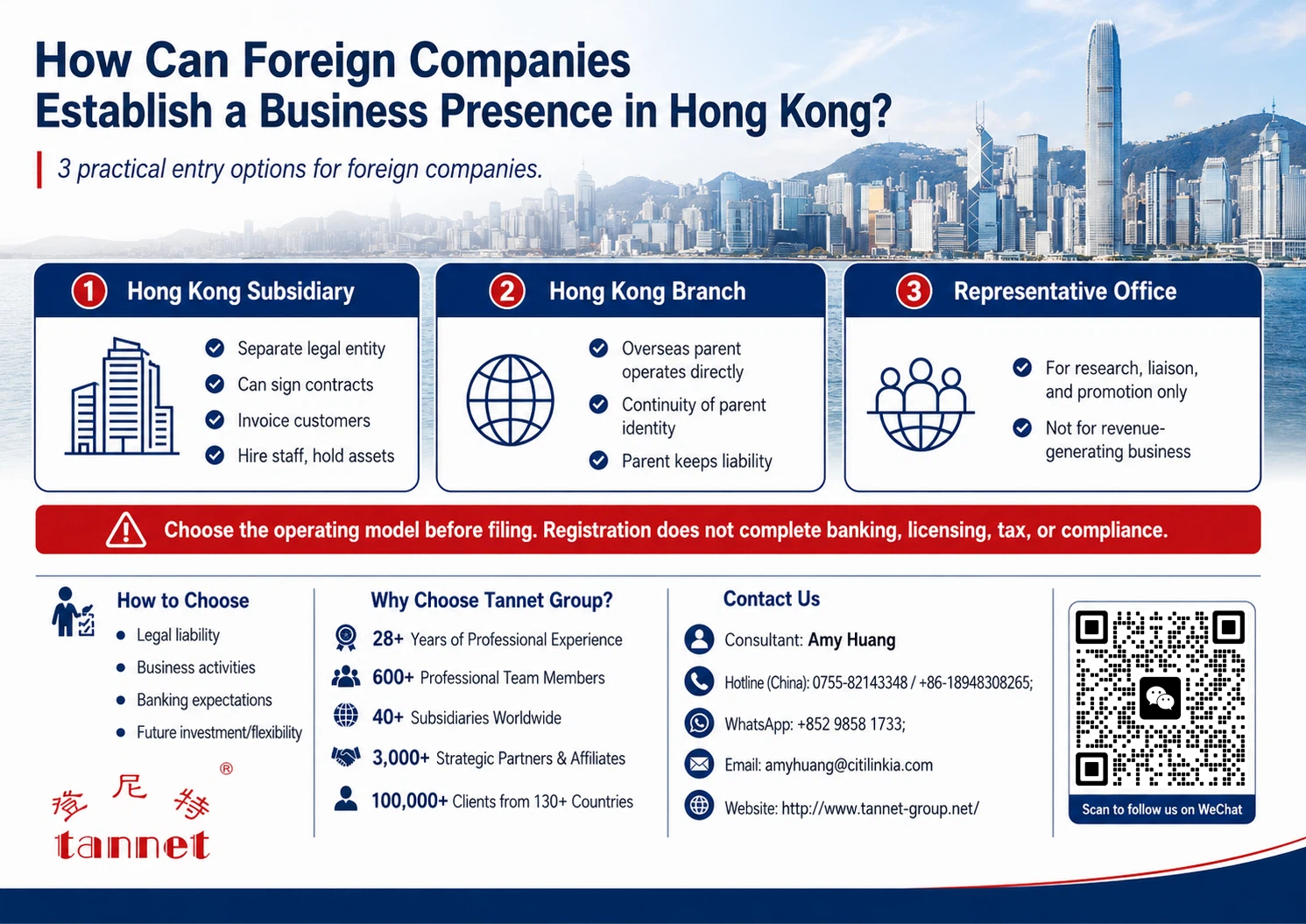
Foreign companies can enter Hong Kong through a locally incorporated subsidiary, a registered branch of the overseas parent, or a representative office.
A private company limited by shares is usually suitable when the business will sign contracts, invoice customers, hire staff, hold assets, or separate Hong Kong liabilities from the parent.
A branch keeps the parent company as the legal operator.
A representative office is limited to non-profit-making activities such as research and liaison.
The most important point is to choose the operating model before filing. Incorporation alone does not complete tax, licensing, banking, accounting, employment, or ongoing company-law obligations.
What Are the Main Hong Kong Market-Entry Options?
Option 1: Incorporate a Hong Kong private company
A foreign shareholder may incorporate a local private company limited by shares. Non-Hong Kong residents are permitted to incorporate a local limited company, and a director is not required to be a Hong Kong resident.[1]
The Hong Kong company is legally separate from its shareholders, subject to guarantees, misconduct, insolvency rules, and the facts of each case.
A private company must have at least one natural-person director. It must also have a company secretary and a registered office in Hong Kong. The sole director cannot act as the company secretary.[1]
The filing normally includes an incorporation form, articles, a business-registration notice, and fees. Under the one-stop system, approved incorporation and business-registration documents are issued together.[2]
Option 2: Register the overseas company as a Hong Kong branch
A foreign company that establishes a place of business in Hong Kong generally registers as a non-Hong Kong company within one month.[3]
A branch is part of the parent, which remains responsible for its debts and obligations.
Registration generally uses Form NN1, certified parent documents, Hong Kong business-address details, and authorised-representative information.[3]
A branch may suit a parent that wants direct operational continuity and accepts direct liability.
Option 3: Use a representative office for limited market testing
A representative office may be used for market research, promotion, liaison, and other preparatory activities. It should not conduct profit-making business, sign revenue-generating contracts, or issue sales invoices in Hong Kong.[4]
This model can suit a company that is testing demand before making a larger commitment. It is not a substitute for an operating subsidiary or branch.
If the office starts trading, contracting, or earning revenue, the company may need a different structure and additional registrations.
How Should a Foreign Company Choose Between the Three Options?
Consider legal liability
A subsidiary is normally separate from the parent. A branch is part of it. A representative office should not earn revenue.
Consider contract, employee, property, financing, and operational risks.
Consider the activities planned in Hong Kong
List what the Hong Kong presence will actually do.
Will it sell goods, provide services, sign contracts, collect payments, employ staff, lease premises, hold inventory, apply for licences, or own intellectual property?
A representative office is generally unsuitable when the answer includes commercial transactions. A subsidiary or branch is more likely to fit an operating business.
Consider banking expectations
Account opening is separate from registration. Financial institutions conduct independent due diligence on ownership, funding, activities, counterparties, and expected transactions.
Consider tax and accounting administration
Business registration is not the same as confirmation of a tax result. Tax treatment depends on the facts, income source, business activities, and applicable law.
A local company must maintain proper accounting records and address annual corporate and tax obligations. A branch may also need Hong Kong accounts, tax filings, and parent-company documents.
Cross-border tax and reporting issues can also arise in the parent company’s home jurisdiction.
Consider ownership and future investment
A subsidiary can admit investors and separate the Hong Kong business for a future sale. A branch has no independent share capital, so investors normally invest in the parent.
What Is the Practical Setup Process?
Step 1: Define the commercial purpose
Write a short operating description.
Identify customers, suppliers, products, services, expected currencies, staff, premises, licensing needs, and the countries involved.
Step 2: Select the entry model
Choose a subsidiary when separate legal personality and local operations are important.
Choose a branch when the parent will operate directly and accept the related liabilities.
Choose a representative office only when activities remain non-commercial and preparatory.
Step 3: Prepare the statutory details
For a local company, confirm the name, shareholders, directors, company secretary, registered office, share structure, and articles.
For a branch, prepare certified parent-company documents, officer details, the Hong Kong address, and authorised-representative information.
Step 4: Complete company and business registration
Local-company incorporation and registration of a non-Hong Kong company use the Companies Registry and the one-stop business-registration process.[2]
Other business forms and branch business registrations may require direct filing with the Inland Revenue Department.
Step 5: Complete operational readiness
After registration, address banking, licences, bookkeeping, payroll, employment filings, customs or product approvals, statutory registers, annual returns, audit, and tax workflows.
Common Mistakes
- Choosing a representative office while planning to invoice customers.
- Registering a branch without considering the parent’s direct liability.
- Incorporating a company before confirming licensing or banking requirements.
- Using a registered address that cannot handle government correspondence reliably.
- Treating business registration as proof that profits are tax-exempt.
- Failing to reconcile the Hong Kong structure with the parent company’s home-country tax rules.
- Assuming that registration automatically creates business substance.
Frequently Asked Questions
Q1: Can a non-Hong Kong resident own the entire local company?
Yes. The Companies Registry confirms that non-Hong Kong residents may incorporate a local limited company. There is no Hong Kong-resident director requirement, although local registered-office and company-secretary requirements still apply.[1]
Q2: Is a branch cheaper or simpler than a subsidiary?
Not always. A branch avoids creating a separate shareholder structure, but certified parent documents, ongoing change reporting, accounts, and direct parent liability may add complexity.
Q3: Does a Hong Kong company need a local director?
A private company needs at least one natural-person director, but the director does not have to be a Hong Kong resident.[1]
Q4: Is a Hong Kong company secretary mandatory?
Yes. A private local company must have a company secretary. If the secretary is an individual, that person must ordinarily reside in Hong Kong. A corporate secretary must have a registered or principal office in Hong Kong.[1]
Q5: Does registration guarantee a corporate bank account?
No. Banks and payment institutions conduct independent due diligence. Approval depends on ownership, business activity, source of funds, expected transactions, jurisdictions, and each institution’s risk policy.
Q6: When must a foreign company register a Hong Kong branch?
A non-Hong Kong company that establishes a place of business in Hong Kong must generally apply for registration within one month.[3]
When Tannet May Be Suitable
Tannet may assist foreign companies that need to compare a local subsidiary, registered branch, or representative-office model and coordinate the selected structure with company registration, registered address, company secretary, business registration, banking preparation, accounting, tax, licences, and cross-border planning.
This may be relevant when Hong Kong is part of a wider China, Asian, or international operating structure. Legal, tax, banking, and licensing outcomes remain subject to the relevant authorities and institutions.
Official and High-Credibility Sources
[1] Hong Kong Companies Registry, FAQ – Local Limited Companies – Incorporation: Companies Registry – FAQ – Local Limited Companies – Incorporation
[2] Inland Revenue Department, One-stop Company and Business Registration Service: https://www.ird.gov.hk/eng/faq/osbrq.htm
[3] Hong Kong Companies Registry, FAQ – Registered Non-Hong Kong Companies – Registration: Companies Registry – FAQ – Registered Non-Hong Kong Companies – Registration
[4] InvestHK, Setting Up in Hong Kong: Setting Up in Hong Kong | InvestHK
[5] Inland Revenue Department, Businesses Required to Be Registered: IRD : “Business” Required to be Registered and Application for Business Registration
[6] Hong Kong Companies Registry, FAQ – Local Limited Companies – Company Name: Companies Registry – FAQ – Local Limited Companies – Company Name
Suggested Tannet Internal Links
Written by: Tannet Hong Kong Business Services Team
Reviewed by: Corporate Services Consultant
First published: 5 August 2026
Last reviewed: 5 August 2026
Jurisdiction: Hong Kong SAR
————————————————Simplifying Business, Empowering Entrepreneurs————————————————