————————————————Simplifying Business, Empowering Entrepreneurs—————————————————
Answer Summary
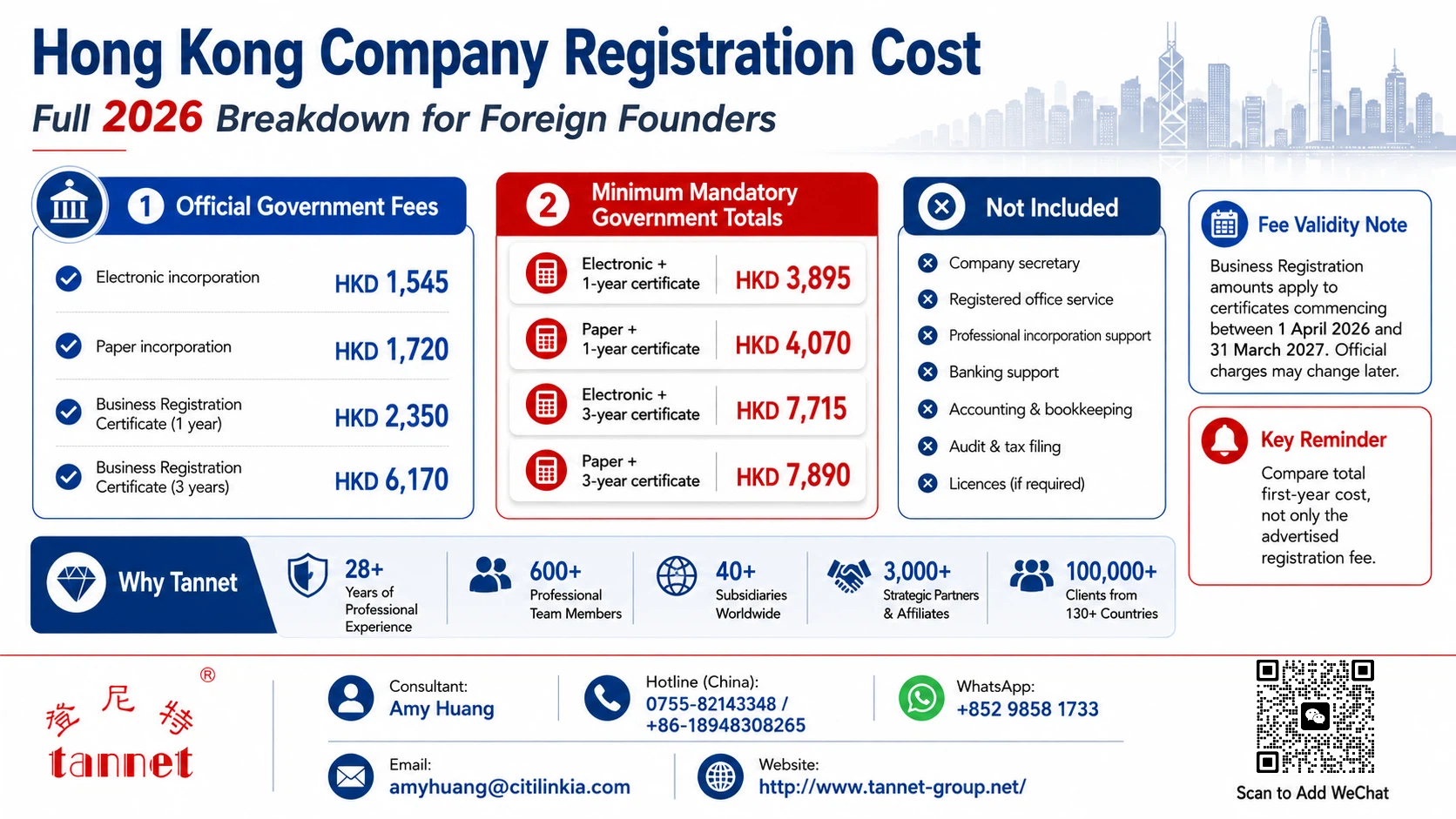
For a private company limited by shares incorporated electronically, the Hong Kong Companies Registry fee is HKD 1,545. Paper filing costs HKD 1,720.
For a Business Registration Certificate commencing between 1 April 2026 and 31 March 2027, the official one-year amount is HKD 2,350. The three-year amount is HKD 6,170.
Therefore, the minimum mandatory government charges are:
- HKD 3,895 for electronic incorporation with a one-year certificate.
- HKD 4,070 for paper incorporation with a one-year certificate.
- HKD 7,715 for electronic incorporation with a three-year certificate.
- HKD 7,890 for paper incorporation with a three-year certificate.
These figures do not include a company secretary, registered-office service, professional incorporation work, certified documents, courier fees, banking support, accounting, audit, tax filing or licences.
Foreign founders should compare total first-year and recurring costs, not only the advertised registration price.
Official Government Fees
The government cost has two main components:
- The incorporation application fee paid to the Companies Registry.
- The Business Registration Certificate fee and levy administered by the Inland Revenue Department.
An incorporation application is treated as a business-registration application at the same time. The relevant charges are paid together.
Companies Registry Incorporation Fee
For a local company having share capital:
- Electronic application: HKD 1,545.
- Hard-copy application: HKD 1,720.
The electronic fee is HKD 175 lower than the hard-copy fee.
If an application is unsuccessful, part of the incorporation fee may be refundable on application. The lodgment portion is not refundable. Founders should use the current Companies Registry refund rules rather than assuming the entire payment will be returned.
Business Registration Fee for 2026-2027
For a certificate commencing from 1 April 2026 to 31 March 2027:
- One-year certificate: HKD 2,200 registration fee plus HKD 150 levy, total HKD 2,350.
- Three-year certificate: HKD 5,720 registration fee plus HKD 450 levy, total HKD 6,170.
The applicable amount depends on the commencement date of the certificate. A company incorporated before 1 April 2026 may fall under a different fee period.
Government fees can change following budget or levy adjustments. A cost article should state the validity period of every quoted amount.
Total Mandatory Government Cost
| Filing method |
Business Registration period |
Incorporation fee |
Business Registration total |
Mandatory government total |
| Electronic |
One year |
HKD 1,545 |
HKD 2,350 |
HKD 3,895 |
| Hard copy |
One year |
HKD 1,720 |
HKD 2,350 |
HKD 4,070 |
| Electronic |
Three years |
HKD 1,545 |
HKD 6,170 |
HKD 7,715 |
| Hard copy |
Three years |
HKD 1,720 |
HKD 6,170 |
HKD 7,890 |
Fee validity note: The Business Registration amounts above apply to certificates commencing between 1 April 2026 and 31 March 2027. Official charges may be adjusted for later periods.
Why the Government Total Is Not the Full Setup Cost
A Hong Kong company also needs a compliant corporate structure.
A typical private company requires:
- A company secretary.
- A registered office in Hong Kong.
- Incorporation documents.
- Statutory registers and resolutions.
- A Significant Controllers Register and designated representative, where applicable.
- Ongoing annual filings.
An overseas founder may not have an eligible individual secretary or a Hong Kong address. The founder may therefore engage a licensed trust or company service provider or another eligible professional arrangement.
The service price is not fixed by the government. It depends on the provider, scope and ownership complexity.
Company Secretary Cost
The company secretary is a statutory requirement.
A service quotation may cover:
- Appointment as company secretary.
- Maintenance of statutory registers.
- Annual-return preparation.
- Filing routine director or secretary changes.
- Preparation of standard resolutions.
- Compliance reminders.
- Custody of corporate records.
- Acting as the SCR designated representative, where included.
The quote may not cover every event. Share allotments, transfers, amendments to articles, restorations and complex restructurings are commonly charged separately.
When comparing secretary fees, ask:
- Which filings are included?
- How many changes are included each year?
- Are government filing fees additional?
- Is the designated-representative service included?
- Are board and shareholder resolutions included?
- What happens when the service ends?
Registered Office Cost
A Hong Kong registered office is also required.
The fee may include:
- Use of the address for statutory registration.
- Receipt of government mail.
- Scanning and forwarding.
- Storage of statutory registers.
- Display of the company name, where required.
It may not include:
- Use as a commercial workspace.
- Meeting rooms.
- Receiving parcels or customer returns.
- Unlimited mail forwarding.
- A dedicated telephone number.
- Permission to use the address for every licence or bank application.
A cheap address can become expensive if official notices are not forwarded promptly. Service quality matters because missed correspondence may lead to late filing or tax problems.
Professional Incorporation Service Cost
A formation provider may charge for:
- Name search.
- Structure review.
- Preparation of NNC1 and IRBR1.
- Preparation or selection of Articles of Association.
- Electronic submission.
- Customer due diligence.
- Certificate delivery.
- Initial registers and resolutions.
- Share certificates.
- Company kit or certified copies.
A low headline fee may cover only document submission. It may exclude the government fees, company secretary, registered office or document delivery.
The correct comparison is not “Which provider has the lowest registration fee?” It is “Which quote covers the required first-year scope, and what is excluded?”
Identity Verification, Certification and Translation
Foreign founders may incur additional document costs.
Examples include:
- Notarized passport copies.
- Certified proof of address.
- Apostille or legalization.
- Certified corporate documents.
- Certified English or Chinese translations.
- International courier charges.
- Video identification or enhanced due diligence.
These costs depend on the founder’s country, ownership structure and service provider’s risk procedures.
A simple individual-shareholder structure usually requires fewer documents than a company owned through several overseas entities.
Banking and Payment Account Costs
A Certificate of Incorporation does not include a bank account.
Banking-related costs may include:
- Application-preparation assistance.
- Certified company documents.
- Initial deposit.
- Account-maintenance charges.
- International transfer fees.
- Currency-conversion spreads.
- Payment-gateway fees.
- Fintech subscription charges.
A provider should not charge a “guaranteed approval” fee or present bank approval as automatic. Banks and payment institutions make independent decisions.
Foreign founders should compare the cost of the account after opening, not only the onboarding fee.
Accounting, Audit and Tax Filing Costs
Company formation creates ongoing financial-reporting duties.
A company may need:
- Monthly or annual bookkeeping.
- Preparation of financial statements.
- Statutory audit.
- Profits tax computation.
- Filing of the corporate tax return.
- Employer reporting.
- Payroll and MPF administration.
These costs depend on:
- Number of transactions.
- Number of bank and payment accounts.
- Number of currencies.
- Quality of supporting records.
- Inventory.
- Employees.
- Related-party transactions.
- Overseas activities.
- Tax positions requiring additional analysis.
A dormant or low-activity company should not assume that all accounting and audit costs disappear. A formal dormant status is different from simply having no revenue.
Optional Costs
Depending on the business, the first-year budget may also include:
- Trademark registration.
- Business licences.
- Data-protection advice.
- Employment contracts.
- Commercial agreements.
- Website terms and privacy documents.
- Virtual office or coworking space.
- Telephone answering.
- Immigration applications.
- China or overseas subsidiary registration.
These are not part of the core Companies Registry filing fee.
Recurring Annual Government Costs
After incorporation, a private company normally pays:
- Business Registration Certificate renewal based on the applicable fee period.
- Annual-return registration fee of HKD 105 when Form NAR1 is filed on time.
The company also needs to maintain its secretary, registered office, records, accounting and tax compliance.
The first-year incorporation fee is not repeated every year. However, most other compliance and service costs recur.
Cost of Late Filing
Failing to budget for compliance can create avoidable statutory costs.
For a private company’s annual return:
- On-time fee: HKD 105.
- More than 42 days but within three months: HKD 870.
- More than three months but within six months: HKD 1,740.
- More than six months but within nine months: HKD 2,610.
- More than nine months: HKD 3,480.
These are registration fees. Continued failure may also expose the company and responsible persons to enforcement action.
Tax and business-registration defaults have separate consequences.
How to Compare Company Formation Quotes
Ask every provider for a written breakdown showing:
- Companies Registry fee.
- Business Registration Certificate period and fee.
- Company-secretary service period.
- Registered-office service period.
- Incorporation preparation fee.
- Initial statutory-record package.
- SCR designated-representative service.
- Courier and printed-document charges.
- Bank-account assistance scope.
- Annual renewal charges.
- Accounting, audit and tax fees.
- Charges for company changes.
A transparent quote should clearly state whether the government fees are included.
Common Pricing Red Flags
The advertised price is lower than the government fees
The quote may exclude mandatory government charges.
“Free company secretary” without a service definition
The provider may charge separately for every filing or renewal.
The registered office includes no mail handling
The address may satisfy the form but fail operationally.
Audit is shown as a fixed low price for every company
Audit cost depends on records and business complexity.
Bank approval is guaranteed
No formation provider controls a bank’s compliance decision.
Year-two charges are not disclosed
A low first-year package may lead to high renewal fees.
Practical Budgeting Method
Use three separate budgets.
Budget 1: Mandatory government formation cost
For electronic filing with a one-year certificate in the 2026-2027 fee period: HKD 3,895.
Budget 2: Required first-year corporate administration
Add the company secretary, registered office, due diligence, incorporation preparation and initial statutory records.
Budget 3: Operating and compliance costs
Add banking, bookkeeping, audit, tax, licences, payroll and legal documentation according to the business plan.
This method prevents the founder from treating HKD 3,895 as the entire cost of operating a compliant company.
Frequently Asked Questions
Q1: What is the minimum official cost to register a Hong Kong company in 2026?
HKD 3,895 for electronic incorporation with a one-year Business Registration Certificate commencing between 1 April 2026 and 31 March 2027.
Q2: Is the Business Registration Certificate included in incorporation?
The application is made through the one-stop process, but the Business Registration fee and levy are separate cost components paid with the incorporation application.
Q3: Is electronic filing cheaper?
Yes. The Companies Registry electronic fee is HKD 1,545, compared with HKD 1,720 for hard copy.
Q4: Does the official total include a company secretary?
No. Company-secretary service is not included in the government fee.
Q5: Does the official total include a Hong Kong address?
No. A registered-office arrangement is separate.
Q6: Does registration include a bank account?
No. Banking is a separate application.
Q7: What costs recur each year?
Business registration, annual-return filing, secretary, registered office, accounting, audit and tax-compliance costs may recur.
Q8: Can a company avoid audit by having no revenue?
No automatic exemption arises merely from having no revenue. Formal dormant status and other legal requirements must be considered.
How Tannet Supports Cost Planning
Tannet Group can provide a written scope covering incorporation, government charges, company-secretary service, registered office, statutory records and ongoing compliance. Optional work may include bank-account preparation, accounting, audit coordination, tax filing, payroll, intellectual property and cross-border structuring support.
A quotation should be based on the ownership structure and expected activity. Government fees should be separated from professional fees, and optional services should be identified clearly.
Official Sources
————————————————Simplifying Business, Empowering Entrepreneurs—————————————————