————————————————Simplifying Business, Empowering Entrepreneurs—————————————————
Direct answer
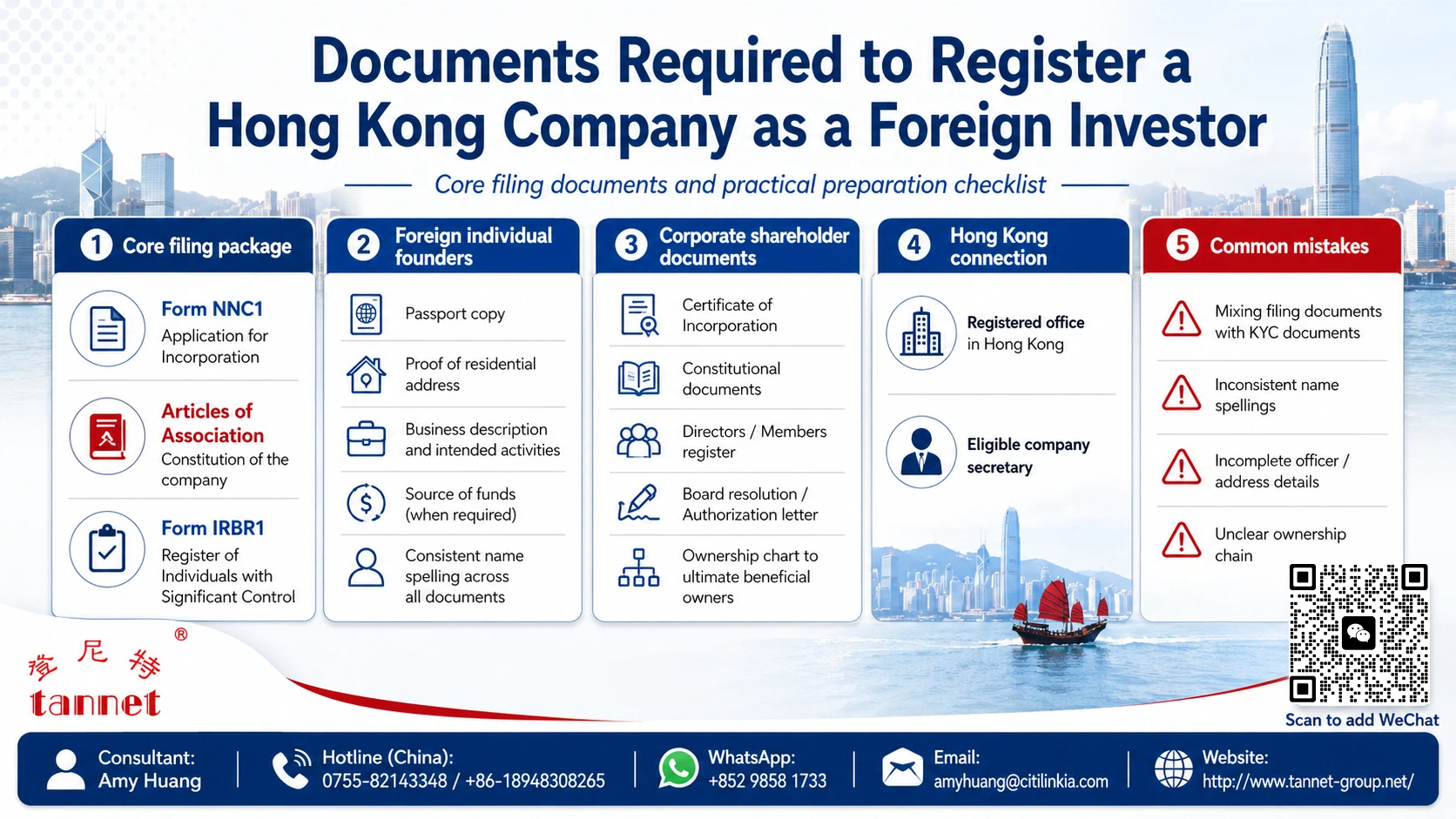
A Hong Kong private company limited by shares is normally incorporated with Form NNC1, its Articles of Association and Form IRBR1. Foreign founders also need accurate identity, address, ownership and control information so the filing and related KYC checks can be completed.
Important distinction
Statutory filing documents are not the same as the identification documents requested by a company secretary, bank or licensed service provider.
Core risk
Most delays come from incomplete forms, inconsistent names or addresses, unclear ownership, missing signatures, or an unsuitable company name.
1. What documents are legally filed with the Companies Registry?
For a typical private company limited by shares, the statutory incorporation package contains three core items. These items are filed together with the required government fees.
(1)Form NNC1
Purpose: Creates a company limited by shares.
Key information: Company name, registered office, founder members, directors, company secretary, share capital and business information.
(2)Articles of Association
Purpose: Sets the company’s internal governance rules.
Key information: Share rights, decision-making rules, director powers and member procedures.
(3)Form IRBR1
Purpose: Notifies the Business Registration Office through the one-stop process.
Key information: Business registration particulars and business nature information.
The application must be complete. The first directors, company secretary and Hong Kong registered office cannot be left blank in Form NNC1.
The Companies Registry may request more information when a proposed name, ownership arrangement or filing detail requires review. An application can therefore be legally complete in form but still require clarification.
2. Company information to decide before preparing the forms
The forms should reflect decisions that have already been made. They should not be used to make those decisions for the first time.
(1)Company name: English name, Chinese name, or both. Prepare alternatives.
Purpose: A proposed name is not confirmed until the Registry processes the application.
(2)Registered office: A physical address in Hong Kong for official correspondence.
Purpose: A local company cannot use a registered office outside Hong Kong.
(3)Director: At least one natural-person director.
Purpose: The director may be non-resident, but accurate identification and address particulars are required.
(4)Company secretary: An eligible Hong Kong resident individual or Hong Kong-based corporate secretary.
Purpose: The sole director cannot also act as company secretary.
(5)Founder member and shareholders: Initial subscribers, number of shares and ownership percentages.
Purpose:The ownership record must match the capital and control explanation.
(6)Share capital: Currency, number of shares and amount paid or unpaid.
Purpose: Hong Kong does not impose a general minimum paid-up capital requirement.
(7)Business nature: A concise description and the relevant business-nature code.
Purpose: The description should be consistent with later banking and accounting records.
3. Identification documents for foreign individual founders
A foreign director who does not hold a Hong Kong Identity Card can be identified by passport number and the passport’s issuing country or region. The same principle supports electronic user-account verification.
A licensed service provider will usually request more than the public filing form. This is because the provider must verify the client and understand the ownership and business purpose.
- A clear, valid passport copy for each individual founder, director, shareholder and ultimate controller.
- Residential-address evidence, commonly a recent utility bill, bank statement or official correspondence.
- Date of birth, nationality, occupation and contact information where required for verification.
- A short explanation of the intended business, customers, suppliers, countries and expected transactions.
- Source-of-funds or source-of-wealth information when the risk profile requires it.
These materials should be readable and consistent. A passport name, proof-of-address name and proposed company record should use the same transliteration and sequence wherever possible.
4. Documents for a corporate shareholder
A corporate founder creates an additional ownership layer. The filing and KYC package must show that the entity exists, who can act for it and who ultimately controls it.
- Certificate of incorporation or equivalent registration evidence for the corporate shareholder.
- Constitution, articles, bylaws or another document defining the entity’s governance.
- Current register of directors and register of members, or official equivalents.
- Board resolution or authorisation identifying the natural person who may sign and act.
- Ownership chart tracing the Hong Kong company to the ultimate beneficial owners.
- Identity and address records for directors, authorised signers and ultimate controllers.
- Certified translation where the original document is not in Chinese or English and the recipient requires one.
Do not submit an ownership chart that stops at another company. Banks, company service providers and compliance reviewers normally need to identify the natural persons who ultimately own or control the structure.
5. Registered office and company secretary evidence
The registered office must be in Hong Kong. It should be an address where government correspondence can be received, escalated and retained.
The company secretary must also meet Hong Kong eligibility rules. An individual secretary must ordinarily reside in Hong Kong. A corporate secretary must have its registered or principal office in Hong Kong.
The incorporation form records the particulars. The service agreement should separately state who receives mail, files statutory forms, maintains registers and reports urgent notices.
6. Electronic signing and portal documents
A person using the electronic incorporation service must follow the Companies Registry’s user-account and e-Filing rules. A natural-person founder who signs electronically must be an Individual User subscribed to e-Filing Services.
A corporate founder signs through an authorised natural person. Account association may be required when the signatory’s relationship with the corporate founder is not already recorded.
For a person without a Hong Kong Identity Card, a passport is an accepted identification document for user registration. Supporting documents may be submitted electronically or presented for checking under the portal rules.
7. A practical document-preparation sequence
- Define the company’s purpose, ownership, director, signing authority and share structure.
- Check the proposed company name and prepare at least two acceptable alternatives.
- Confirm the Hong Kong registered office and eligible company secretary.
- Collect passport and residential-address records for all relevant individuals.
- Collect corporate records and prepare an ultimate-ownership chart where a company will hold shares.
- Draft Form NNC1, the Articles of Association and Form IRBR1 using consistent particulars.
- Review every name, address, passport number, share figure and signature before submission.
- Save the signed filing package and all approval evidence in the company’s permanent records.
8. Document control checklist
| Control |
Minimum standard |
Failure risk |
| Names |
Match passport spelling and order. |
Identity mismatch or KYC delay. |
| Addresses |
Use complete, consistent and structured addresses. |
Returned filing or verification questions. |
| Dates |
Use the correct format and confirm document validity. |
System validation failure. |
| Ownership |
Shares, percentages and control chart must agree. |
Beneficial-ownership concerns. |
| Signatures |
Correct person signs in the correct capacity. |
Invalid or rejected filing. |
| Translations |
Complete and certified when required by the recipient. |
Document cannot be relied upon. |
| File quality |
Full pages, readable scans and no cropped details. |
Repeated document requests. |
9. How the documents support later compliance
The incorporation documents become the starting point for later corporate records. The registered office, officers, shareholders and capital must remain consistent with the company’s statutory registers.
A change after incorporation may require a separate statutory filing. The annual return does not replace a form that should have been filed when the change occurred.
Bank onboarding
Banks do not approve an account only because the company has been incorporated. They compare the filed ownership information with the KYC package, contracts, website and expected transaction profile.
A mismatch can be small but material. For example, the filing may describe consulting while the bank pack describes product trading. Resolve these differences before the application is submitted.
Accounting and audit
The share capital, shareholder funding and director expenses must be recorded correctly from the first transaction. Retain payment evidence for capital contributions and shareholder loans.
The company should create document folders for sales, purchases, banking, contracts, corporate records, payroll and tax. The filing package belongs in the permanent corporate-records folder.
Significant Controllers Register
The ownership analysis used during incorporation can support the Significant Controllers Register. It should identify both direct and indirect control, not only the registered shareholder.
A complex structure should be reviewed whenever shares, voting rights or control arrangements change. The ownership chart should not be treated as a one-time incorporation document.
Tax and home-country reporting
The Hong Kong filing does not determine the founder’s tax position in another jurisdiction. Foreign owners may have controlled-company, foreign-asset or information-reporting duties where they reside.
Keep the incorporation and ownership records available for home-country advisers. Do not wait until a tax deadline to reconstruct the structure.
10. Data privacy and document security
Passport copies and ownership records are sensitive. Send them only through an agreed secure channel and confirm who can access, retain and delete them.
A provider should explain its privacy process and the legal basis for collecting the information. The founder should also keep an independent copy of every final document.
- Avoid sending unencrypted identity files through public group chats.
- Use clear filenames that identify the person, document type and issue date.
- Do not add unnecessary personal information to public filing documents.
- Record which provider or institution received each certified copy.
- Remove access promptly when an adviser or employee no longer needs the files.
11. Common mistakes
Mistake 1: Treating a service-provider checklist as the statutory filing list
The Registry’s core filing package has three items. A provider may request passports, address evidence and business information for verification. Both lists matter, but they serve different purposes.
Mistake 2: Using different spellings for the same person
A shortened name on one document and a full legal name on another can trigger questions. Use the passport version unless a clear legal explanation supports the difference.
Mistake 3: Leaving first-officer or address fields incomplete
The first directors, company secretary and registered office must be stated. An incomplete incorporation form can be rejected.
Mistake 4: Assuming a proposed name is already approved
A search result is only preliminary. Registrability is confirmed after the Registry processes the incorporation application.
Mistake 5: Using a complex shareholder chain without a control explanation
Each additional entity increases verification work. Prepare a full chart and explain the business reason for the structure.
Mistake 6: Using old proof of address or cropped scans
A document may be genuine but unusable. The full name, residential address, issuer and date should be visible.
Mistake 7: Copying a broad business description without operational detail
“Trading and consulting” does not explain customers, products, service delivery or payment flows. Build a short business map before filing.
Mistake 8: Ignoring director consent timing
A first director who does not sign the consent in the incorporation form may need to deliver Form NNC3 within 15 days after incorporation.
Mistake 9: Failing to retain the final signed versions
Keep the exact forms, Articles, certificates and approvals used. These records are needed for banking, audit, tax and future corporate changes.
12. FAQ
Q1: What are the three statutory incorporation documents?
For a company limited by shares, they are Form NNC1, the Articles of Association and Form IRBR1.
Q2: Does a foreign director need a Hong Kong Identity Card?
No. When a director has no HKID, the incorporation information can use passport number and issuing country or region.
Q3: Is proof of address filed as one of the three core documents?
Not as a separate core filing item. However, a service provider or portal verification process may require address evidence to verify the person and prepare accurate particulars.
Q4: Can a corporate entity own the Hong Kong company?
Yes. The corporate records, authorised signatory and ultimate beneficial owners should be documented clearly.
Q5: Must the registered office be in Hong Kong?
Yes. A local limited company’s registered office cannot be outside Hong Kong.
Q6: Can the sole director also be the company secretary?
No. A private company’s sole director cannot also serve as its company secretary.
Q7: Is there a statutory minimum paid-up capital?
No general minimum paid-up capital is required under the Companies Ordinance. The stated capital should still be commercially sensible and accurately recorded.
Q8: Do all first directors have to sign the incorporation form?
Not always. The applicable consent rules depend on who signs the incorporation form. Form NNC3 may be required within 15 days after incorporation for another first director.
Q9: Do foreign-language documents need translation?
The filing and verification recipient may require a Chinese or English translation. Confirm the required certification standard before arranging it.
Q10: What is the best way to reduce document delays?
Use one controlled data sheet. Match every name, address, ownership figure and signature across the complete package before submission.
Conclusion
The legal filing package is short. The underlying document-control work is not.
Foreign investors should separate statutory forms from KYC materials, keep ownership transparent and use consistent identity data. That approach reduces filing, banking and compliance friction after incorporation.
————————————————Simplifying Business, Empowering Entrepreneurs—————————————————