————————————————Simplifying Business, Empowering Entrepreneurs————————————————
Direct answer
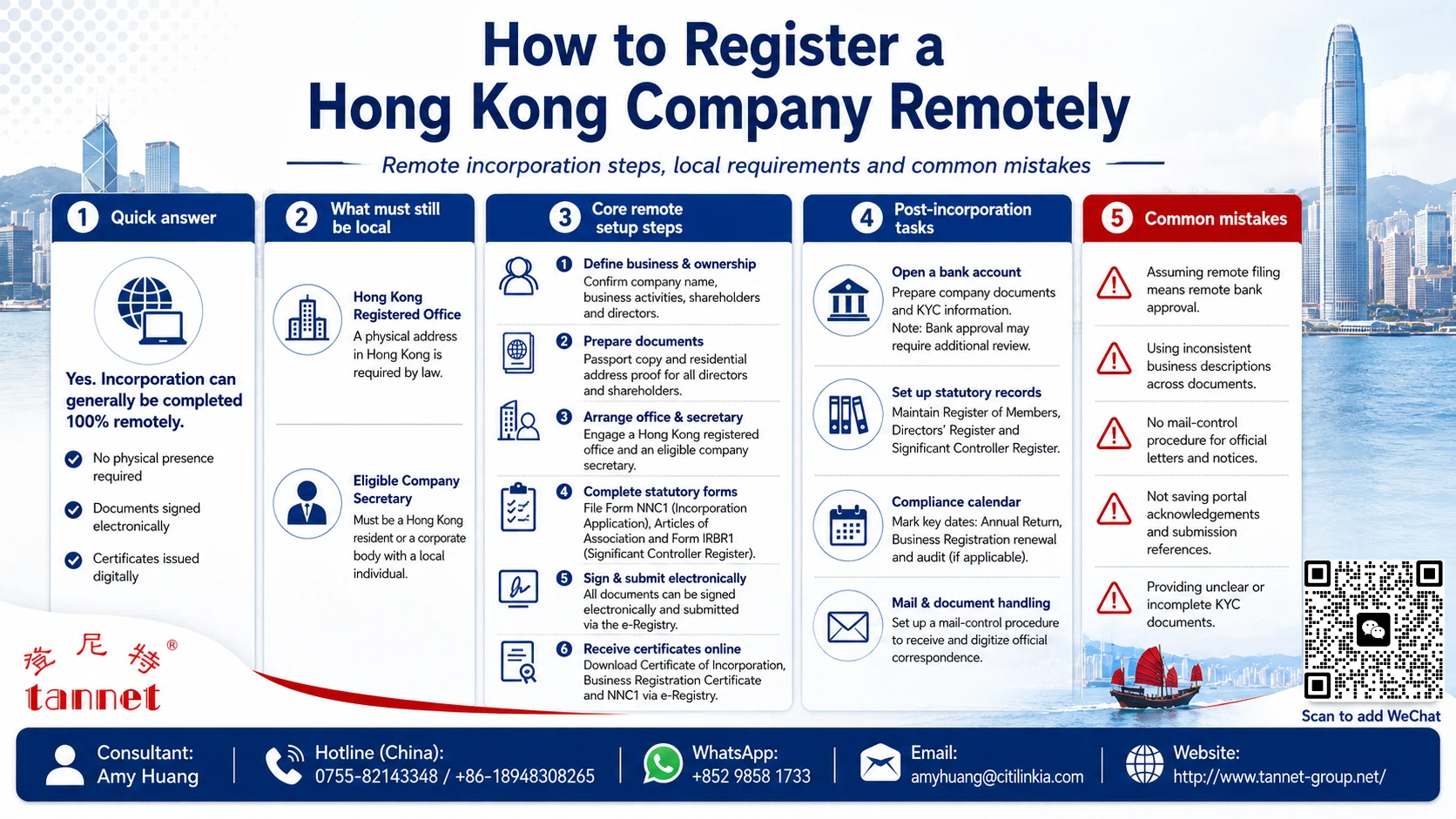
A foreign founder can generally complete the Hong Kong incorporation filing remotely. The Companies Registry provides a 24-hour electronic incorporation service, and a non-HKID holder can use passport information under the e-Services rules.
Local requirements remain
The company still needs a Hong Kong registered office and an eligible company secretary.
Not included
Remote incorporation does not guarantee remote bank onboarding, licensing approval or immigration status.
1. What “remote incorporation” means
Remote incorporation means that the founder does not normally need to travel to Hong Kong merely to submit the incorporation application. The filing can be prepared, signed and delivered through the Companies Registry’s e-Services Portal.
It does not mean that every later business step is automatically remote. Banks, payment providers, landlords, licensing authorities and counterparties apply their own verification rules.
2. Confirm that a Hong Kong company fits the business
A remote process is useful only when the entity has a defined role. The founder should first state what the company will sell, where activities will occur and how money will move.
- Customers, suppliers and main operating countries.
- Products or services and who performs the work.
- Contracting entity and invoicing flow.
- Currencies, payment channels and expected transaction values.
- Owners, directors and authorised signers.
- Need for employees, premises, licences or intellectual-property ownership.
This business map should be consistent with the incorporation form, website, contracts, bank application and accounting system.
3. Choose the company structure
Most foreign founders use a private company limited by shares. It is a separate legal entity and can have one or more individual or corporate shareholders.
A private company must have at least one natural-person director. The director does not have to be resident in Hong Kong.
The company must appoint a company secretary. An individual secretary must ordinarily reside in Hong Kong. A corporate secretary must have a registered or principal office in Hong Kong.
4. Arrange the Hong Kong connection
Two local elements must be ready before filing: the registered office and the company secretary. They are recorded in Form NNC1.
The registered office should have a clear mail process. The company should know who opens government correspondence, who assesses urgency and who confirms that action was completed.
The secretary’s scope should also be written. Incorporation, annual returns, statutory registers, ownership updates and change filings are separate tasks.
5. Prepare identity and ownership records
A foreign founder should prepare a valid passport and reliable residential-address evidence. Corporate shareholders require current entity and ownership records.
| (1)Individual founder:
Typical preparation: Passport, address evidence, contact details and business description.
Remote-control point: Use the same legal name and address format throughout. |
| (2)Corporate founder:
Typical preparation: Incorporation record, constitution, registers, authorisation and ownership chart.
Remote-control point: Identify the natural persons who ultimately own or control the structure. |
| (3)Multiple founders:
Typical preparation: Identity records plus shareholder and decision terms.
Remote-control point: Agree voting, funding, board and exit rules before filing. |
6. Register for electronic filing or use an authorised presenter
A founder member who signs the electronic incorporation form must follow the portal’s Individual User and e-Filing subscription requirements. A corporate founder uses an authorised natural person.
A non-HKID holder can use a passport for individual-user identification. Account association may be needed where the system does not already recognise the signatory’s connection with the corporate founder.
An overseas founder may also engage an eligible Hong Kong service provider to coordinate the application. The founder should still review every filed particular and retain the final signed package.
7. Complete the electronic incorporation package
The electronic filing includes the incorporation form, Articles of Association and IRBR1 information. Company incorporation and business registration are processed through a one-stop service.
- Check the proposed company name and prepare alternatives.
- Enter the registered office, company secretary, directors and founder members.
- State the share capital, initial shareholdings and business information.
- Adopt suitable Articles of Association or prepare customised articles when needed.
- Review the complete form and attached information before signing.
- Apply the required electronic signatures in the correct capacity.
- Pay the incorporation and business-registration amounts through the portal.
- Monitor the portal message box and registered email address for the result.
8. Download and control the electronic certificates
For a straightforward private company limited by shares, electronic certificates are normally issued as PDF files after successful processing. The Certificate of Incorporation and Business Registration Certificate are issued together.
Electronic certificates remain in the e-Services system for a limited period. Download them promptly and store them in a controlled company-records folder.
9. Complete the post-incorporation setup
The company exists when it is incorporated. It is not yet an operating system.
(1)Corporate records: Create registers, resolutions and share records.
Evidence to retain: Signed resolutions, registers and share documentation.
(2)Significant controllers: Identify controllers and arrange the register and designated representative.
Evidence to retain: Ownership analysis and completed SCR records.
(3)Accounting: Set a financial year-end, chart of accounts and monthly close date.
Evidence to retain: Accounting policy and document folders.
(4)Banking: Prepare ownership, business, source-of-funds and transaction evidence.
Evidence to retain: KYC pack and application record.
(5)Tax and audit: Record correspondence and establish responsibility for returns and audit.
Evidence to retain: Calendar, notices and adviser scope.
(6)Licensing: Check whether the planned activity requires separate approval.
Evidence to retain: Licence analysis and applications.
10. What may still require extra verification?
A remote incorporation filing does not override third-party rules. A bank may request a video meeting, original documents, certified copies or an in-person visit.
A regulated activity may require a licence, responsible officers, local premises or evidence of operational capability. Immigration permission is also separate from company ownership.
Treat each workstream as its own approval process. Do not describe the company as “fully set up” when only the incorporation certificate has been issued.
11. Remote incorporation versus remote operation
Incorporation is a legal event. Operation is a continuing set of commercial, accounting and compliance activities.
A company can be incorporated remotely and still need local action later. Examples include signing a lease, meeting a bank, storing regulated records or appointing a local responsible person.
Must the founder visit to file?
Remote incorporation answer: Usually no for a straightforward electronic filing.
Operational answer: A later bank, licence or counterparty may request a visit.
Is a local employee required?
Remote incorporation answer: No general employee requirement for incorporation.
Operational answer: The business model or licence may require local staff.
Does the certificate prove substance?
Remote incorporation answer: It proves legal incorporation.
Operational answer: Substance depends on real activities, people, premises, decisions and records.
Can all records stay overseas?
Remote incorporation answer: Electronic copies may be managed remotely.
Operational answer: Certain statutory records must be kept at an approved Hong Kong location or made available as required.
12. First 30 days after remote incorporation
- Download and archive the Certificate of Incorporation, Business Registration Certificate, signed forms and payment receipts.
- Complete the initial board and member resolutions and create the statutory registers.
- Issue share records and document the payment or outstanding status of the initial capital.
- Establish the Significant Controllers Register and designated-representative arrangement.
- Confirm the financial year-end, accounting owner and monthly document deadline.
- Prepare the bank or payment-account application using the same ownership and business description.
- Create a compliance calendar for annual returns, business registration, accounting, audit, tax and event-driven changes.
- Check licences, employment duties, data privacy and home-country reporting before trading begins.
13. Evidence pack for remote management
A remote company should be easy to explain without relying on the founder’s physical presence. The evidence pack should show who made decisions and why transactions occurred.
- Board and shareholder resolutions with clear dates and authority.
- Contracts, proposals, purchase orders and service-delivery records.
- Invoices, payment confirmations and bank or payment-account statements.
- Ownership chart, source-of-funds explanation and capital records.
- Monthly accounting reconciliations and supporting document folders.
- Government correspondence, filed forms and proof of completion.
14. Selecting a remote service provider
A provider may coordinate the registered office, company secretary, identity review and filing. The founder should assess the service as an ongoing compliance relationship, not only a document-submission transaction.
- Confirm the provider’s legal entity, Hong Kong address and licensing position where applicable.
- Request a written list of included and excluded services for the first year and renewal years.
- Ask who will be the named account manager and how urgent government mail is escalated.
- Confirm who owns the digital and physical company records and how they are transferred when the engagement ends.
- Review charges for annual returns, routine changes, certified copies and termination.
The founder remains responsible for understanding the filed information. Do not sign a blank or incomplete form and do not rely on a provider to invent the company’s business purpose.
15. Common mistakes
Mistake 1: Starting the portal form before the structure is decided
The filing should record completed decisions. It should not be used to improvise ownership, authority or business purpose.
Mistake 2: Assuming “online” means no identity verification
Electronic filing still requires reliable identity information, correct signing authority and portal-account compliance.
Mistake 3: Using a registered office without a mail-control procedure
An address alone is not enough. Missed government notices can create deadlines, penalties and banking problems.
Mistake 4: Appointing a company secretary without defining scope
The secretary may not provide bookkeeping, audit, tax or bank support. Confirm each responsibility in writing.
Mistake 5: Promising that the bank account will also be remote
Bank onboarding is a separate commercial and compliance decision. Requirements differ by institution and risk profile.
Mistake 6: Using inconsistent business descriptions
The incorporation form, website, contracts and bank application should describe the same business model.
Mistake 7: Failing to save the portal records
Download certificates, signed forms, receipts and submission evidence. Portal availability is not a permanent records strategy.
Mistake 8: Ignoring home-country obligations
A Hong Kong company can create reporting, controlled-company, tax or foreign-asset obligations where the owner lives. Obtain advice in the relevant jurisdiction.
16. FAQ
Q1: Can a foreigner register a Hong Kong company without visiting Hong Kong?
The incorporation filing can generally be completed electronically without a visit, subject to signing, identity verification and local office and secretary arrangements.
Q2: Is the electronic service available outside business hours?
Yes. The Companies Registry states that the e-incorporation service is available on a 24-hour basis, including general holidays.
Q3: Can a person without an HKID use the e-Services Portal?
A non-HKID holder can use a passport as an identification document under the user-registration rules.
Q4: Does the company need a Hong Kong-resident director?
No. The Companies Ordinance does not require a director of a private company to be a Hong Kong resident.
Q5: What must be local?
The company must maintain a registered office in Hong Kong and an eligible company secretary connected to Hong Kong.
Q6: Can a corporate shareholder sign remotely?
An authorised natural person signs for the corporate founder under the portal rules. Account association may be required.
Q7: Are incorporation and business registration separate applications?
They are handled through a one-stop process. The applicant submits the IRBR1 information and pays the applicable business-registration amount with the incorporation application.
Q8: Does remote incorporation include a bank account?
No. Bank onboarding has separate KYC, commercial-evidence and meeting requirements.
Q9: Can a remote company hire staff later?
Yes. Employment, payroll, tax reporting and MPF obligations begin when the company hires eligible staff.
Q10: What should be done immediately after incorporation?
Save the certificates, establish statutory and accounting records, prepare the compliance calendar and begin banking or licensing work where needed.
Conclusion
Hong Kong provides a practical electronic incorporation route for overseas founders. The online form is only one part of the setup.
Remote management works when local administration, identity records, ownership, banking evidence and post-incorporation duties are designed before filing.
————————————————Simplifying Business, Empowering Entrepreneurs————————————————