————————————————Simplifying Business, Empowering Entrepreneurs————————————————
Direct answer
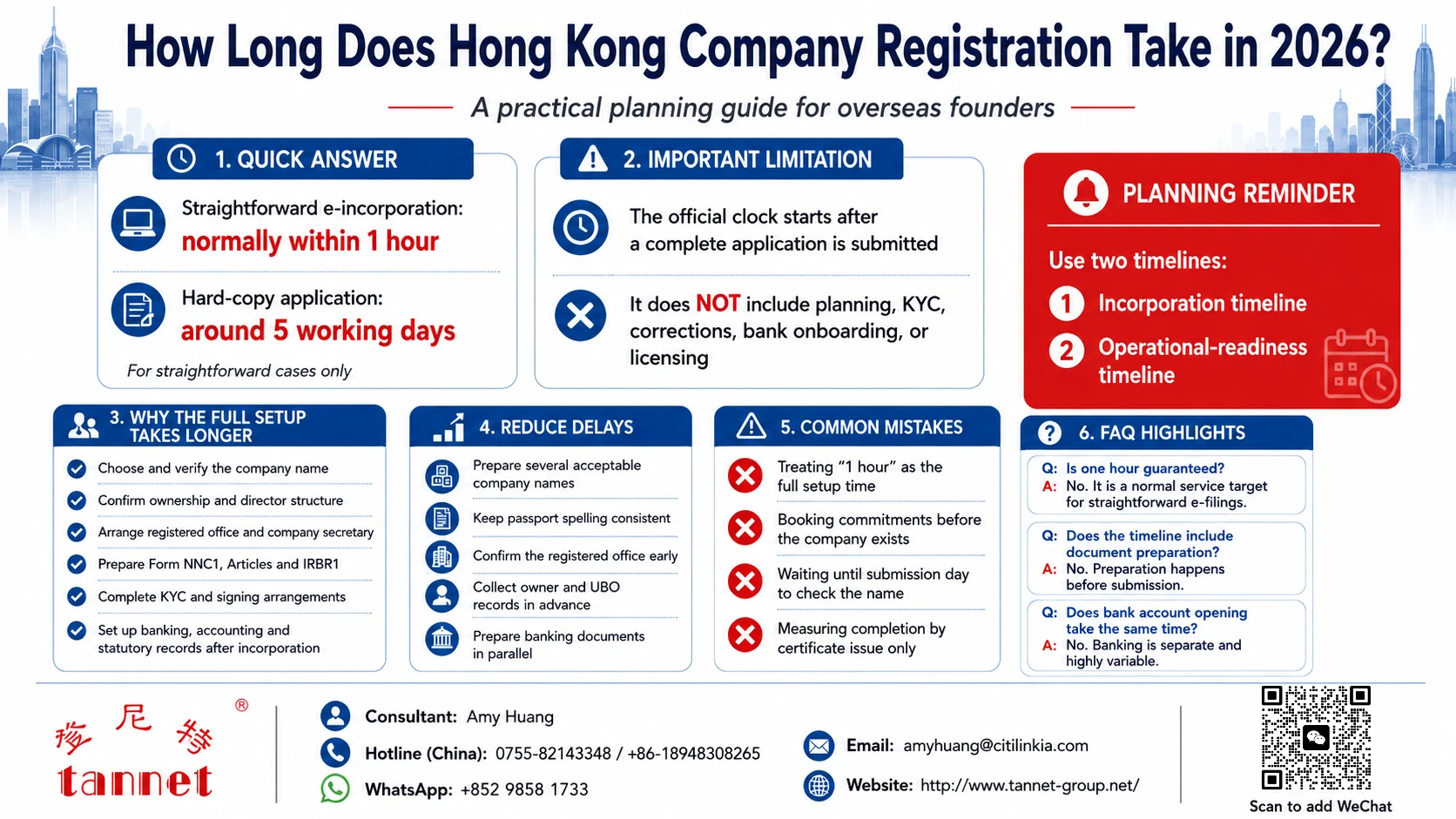
For a straightforward private company limited by shares, the Companies Registry states that electronic incorporation can normally be completed within one hour. Its 2026 service standard for a hard-copy application is five working days.
Important limitation
Those figures measure government processing after a complete application is submitted. They do not include planning, document collection, KYC, corrections, delivery, bank onboarding or licensing.
Best planning rule
Use two timelines: the incorporation timeline and the operational-readiness timeline.
1. Government processing time
The official processing target depends on the filing method and whether the case is straightforward.
Official timing: Normally within 1 hour for a straightforward private company limited by shares.
Conditions: The name must not require further review, and the form must pass system validation.
Official timing: 2026 service standard: 5 working days.
Conditions: The standard excludes the delivery day and does not apply when amendments or extra information are required.
- Public company or company limited by guarantee
Official timing: Additional staff processing is required.
Conditions: Do not assume the one-hour private-company timing.
The electronic Certificate of Incorporation and Business Registration Certificate are normally issued together after successful e-incorporation. The applicant receives a notification to download the PDF certificates.
2. Why the full setup takes longer than one hour
The official target starts after a valid application reaches the Registry. A founder must complete several tasks before that point.
- Define the business purpose, ownership and director structure.
- Select and check a company name.
- Arrange a Hong Kong registered office and company secretary.
- Collect identity, address and corporate-owner records.
- Prepare and review Form NNC1, the Articles and IRBR1.
- Complete KYC and signing arrangements with the presenter or service provider.
After incorporation, banking, accounting, statutory records, licensing and contract setup remain separate. These tasks can take days or months depending on the business.
3. A realistic planning timeline
- Business and structure design
Timeline: 1–3 working days
Main variables: Number of founders, ownership complexity, regulated activity and home-country advice.
- Identity and corporate-document collection
Timeline: 1–5 working days
Main variables: Document availability, translations, certification and corporate shareholder records.
- Name and filing preparation
Timeline: 1–2 working days
Main variables: Name risk, customised Articles and accuracy of particulars.
Timeline: About 1 hour in a straightforward case
Main variables: System validation, acceptable name and complete data.
- Government hard-copy processing
Timeline: 5 working days service standard
Main variables: Delivery time, amendments and additional-information requests.
- Corporate records and accounting setup
Timeline: 1–5 working days
Main variables: Provider workflow, resolutions, registers and accounting design.
- Bank or payment-account onboarding
Timeline: Variable; often materially longer
Main variables: Business evidence, owners, countries, source of funds and institution requirements.
The ranges above are project-planning estimates except where the table identifies an official service standard. A complex or regulated business should allow more time.
4. What starts the official clock?
The electronic service standard is measured from e-submission. The hard-copy standard excludes the day on which the documents are delivered.
The service standard does not apply when the documents require amendment, additional information or further consideration. A fast submission is therefore less important than a correct submission.
5. Factors that delay incorporation
Company-name review
A name search is not final approval. The Registry may reject a name that is identical, restricted, misleading or otherwise unacceptable.
Incomplete particulars
The first directors, company secretary and registered office must be stated. Missing fields can make the form unsatisfactory.
Inconsistent identity information
Different spellings, address formats or passport details create verification questions and correction work.
Corporate shareholders
A company owner adds entity records, signing authority and ultimate-beneficial-owner analysis. Missing layers delay KYC and drafting.
Customised Articles
Special share rights, investor protections or board rules require legal review. This should occur before the filing date.
Translations and certification
Foreign-language or corporate documents may need translation or certification for a provider, bank or other recipient.
Signature and portal-account issues
The correct person must sign in the correct capacity. User registration and account association should not be left until submission day.
6. What happens after approval?
Approval creates the company and provides the core certificates. It does not finish the business setup.
| After-incorporation task |
Why it matters |
Timing approach |
| Download certificates and receipts |
Electronic documents should be saved outside the portal. |
Immediately after notification. |
| Complete statutory records |
Registers, resolutions and ownership records support governance. |
Immediately after incorporation. |
| Create the compliance calendar |
Annual and event-driven duties follow different dates. |
On incorporation day. |
| Start accounting records |
Records should begin with the first transaction. |
Before or at first activity. |
| Apply for banking or payments |
The company needs a practical transaction channel. |
Prepare before filing; apply after incorporation. |
| Check licences |
Some activities cannot begin without separate approval. |
Before regulated activity starts. |
7. How to reduce the total timeline
- Prepare a one-page structure and business map before collecting documents.
- Use the passport spelling as the master name for foreign individuals.
- Collect corporate-owner and beneficial-owner records at the start.
- Prepare several acceptable company names.
- Confirm the registered office and secretary before drafting Form NNC1.
- Complete portal user registration and signing authority early.
- Review the filing package using a second-person check.
- Prepare banking evidence in parallel with the incorporation work.
Parallel preparation is useful only when information is consistent. A bank pack and incorporation form should not describe different businesses or ownership structures.
8. Four scenarios and their likely timelines
Scenario A: One foreign individual founder
The founder uses a simple share structure, standard Articles and complete passport and address records. Preparation may take one or two working days, followed by the electronic filing.
The company may be incorporated quickly, but the bank or payment account remains a separate project.
Scenario B: Two or more founders
The filing can still be straightforward. More time is needed to agree share percentages, director authority, signing rules, funding and exit arrangements.
A founders’ or shareholders’ agreement is not the same as the Articles. It may require separate legal drafting.
Scenario C: Corporate shareholder
Preparation usually takes longer because the file must include entity records, authority and ultimate beneficial ownership. Foreign-language documents may also need translation.
Portal account association and corporate signing arrangements should be confirmed early.
Scenario D: Regulated or operationally complex business
Incorporation may still be fast, but launch timing depends on licensing, premises, staff, product approvals or compliance systems.
The incorporation date should not be presented as the date on which the regulated business can begin.
9. Timeline questions to ask a service provider
- When does your quoted timeline begin: payment, KYC approval, signed documents or government submission?
- Does the timeline include name checking and alternative-name preparation?
- Does it include the company secretary, registered office and document verification?
- Is the quoted period for certificate issue or for delivery of a complete company-records pack?
- What happens if the Registry requests an amendment or additional information?
- Are bank onboarding, accounting setup and licence analysis excluded?
- Which delays are within the provider’s control and which depend on government or third parties?
10. Internal launch milestones
| Milestone |
Completion test |
Do not confuse with |
| Structure approved |
Owners, directors, shares and authority are documented. |
Company incorporation. |
| Filing ready |
Forms, Articles, identity checks and signatures are complete. |
Government approval. |
| Incorporated |
Certificates have been issued. |
Banking or licence approval. |
| Financially ready |
Required bank or payment channels are active. |
Tax compliance. |
| Operationally ready |
Contracts, accounting, licences and controls are in place. |
Long-term compliance completion. |
A project dashboard should show these milestones separately. That prevents teams from assuming that a certificate resolves every dependency.
11. Contingency planning
Set a target date and a fallback date. Avoid scheduling customer collections, payroll or a regulated launch on the assumption that every approval will arrive at the fastest published time.
Keep alternative company names, replacement signatories and missing-document escalation contacts ready. Record the reason for every change to the filing package.
12. How to communicate the timeline internally
Use a dated project tracker rather than a single “company ready” status. Each dependency should show the responsible person, target date and evidence required for completion.
| Tracker field |
Example |
Purpose |
| Submission readiness |
Passports verified; Articles approved; signatures complete. |
Shows whether the application can be filed. |
| Registry status |
Submitted; clarification requested; approved. |
Separates government processing from preparation. |
| Banking status |
KYC pack ready; application submitted; meeting pending. |
Prevents the certificate date from being treated as payment readiness. |
| Operational status |
Accounting active; contracts approved; licence cleared. |
Shows whether business can begin responsibly. |
Record the actual completion date as well as the target date. The difference helps improve future incorporation estimates.
13. When to use hard-copy filing
Electronic filing is normally faster for a straightforward private company. A hard-copy route may still be used when the parties or advisers prefer wet signatures or when a specific document arrangement is better handled outside the web form.
The filing method should be chosen early. Switching routes late can require new signatures, payment arrangements and document checks.
14. Example: calculating a safe launch date
Assume the founders need two working days to finalise documents and the company qualifies for straightforward electronic processing. The legal incorporation may be completed on the submission day, but that is not a safe customer launch date.
Add time for statutory records, accounting setup, contract approval and the required payment channel. If a bank account is essential, the launch date should depend on bank approval rather than certificate issue.
A conservative plan communicates the earliest possible date, the expected date and the fallback date. This avoids using an official service target as a commercial promise.
15. Common mistakes
Mistake 1: Advertising the one-hour target as the full setup time
The one-hour figure relates to straightforward government e-processing. It does not include document preparation or operational setup.
Mistake 2: Booking commercial commitments before the company exists
Do not promise an invoice date, bank transfer or regulated launch based only on an optimistic filing estimate.
Mistake 3: Waiting until submission day to check the name
Prepare alternatives. A name that requires review can remove the application from the straightforward route.
Mistake 4: Treating paper and electronic timing as identical
The official service standards differ. Delivery and courier time can also extend a hard-copy project.
Mistake 5: Ignoring corporate-shareholder KYC
A corporate owner can be legally acceptable but operationally slower when records or beneficial ownership are unclear.
Mistake 6: Measuring completion by certificate issue only
A company may be incorporated but unable to receive payments, sign a lease or start a regulated activity.
Mistake 7: Failing to distinguish official targets from provider timelines
A provider’s timeline may include document review, KYC, internal approval and delivery. Ask what each quoted time begins and ends with.
Mistake 8: Reconstructing information after a rejection
Maintain a controlled data sheet and review it before filing. Prevention is faster than correcting multiple versions.
16. FAQ
Q1: Can a Hong Kong private company really be incorporated in one hour?
Yes, in a straightforward electronic case where the name needs no further review and the form passes system validation.
Q2: Is one hour guaranteed?
No. It is a normal processing time and service target for qualifying straightforward cases, not an absolute guarantee.
Q3: How long does a hard-copy application take?
The Companies Registry’s 2026 service standard is four working days for a local company limited by shares, subject to the stated conditions.
Q4: Does the timing include document preparation?
No. Identity collection, KYC, drafting, translations, certification and signatures occur before submission.
Q5: Are the Business Registration Certificate and Certificate of Incorporation issued together?
Yes. Under the one-stop service, they are normally issued together after successful incorporation.
Q6: Does the company have to wait for a physical certificate?
An e-incorporation applicant normally receives electronic PDF certificates through the e-Services process.
Q7: Can a complex ownership structure still be filed electronically?
It may be possible, but document preparation, account association and KYC can increase the total project time.
Q8: How long does bank account opening take?
It is separate and highly variable. The timing depends on the institution, owners, business model, countries, source of funds and evidence.
Q9: What is the safest date to tell a customer the company will be ready?
Use a range that includes document preparation, government processing and the operational step the customer actually needs, such as banking or licensing.
Q10: What is the fastest way to avoid delays?
Submit a complete, consistent application with an acceptable name and verified signing arrangements.
Conclusion
Hong Kong incorporation can be fast. A straightforward electronic application may be processed within one hour.
A responsible project plan separates that official processing time from document preparation and operational readiness. The company is useful only when its records, banking, accounting and compliance arrangements are also ready.