————————————————Simplifying Business, Empowering Entrepreneurs————————————————
Direct answer
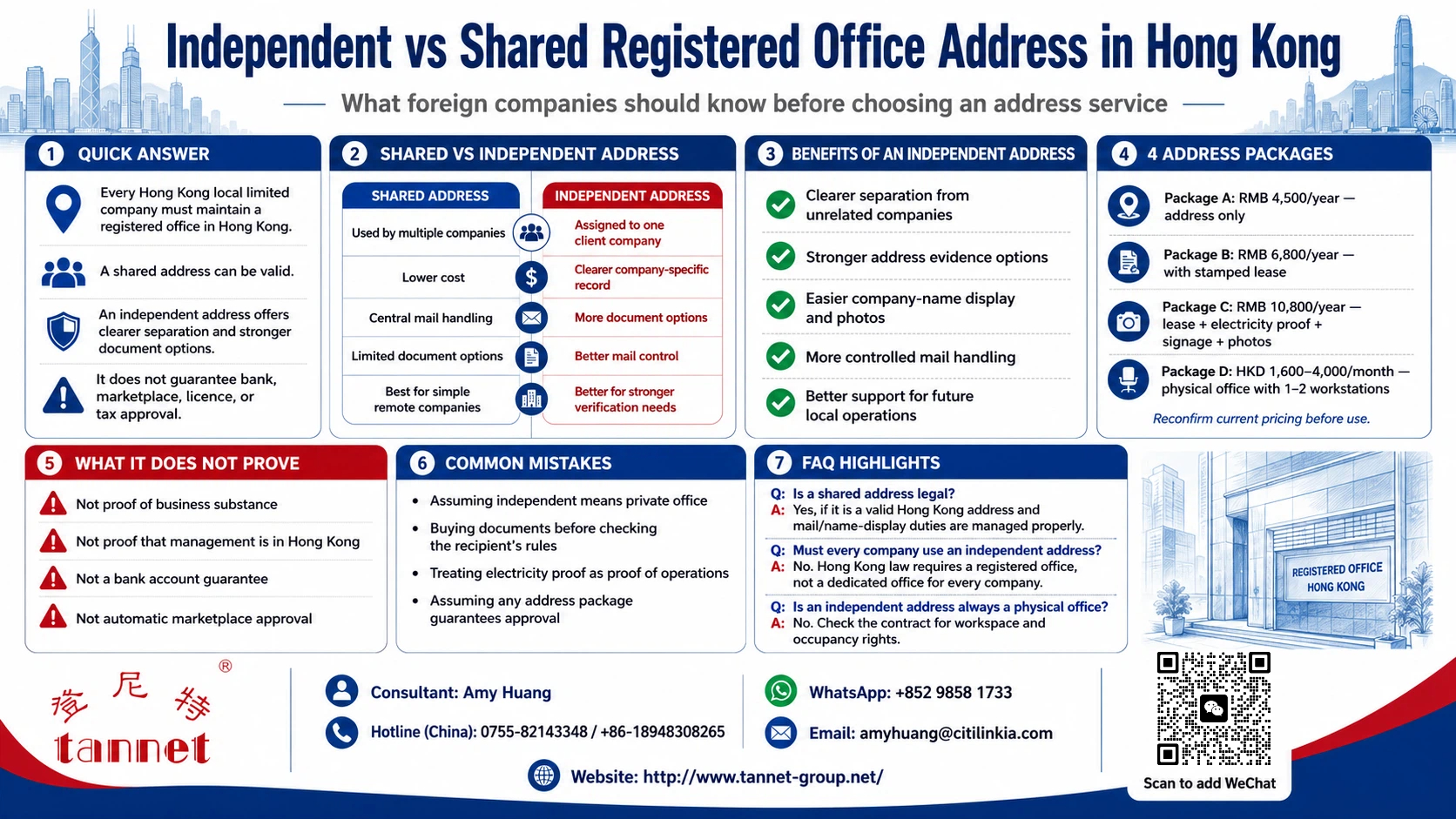
A Hong Kong local limited company must maintain a registered office in Hong Kong. The address can be supplied through a professional provider, and it does not always need to be a private office.
A shared address is normally used by several client companies, often as part of a company-secretarial or virtual-office service. An independent address is allocated to one client company or presented as a separate unit arrangement, subject to the actual service contract.
An independent address can provide clearer separation, stronger address documents, company-name display options and more controlled mail handling. It does not automatically prove business substance or guarantee banking, marketplace, licence or tax approval.
Key facts
- A Hong Kong local limited company must maintain a registered office in Hong Kong.
- A shared address can be valid when the address, mail handling and name display are properly managed.
- An independent address is not a physical office unless the contract grants real workspace or occupancy rights.
- Leases, electricity documents, signage and photographs may support verification, but none guarantees approval.
- Banks may ask for both the registered office and the principal place of business.
1. What is a Hong Kong registered office?
The registered office is the company’s official legal address in Hong Kong. It is stated in the incorporation form and becomes effective from the incorporation date.
Government notices and statutory correspondence may be delivered there. The company therefore needs a reliable method to receive, scan, forward and respond to mail.
The registered office can also be the location of statutory records. For example, the Significant Controllers Register may be kept there or at another permitted place in Hong Kong.
A non-Hong Kong address, a “care of” address or a post-office box should not be used as the registered office. The full Hong Kong address should identify the building, floor, unit and street.
2. What is a shared registered-office address?
A shared address is used as the registered office for multiple companies. It is common in company-secretarial, serviced-office and virtual-office arrangements.
The companies may share the same unit number. They may also use an electronic display system for company names where the location serves more than six companies.
A shared address can be practical for a new or remote company. It usually costs less and can combine the registered office with government-mail handling and company-secretarial support.
The limitation is that the address may be visibly connected with many unrelated companies. The provider may also restrict leases, utility documents, photographs, parcel handling, client visits or use in third-party applications.
3. What is an independent address?
An independent address is arranged for one client company rather than presented as a common secretary address. The exact level of independence depends on the agreement.
Some services provide only a distinct address identifier and mail handling. Others add a stamped tenancy agreement, electricity documentation, company-name signage, photographs or actual workspace.
The term “independent address” should not be treated as a legal category. It is a commercial description. Founders should confirm what is exclusive, what is shared and what evidence the provider can issue.
An independent address is not automatically a private office. A true office arrangement normally includes access rights, workspace, practical occupancy terms and a lease that reflects the real use.
4. Independent address vs shared address: the main differences
- Separation: A shared address is used by many companies. An independent address creates a clearer company-specific record.
- Documents: Shared services may provide only an address agreement. Independent packages may add a stamped lease, electricity evidence, signage or photographs.
- Mail: Shared providers use a central mailroom. Independent arrangements may make identification and escalation easier.
- Physical use: A shared address rarely includes workspace. An independent address may still be address-only unless access rights are stated.
- Review: Banks and marketplaces decide whether the evidence is acceptable.
- Cost and fit: Shared addresses suit simple remote companies. Independent addresses cost more but may support stronger evidence or future local operations.
5. Benefits and advantages of an independent Hong Kong address
An independent address creates clearer separation from unrelated companies. It can give customers and compliance reviewers a simpler address reference.
It may support a stronger document set, including a service agreement, lease, electricity evidence, signage and photographs where included.
Government mail may be easier to identify and escalate. The company can also define how original documents are stored and forwarded.
An independent arrangement can support future growth if the company later needs a workstation, client access or a local operating presence.
The main advantage is control over documents, mail, signage and permitted use. It is not a guarantee of acceptance by any institution.
6. What an independent address does not prove
An independent address does not automatically prove that management decisions occur in Hong Kong. It does not show where services are performed or where profits arise.
It does not create employees, customers, contracts, inventory or operational capacity. Those facts require separate evidence.
It does not guarantee a bank account. Banks conduct their own risk assessment and may review owners, source of funds, countries, expected transactions and commercial activity.
It does not guarantee acceptance by Amazon or another marketplace. Each platform applies its own verification rules and may request different document dates, formats or combinations.
It does not replace a licence, immigration permission or sector-specific premises requirement. A regulated business may need a true operating office and responsible personnel.
Founders should use address documents to describe reality. They should never create a lease, bill or photograph that gives a misleading impression of occupancy.
7. 4 independent address service packages by Tannet
Below are the various Hong Kong address service packages offered by Tannet Group. Clients can choose the most suitable option based on their specific needs.
These packages can be seamlessly integrated with our comprehensive services, including Hong Kong company incorporation, corporate bank account opening, barcode registration, trademark registration, and Mandatory Provident Fund (MPF) setup.
The figures should be reconfirmed before use.
Package A is RMB 4,500 per year for an independent address without a lease or stamp-duty documentation. Its purpose is limited to the address function.
Package B is RMB 6,800 per year and includes a stamped tenancy agreement for a company that needs lease evidence.
Package C is RMB 10,800 per year. It includes a stamped lease, landlord electricity evidence, a company electricity invoice, signage and photographs. Each electricity-bill request has a listed RMB 200 processing charge. This package may be relevant when a platform requests address proof or photographs.
Package D is a physical-office arrangement, with prices starting from HKD 1,600 to HKD 4,000 per month. It includes one or two workstations, lease documents, electricity evidence and signage. It is intended for actual office use.
8. How to choose the right address in seven steps
- Define the business model. Identify the products, services, customers, suppliers, staff, licences and transaction countries.
- Separate legal registration from operational needs. A registered office may satisfy incorporation, while a bank, marketplace or licence may need more evidence.
- Ask the receiving institution what it requires. Confirm whether it needs a lease, utility document, signboard, photograph, workspace or principal-place-of-business evidence.
- Review the exact contract. Check whether the address is exclusive, whether other companies use the same unit and whether client visits are permitted.
- Test the mail process. Ask how quickly government correspondence is scanned, who receives urgent alerts and how original documents are stored.
- Review renewal and exit terms. Confirm notice periods, price changes, forwarding after termination and assistance with Form NR1 if the registered office changes.
- Keep the address story consistent. The Companies Registry record, business registration, bank application, invoices and website should not contradict one another.
9. Address evidence for banking and marketplace reviews
Hong Kong banks do not use one identical account-opening checklist. The Hong Kong Monetary Authority notes that banks set requirements according to their business strategies and risk assessments.
A bank may ask for the registered office and the principal place of business if they differ. It may also request ownership, business, source-of-funds and expected-transaction information.
A stamped lease or electricity invoice can answer an address question. It cannot answer why the company exists, who controls it or how money will move.
Online marketplaces may request recent address evidence, company-name photographs or a document issued in the company’s name. The company should confirm the exact platform rule before purchasing a package.
Document dates and descriptions matter. A provider invoice described as an “address service fee” may be treated differently from a utility bill or lease.
Use the narrowest accurate description. Do not label a mail address as a staffed office when no staff work there.
10. Compliance after the address is selected
The company should keep the address current. A change of registered office is reported to the Companies Registry on Form NR1, generally within 15 days after the change.
If the business address also changes, the Inland Revenue Department must receive the relevant update. A one-stop notification may be available when the new business address is the same as the new registered office.
Update banks, payment providers, contracts, invoices, licences, insurers and the company website where relevant.
Keep the service agreement, lease, address invoices, mail logs, signage evidence and change filings in the permanent company records.
Review the arrangement before renewal. A company that has hired staff, changed its activities or entered a regulated sector may need a different address level.
Common mistakes
Mistake 1: Assuming an independent address is a private office. It may be address-only.
Mistake 2: Buying a lease before confirming the recipient’s document rule.
Mistake 3: Treating an electricity invoice as proof of real operations.
Mistake 4: Using a shared address without checking mail scanning and escalation.
Mistake 5: Describing a mail address as a staffed office.
Mistake 6: Assuming an address package guarantees bank or marketplace approval.
Mistake 7: Using several addresses without explaining their different functions.
Mistake 8: Ignoring company-name display and address-change filings.
FAQ
Q1: Is a shared registered office legal in Hong Kong?
Yes, when it is a valid Hong Kong address and mail and name-display duties are managed properly.
Q2: Must every company have an independent address?
No. The law requires a Hong Kong registered office, not a dedicated office for every company.
Q3: Is an independent address a physical office?
Not necessarily. Review the contract for workspace, access and occupancy rights.
Q4: What is its main advantage?
Clearer separation and stronger options for leases, electricity evidence, signage, photographs and mail control.
Q5: Is a lease required for incorporation?
Not universally. It may be requested by a bank, marketplace, licence authority or counterparty.
Q6: Does an independent address improve bank KYC?
It can clarify address evidence, but it does not replace ownership, source-of-funds and business evidence.
Q7: Can a shared address display the company name?
Yes. Electronic display can be used at locations serving more than six companies if the rules are followed.
Q8: Which package suits marketplace verification?
Confirm the platform’s current rule first. More documents provide options, but acceptance is never automatic.
Conclusion
A shared registered office can be sufficient for a simple Hong Kong company. An independent address becomes useful when the company needs stronger separation, additional documents, signage, photographs or a path toward physical operations.
The decision should be based on function, not appearance. Define the legal purpose, evidence recipient, mail process and operational plan before selecting a package.
An address is one part of a credible company file. Ownership, business activity, banking evidence, accounting records and ongoing compliance still need separate planning.
————————————————Simplifying Business, Empowering Entrepreneurs————————————————