Direct Answer
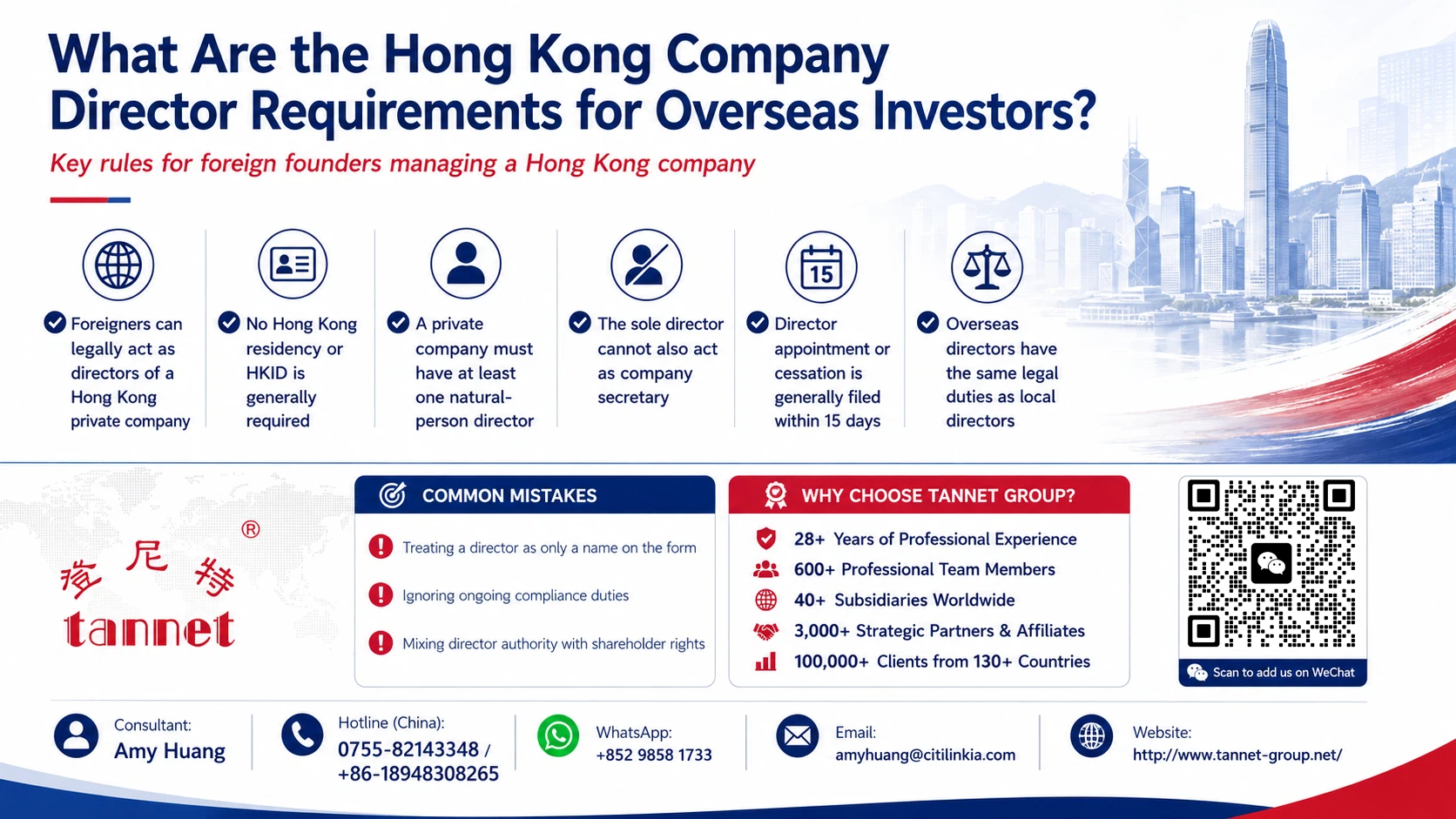
A non-Hong Kong resident can legally serve as a director of a Hong Kong local limited company. Hong Kong residency and a Hong Kong Identity Card are not general director requirements.
A private company must have at least one director who is a natural person. A sole director cannot also act as the company secretary.
Foreign directors have the same legal responsibilities as resident directors. Distance does not reduce the duty to supervise records, filings, financial information and company decisions.
Key Facts
- A Hong Kong private company must have at least one individual director.
- A director does not need to be a Hong Kong resident.
- A foreign director without an HKID can use passport information in the incorporation and verification process.
- The sole director cannot also be the company secretary.
- Certain private companies may appoint a corporate director, but at least one natural-person director remains required.
- A director appointment or cessation is generally reported on Form ND2A within 15 days.
- A change in a director’s registered particulars is generally reported on Form ND2B within 15 days.
- Directors remain responsible even when professional advisers perform administrative work.
1. Who Can Be a Director of a Hong Kong Private Company?
The starting rule is simple. Every local private company must have at least one director who is a natural person.
The Companies Ordinance does not impose a general Hong Kong-residency requirement on that director. An overseas founder may therefore own shares, act as director and manage the company from another country.
The individual should be legally capable of accepting the appointment. The incorporation consent confirms that the proposed director has attained the required age and agrees to act.
A director should provide accurate identity and address particulars. Passport spelling should be used consistently across the incorporation form, bank file, contracts and later statutory records.
2. Does a Foreign Director Need an HKID?
No. A foreign director does not need a Hong Kong Identity Card merely to hold office.
Where the director has no HKID, passport details and the issuing country or region are used for the relevant company record. Service providers and banks may also request proof of residential address, nationality, occupation and contact information.
The practical risk is inconsistency. A missing middle name, different transliteration or outdated address can create repeated verification questions.
Use one verified data sheet for the director’s legal name, passport number, address, date of birth, role and signing authority. Update every workstream from that master record.
3. Can a Company Act as a Director?
Corporate directorship is restricted for public companies, companies limited by guarantee and private companies within a group that includes a listed company.
Other private companies may appoint a body corporate as a director. However, the company must still have at least one natural-person director.
A corporate director adds another ownership and authority layer. The file should show the corporate director’s existence, its governing documents, the people authorised to act and the natural persons who ultimately control it.
Foreign founders should not add a corporate director merely for appearance. Each additional entity increases KYC, governance and record-control work.
4. Appointment and Consent to Act
The first directors are named in Form NNC1. Their appointments become effective on the incorporation date shown on the Certificate of Incorporation.
A first director may consent by signing the consent statement in the incorporation form. Where the required consent is not included there, Form NNC3 may need to be delivered within 15 days after incorporation.
The company should retain the signed consent, identity review, appointment resolution and final filed form in its permanent corporate records.
Do not allow an adviser to enter a person as director before that person understands the role. A director is not a nominee name for the certificate. The appointment carries continuing legal responsibility.
5. Core Responsibilities of a Director
A director manages the company’s affairs and exercises decision-making power under the Companies Ordinance, the Articles of Association and internal approvals.
The Companies Registry publishes a Guide on Directors’ Duties. It explains general principles, including acting in good faith for the company’s benefit, using powers for proper purposes, avoiding conflicts and exercising reasonable care, skill and diligence.
The standard of care has both objective and subjective elements. A director is measured against what a reasonably diligent person would do and against the actual knowledge, skill and experience that the director has.
A director should not sign filings, accounts, contracts or banking documents without reviewing them. Delegation can support the work. It does not remove the need for supervision.
6. What Overseas Directors Should Control
Remote management works only when responsibility is visible. The director should know who performs each task and what evidence proves completion.
- Government correspondence: identify who receives, scans and escalates official mail.
- Company filings: track annual returns and event-driven changes separately.
- Statutory records: maintain current registers of directors, members, secretaries and significant controllers.
- Accounting: collect invoices, contracts, bank records and supporting evidence every month.
- Audit and tax: approve the timetable, answer questions and retain filing receipts.
- Bank KYC: keep ownership, business activity and expected transaction information current.
- Contracts: document who may sign and any value limits or board-approval requirements.
A useful control is a monthly director dashboard. It should show open filings, missing accounting documents, bank requests, ownership changes, contracts awaiting approval and upcoming deadlines.
7. Director Authority Is Not the Same as Share Ownership
A shareholder owns shares. A director manages the company. The same person may hold both roles, but the legal functions remain different.
A 100% shareholder does not automatically have unlimited authority to bypass the company’s Articles, board procedures, contracts or statutory requirements.
Where there are several founders, define reserved matters before incorporation. Examples include issuing shares, borrowing, changing bank signatories, entering major contracts, paying dividends and selling intellectual property.
The authority map should match the Articles, shareholders’ agreement, board resolutions and bank mandate. Contradictory rules create operational disputes.
8. Changes After Incorporation
The company must keep the public record and internal registers current.
An appointment or cessation of a director is generally reported on Form ND2A within 15 days. A change in a director’s particulars is generally reported on Form ND2B within 15 days.
The annual return is not a substitute for an event-driven filing that should have been delivered earlier.
After a change, also update the register of directors, board authority records, bank mandates, insurance, payment platforms, contracts and internal access rights.
9. Banking and KYC Considerations
A foreign director is legally permitted, but a bank performs a separate customer review.
Banks may assess the director’s identity, residence, business experience, source of funds, company purpose, countries involved and expected transactions.
The incorporation form should not describe consulting while the website and bank application describe wholesale trading. The director should approve one accurate business narrative and use it consistently.
A director may also be asked to attend a video or in-person meeting. The exact requirement depends on the institution and risk profile.
10. Home-Country and Management Issues
Hong Kong company law allows remote directors. That does not determine the tax or reporting position in the country where the director lives.
Management activity from another jurisdiction may create local tax-residence, permanent-establishment, controlled-company or foreign-asset questions.
The company should record where key decisions are made, who participates, what information was reviewed and how resolutions are approved.
This evidence supports governance. It also gives tax and legal advisers reliable facts instead of assumptions.
11. Director Appointment Checklist
- Confirm that the individual understands the legal role and agrees to act.
- Use the passport as the master identity record where no HKID exists.
- Define whether the director is also a shareholder or authorised bank signatory.
- Review conflicts, outside interests and related-party arrangements.
- Document signing limits and reserved matters.
- Complete consent and incorporation records accurately.
- Create a secure director record folder.
- Set a monthly reporting and compliance process.
- Review home-country tax and reporting issues.
- Update all records promptly after any change.
Common Mistakes
Mistake 1: Treating a director as a name on the form
The role carries decision-making and supervisory responsibility. A passive nominee arrangement can create serious governance and KYC risk.
Mistake 2: Assuming an overseas director has fewer duties
The legal responsibilities do not disappear because the director lives outside Hong Kong.
Mistake 3: Letting the sole director act as company secretary
A private company’s sole director cannot also hold the company-secretary position.
Mistake 4: Using inconsistent identity information
Different name spellings and addresses can affect filings, banking and contracts.
Mistake 5: Giving unrestricted signing authority without controls
Define approval limits, dual-signature rules and reserved matters before transactions begin.
Mistake 6: Assuming the company secretary makes all decisions
The secretary supports administration. Directors remain responsible for management and supervision.
Mistake 7: Reporting changes only in the annual return
Director appointments, cessations and changes in particulars have separate filing deadlines.
Mistake 8: Ignoring home-country advice
Remote management may create obligations where the director resides or works.
FAQ
Q1: Can a non-Hong Kong resident be a director?
Yes. Hong Kong does not impose a general residency requirement on a director of a local private company.
Q2: Does a foreign director need an HKID?
No. Passport information may be used where the person does not hold an HKID.
Q3: How many directors does a private company need?
It must have at least one director who is a natural person.
Q4: Can the sole director also be the company secretary?
No.
Q5: Can a body corporate be a director?
In some private companies, yes. Restrictions apply, and at least one natural-person director is still required.
Q6: When does the first director’s appointment begin?
It becomes effective on the incorporation date stated in the Certificate of Incorporation.
Q7: How is a new director reported?
Form ND2A is generally delivered within 15 days after the appointment.
Q8: How is a change of address or particulars reported?
Form ND2B is generally delivered within 15 days after the change.
Q9: Can professional advisers take over all director responsibility?
No. Advisers may perform tasks, but directors must supervise the company and make informed decisions.
Q10: Does being a director provide immigration status?
No. Company office and immigration permission are separate matters.
12. Monthly Director Information Pack
An overseas director should receive a repeatable information pack rather than irregular messages from several advisers.
The pack can include bank balances, major receipts and payments, overdue invoices, new contracts, related-party transactions, tax or audit requests and unresolved compliance items.
It should also identify decisions that require approval. Examples include borrowing, share issues, changes in signatories, large supplier commitments and payments to shareholders or directors.
The director should record questions and approvals. A short written record is stronger than an undocumented phone call when the transaction is reviewed later.
The objective is not to create paperwork for every routine action. It is to ensure that material decisions are visible, supported and made by the right person.
Conclusion
Hong Kong permits overseas investors to act as directors without becoming Hong Kong residents.
The important issue is not nationality. It is whether the director understands the company, controls information and keeps decisions and filings current.
A strong structure uses accurate identity data, clear authority, reliable local administration and documented oversight from the first day.
————————————————Simplifying Business, Empowering Entrepreneurs————————————————