Direct Answer
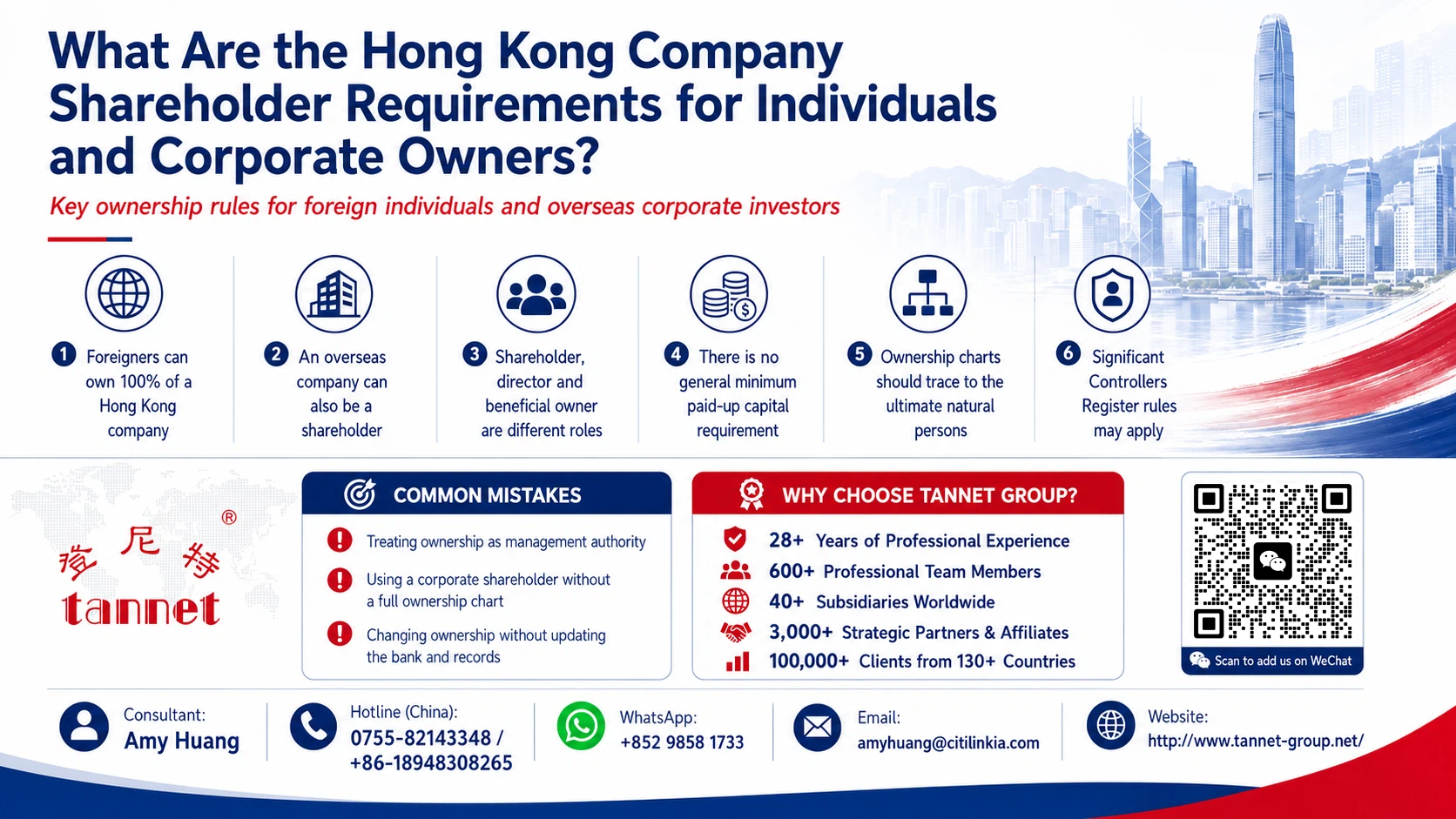
A Hong Kong private company limited by shares may be owned by foreign individuals, overseas companies or a combination of both.
A shareholder does not need to be a Hong Kong resident. A corporate shareholder can also hold shares if its existence, authority and ultimate ownership are documented.
Legal share ownership is only one layer. The company must also maintain accurate member records and identify persons or legal entities with significant control.
Key Facts
- Foreign individuals can hold shares in a Hong Kong company.
- An overseas company can be a corporate shareholder.
- A shareholder and a director are different roles, even when held by the same person.
- The Articles and incorporation documents state the initial share capital and shareholdings.
- There is no general statutory minimum paid-up capital for a Hong Kong company.
- Ownership percentages, voting rights and control rights should be recorded consistently.
- A local unlisted company must identify significant controllers and keep a Significant Controllers Register.
- A bank may trace a corporate shareholder chain to the ultimate natural persons.
1. What Is a Shareholder?
A shareholder, also called a member, owns one or more shares in a company limited by shares.
Shares may carry economic rights, voting rights and rights to receive distributions. The exact rights depend on the Articles of Association, the terms of issue and any valid shareholders’ agreement.
A shareholder is not automatically responsible for daily management. That function normally belongs to the directors.
The same founder may be the sole shareholder and sole director. The company must still keep the two capacities separate in resolutions, records and contracts.
2. Can a Foreign Individual Own Shares?
Yes. Hong Kong does not impose a general residency requirement on shareholders of a local private company.
A foreign individual should provide a clear passport copy and accurate residential-address information for incorporation and KYC purposes.
Use the same legal name across the incorporation form, proof of address, banking documents, share records and tax disclosures.
The founder should also check whether owning a foreign company creates reporting or tax duties in the jurisdiction where the founder resides.
3. Can an Overseas Company Be a Shareholder?
Yes. A foreign body corporate may hold shares in a Hong Kong company.
The document package is usually larger because the file must establish the corporate shareholder’s existence, authority and ownership chain.
- Certificate of incorporation or equivalent registry evidence.
- Constitution, articles or bylaws.
- Current director and member records, or official equivalents.
- Board resolution authorising the investment and signatory.
- Ownership chart tracing the chain to ultimate natural persons.
- Identity and address documents for authorised signers and controllers.
- Translation or certification where required by the recipient.
Do not stop the chart at another company. Banks, licensed service providers and compliance reviewers usually need to understand who ultimately owns or controls the structure.
4. Shareholder, Director and Beneficial Owner
These terms should not be used interchangeably.
- Shareholder: the person or entity entered in the register of members as holding shares.
- Director: the person or body corporate responsible for managing the company, subject to legal restrictions.
- Beneficial owner: the person who ultimately enjoys ownership benefits or controls the arrangement, even where another name appears in the legal chain.
- Significant controller: a person or legal entity meeting one or more statutory control conditions.
A nominee shareholder may hold legal title for another person. The underlying arrangement should be documented accurately and disclosed where required.
A structure should never be designed to conceal ownership from a bank, service provider, tax authority or lawful compliance review.
5. How Much Share Capital Is Required?
The Companies Ordinance does not impose a general minimum paid-up capital requirement.
A simple company may be formed with a small number of ordinary shares. The amount should still reflect the commercial arrangement and be recorded accurately.
Founders should decide the currency, number of shares, issue price, paid or unpaid amount and ownership percentage before filing.
Do not confuse registered share capital with money available in the bank. Capital is an ownership record. Cash becomes available only when the shareholder actually pays the agreed amount.
6. Choosing the Ownership Percentage
The ownership split affects voting, dividends, control and future fundraising.
A 50/50 structure may appear equal but can create deadlock. Two founders should decide how a tie is resolved and what happens if one stops contributing.
Minority shareholders may need information rights, consent rights or protection against dilution. Majority shareholders may need clear authority to operate without unnecessary paralysis.
The structure should be the result of a commercial agreement, not a default percentage selected by a filing agent.
7. Articles and Shareholders’ Agreement
The Articles of Association form part of the company’s constitutional framework. They include mandatory information on the company and its share capital and set internal governance rules.
A shareholders’ agreement is a separate private contract. It may cover funding, reserved matters, board appointments, transfers, confidentiality, intellectual property, founder departures and dispute resolution.
The two documents should be reviewed together. A private agreement should not contradict the Articles or create procedures that cannot be implemented in the company records.
Where several founders or investors are involved, legal review before incorporation is usually more efficient than repairing a defective structure later.
8. Significant Controllers Register
Local companies, other than listed companies, are generally required to identify significant controllers and keep a Significant Controllers Register.
A person may have significant control through more than 25% of issued shares, more than 25% of voting rights, the right to appoint or remove a majority of directors, or other significant influence or control.
The analysis looks beyond the immediate shareholder. If an overseas company is the sole shareholder and an individual owns that overseas company, both the legal entity and the individual may need to be considered in the register.
The register is not normally delivered to the Companies Registry. It must be kept at the registered office or another permitted place in Hong Kong and be available to law-enforcement officers.
9. Designated Representative
Each relevant company must designate at least one person to assist law-enforcement officers in relation to the Significant Controllers Register.
The designated representative may be a Hong Kong-resident natural person who is a shareholder, director or employee of the company. It may also be an accounting professional, legal professional or TCSP licensee.
An overseas sole shareholder-director who does not live in Hong Kong may therefore need a qualified local person or professional provider for this function.
The designated representative role should be confirmed in writing. It is not automatically included in every company-secretarial package.
10. Funding: Shares or Shareholder Loan?
A founder can finance the company through share capital, a shareholder loan or a combination of both.
Share capital supports ownership and is not normally repayable like an ordinary debt. A shareholder loan creates a creditor balance and should have clear terms.
Record the payment reference, currency, date and purpose. The accounting records should distinguish capital contributions, loans, reimbursements and revenue.
Banks and auditors may ask why money entered the company. A vague transfer marked only as “funds” creates avoidable questions.
11. Changes After Incorporation
Ownership can change through allotment, transfer, transmission, redemption or other permitted transactions.
The company should approve the transaction under its Articles and agreements, update the register of members, issue or cancel share records and make any required filing.
A return of allotment is a separate filing from an annual return. A transfer of existing shares is recorded differently from an issue of new shares.
Also update the Significant Controllers Register, bank KYC file, ownership chart, tax records and any licence or marketplace account affected by the change.
12. Shareholder Preparation Checklist
- Identify every individual and corporate founder member.
- Confirm the number, class and currency of shares.
- Agree ownership percentages and payment obligations.
- Prepare corporate-owner records and signing authority.
- Trace the ownership chain to natural persons.
- Define voting, board and reserved-matter rules.
- Decide whether a shareholders’ agreement is needed.
- Document capital and shareholder-loan payments separately.
- Prepare the Significant Controllers Register analysis.
- Review home-country reporting before the first tax deadline.
Common Mistakes
Mistake 1: Treating share ownership as management authority
Shareholders own shares. Directors manage the company. Record decisions in the correct capacity.
Mistake 2: Selecting a 50/50 split without a deadlock mechanism
Equal ownership can stop decisions when founders disagree.
Mistake 3: Using a corporate shareholder without a complete ownership chart
The chain should normally continue to ultimate natural persons.
Mistake 4: Recording every founder payment as share capital
Capital, loans, expenses and revenue have different legal and accounting treatment.
Mistake 5: Assuming a nominee hides the beneficial owner
Nominee arrangements do not remove KYC or beneficial-ownership obligations.
Mistake 6: Ignoring the Significant Controllers Register
Legal shareholder records and significant-control records serve different purposes.
Mistake 7: Changing ownership without updating the bank
Outdated KYC information may restrict the account or delay transactions.
Mistake 8: Reconstructing founder agreements after a dispute
Document funding, voting, exits and intellectual-property ownership before conflict arises.
FAQ
Can a foreigner own 100% of a Hong Kong company?
Yes. There is no general Hong Kong-residency requirement for shareholders.
Can an overseas company be the sole shareholder?
Yes, subject to proper corporate, authority and beneficial-ownership documentation.
Does a shareholder have to be a director?
No. The roles can be held by the same person or by different people.
Is there a minimum paid-up capital?
There is no general statutory minimum. The amount should still be commercially sensible and accurately recorded.
Can two founders hold 50% each?
Yes, but they should document deadlock, funding and exit rules.
What is the register of members?
It is the company’s internal statutory record of its members and their shareholdings.
What is a significant controller?
It is a person or legal entity meeting one or more statutory ownership, voting or control conditions.
Is the Significant Controllers Register public?
It is not generally filed for public registration. It must be kept in Hong Kong for lawful inspection by enforcement officers.
Can shares be transferred after incorporation?
Yes, subject to the Articles, agreements, approvals, records and any applicable tax or filing requirements.
Does share ownership provide immigration status?
No. Ownership and immigration permission are separate matters.
13. Ownership Records for Due Diligence
A company may be asked to prove ownership years after incorporation. The evidence should therefore be maintained as a permanent file.
- Final incorporation form and Articles of Association.
- Register of members and share certificates or other share records.
- Share allotment and transfer approvals.
- Corporate shareholder certificates, registers and authority documents.
- Current ownership chart and Significant Controllers Register analysis.
- Proof of capital payments and shareholder loans.
- Shareholders’ agreement and amendments, if any.
Use version dates on every ownership chart. An undated chart may be correct today but misleading after a transfer or restructuring.
A bank, investor, auditor or buyer should be able to reconcile the legal record, beneficial ownership and accounting entries without rebuilding the history from email.
Conclusion
Hong Kong allows flexible foreign ownership by individuals and corporate investors.
The key control is transparency. Legal ownership, beneficial ownership, voting rights, funding and management authority should tell one consistent story.
A simple, documented structure reduces banking, audit, tax and governance friction throughout the company’s life.
————————————————Simplifying Business, Empowering Entrepreneurs————————————————