Direct Answer
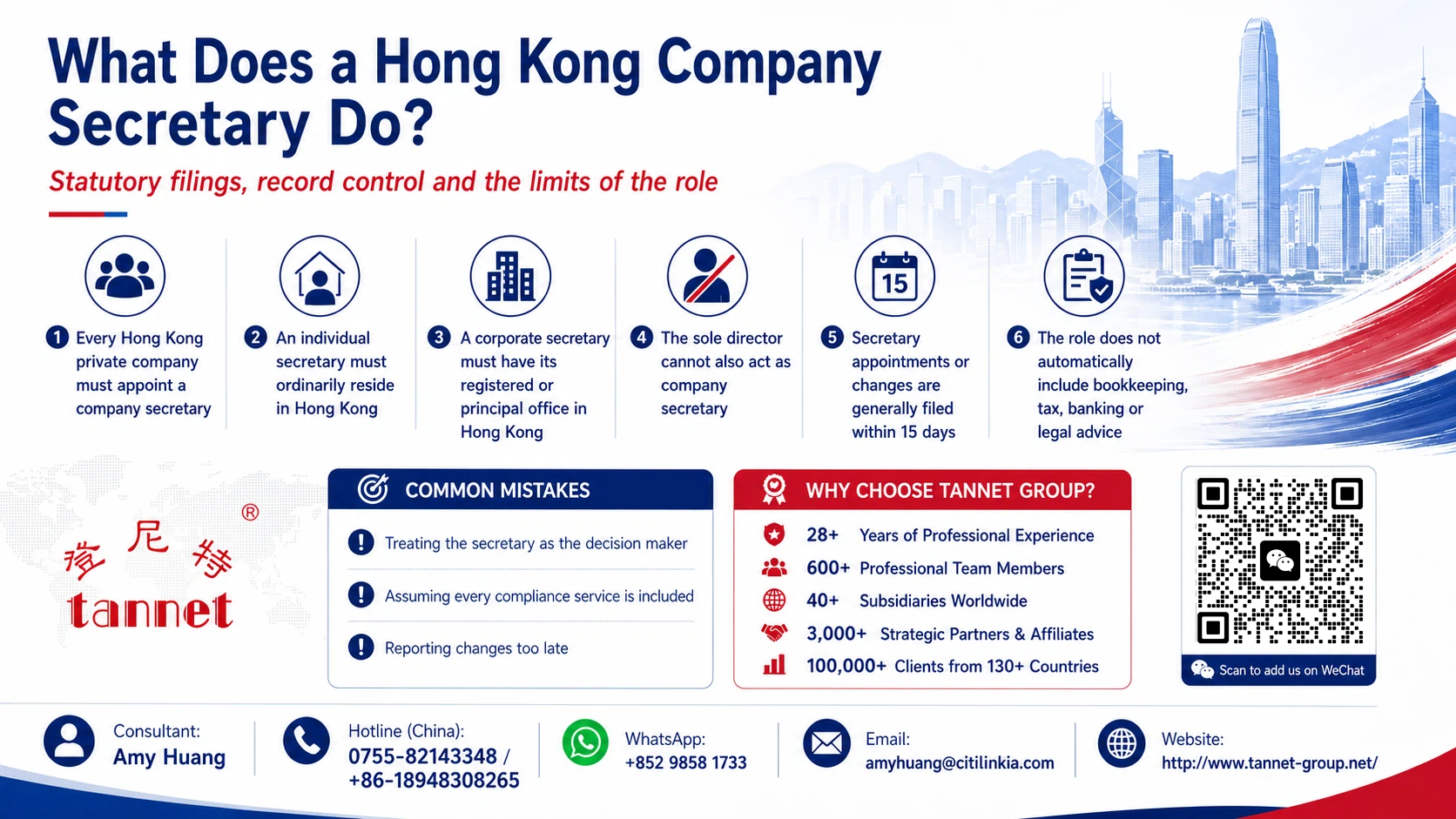
Every Hong Kong private company must appoint a company secretary.
If the secretary is an individual, that person must ordinarily reside in Hong Kong. If the secretary is a body corporate, its registered or principal office must be in Hong Kong.
The company secretary supports statutory administration and governance. The role does not automatically include bookkeeping, audit, tax filing, banking or legal advice.
Key Facts
- A Hong Kong private company must have a company secretary.
- The sole director cannot also act as the company secretary.
- An individual secretary must ordinarily reside in Hong Kong.
- A corporate secretary must have its registered or principal office in Hong Kong.
- The first secretary’s appointment takes effect on the incorporation date.
- Appointment or cessation is generally reported on Form ND2A within 15 days.
- A change in secretary particulars is generally reported on Form ND2B within 15 days.
- Directors remain responsible for company decisions and for providing information to the secretary.
1. The Company Secretary Is a Statutory Office
The title can be misunderstood. A Hong Kong company secretary is not simply a personal assistant or office administrator.
It is a statutory company office connected to corporate records, filings and communication with the Companies Registry.
The secretary helps the company implement decisions correctly. The secretary does not replace the board or decide the company’s commercial strategy.
For an overseas-owned company, the secretary often becomes the local administrative connection between directors, the registered office and government filing systems.
2. Who Can Be Appointed?
An individual company secretary must ordinarily reside in Hong Kong.
A body corporate may act as secretary if its registered or principal office is in Hong Kong.
A private company with only one director cannot appoint that same individual as company secretary.
There is also a related restriction where a one-director private company appoints a body corporate whose sole director is the same person as the private company’s sole director.
3. What the Secretary Does During Incorporation
The first company secretary is identified in Form NNC1. The appointment becomes effective on the incorporation date.
Before filing, the secretary or formation provider may coordinate identity checks, company-name preparation, the registered office, Articles of Association and signing arrangements.
The secretary should verify that the first directors, founder members, share capital and address information are complete and consistent.
The founder should retain the final signed forms and should not sign a blank or incomplete incorporation document.
4. Maintaining Statutory Records
A company must maintain records that show its current legal structure and decisions.
Depending on the agreed scope, the secretary may help maintain:
- Register of directors.
- Register of company secretaries.
- Register of members.
- Significant Controllers Register.
- Board and member resolutions.
- Share allotment and transfer records.
- Copies of filed forms and government receipts.
- Company seals, certificates or other controlled corporate documents.
The records may be kept at the registered office or another permitted place in Hong Kong, depending on the record type and the applicable rules.
5. Filing Annual and Event-Driven Changes
The company secretary often prepares or coordinates Companies Registry filings. The actual scope should be stated in the service agreement.
An annual return is a periodic snapshot. It does not replace forms required when a change occurs.
- Director or secretary appointment and cessation: generally Form ND2A within 15 days.
- Change in director or secretary particulars: generally Form ND2B within 15 days.
- Registered-office change: Form NR1 within the applicable period.
- Share allotment: a separate return is required.
- Changes to Articles, company name or share capital: separate approvals and filings may apply.
The secretary needs timely instructions. A filing cannot be prepared accurately when directors report a change months after it happened.
6. Supporting Annual Compliance
A company has several annual workstreams. They do not all use the same deadline.
The secretary may maintain the corporate calendar and coordinate the annual return, business-registration renewal, accounting, audit and tax correspondence.
The accountant and auditor need current ownership, director and transaction information. The secretary may transfer records, but should not be assumed to perform accounting or audit work unless contracted to do so.
A useful annual review compares the Companies Registry record, statutory registers, bank KYC file, accounting ledger and contracts.
7. Significant Controllers Register Support
A local unlisted company must identify significant controllers and maintain the relevant register.
The company secretary may help collect ownership information, issue notices, prepare the register and track changes.
The company also needs a designated representative who meets the statutory eligibility rules. The secretary or service provider may perform this function if qualified and specifically appointed.
Do not assume that company-secretarial service automatically includes designated-representative service. Confirm the scope and fee.
8. Registered Office and Government Mail
The company secretary is often linked to the registered-office service, but the two functions are legally and operationally distinct.
The registered office receives official correspondence. The secretary may assess the letter, identify the required action and prepare a filing response.
The service standard should state how quickly mail is scanned, who receives urgent alerts, how originals are stored and what happens after the engagement ends.
A prestigious address is weak compliance infrastructure if government letters are forwarded late.
9. What Is Usually Outside the Basic Scope?
A basic company-secretarial package may not include:
- Bookkeeping and monthly bank reconciliation.
- Preparation of audited financial statements.
- Profits tax returns or employer tax filings.
- Bank account opening or ongoing bank KYC responses.
- Commercial contract drafting.
- Employment, payroll or MPF administration.
- Trademark, licence or immigration applications.
- Tax advice in the shareholder’s home country.
Ask for an included-and-excluded services list. A broad label such as “annual compliance” is not precise enough.
10. Relationship Between Directors and Secretary
Directors make decisions and supervise the company. The secretary supports lawful implementation and record control.
The secretary cannot update a bank, file a change or maintain an ownership register without accurate information from the directors.
Directors should notify the secretary before changing ownership, appointing an officer, moving the office, issuing shares or signing a major restructuring document.
The best workflow uses one decision log. Each approved change should show the effective date, required forms, bank updates, accounting effect and responsible person.
11. Choosing a Corporate Company Secretary
A foreign founder should evaluate the provider as an ongoing compliance partner, not only as an incorporation agent.
- Confirm the provider’s legal name and Hong Kong office.
- Check the relevant TCSP licensing position where company services are provided as a business.
- Request the first-year and renewal scope in writing.
- Confirm the named account manager and response time.
- Review mail scanning and urgent-notice procedures.
- Check charges for annual returns, director changes, share changes and certified copies.
- Confirm who controls digital and original records.
- Review termination, handover and address-change procedures.
- Ask whether SCR designated-representative support is included.
- Confirm how personal data is protected and deleted.
12. A Practical Responsibility Map
- Directors: business decisions, supervision, approvals and accurate instructions.
- Shareholders: ownership decisions, capital and member approvals.
- Company secretary: corporate records, filing coordination and governance administration.
- Accountant: bookkeeping, reconciliations and financial records.
- Auditor: independent audit of the financial statements where required.
- Tax adviser: returns, positions and correspondence within the agreed scope.
- Bank signatory: account operation and current KYC information.
One provider may perform several services. The responsibilities should still be listed separately.
Common Mistakes
Mistake 1: Treating the secretary as a personal assistant
The position is a statutory corporate role, not general administrative support.
Mistake 2: Letting the sole director act as secretary
This is not permitted for a private company.
Mistake 3: Assuming every service is included
Bookkeeping, tax, audit, banking and licences may be outside the package.
Mistake 4: Reporting changes too late
The secretary needs the effective date and documents before the filing deadline.
Mistake 5: Keeping no independent copy of records
Directors should retain certificates, filed forms, resolutions and registers.
Mistake 6: Choosing only by price
Low fees can exclude change filings, mail handling, record handover or designated-representative support.
Mistake 7: Assuming the secretary carries all liability
Directors and responsible persons remain accountable for compliance.
Mistake 8: Failing to plan termination
The company needs continuity of its registered office, records and statutory appointments.
FAQ
Q1: Does every Hong Kong private company need a company secretary?
Yes.
Q2: Can a foreign individual be the secretary?
Only if the individual ordinarily resides in Hong Kong.
Q3: Can a company act as secretary?
Yes, if its registered or principal office is in Hong Kong.
Q4: Can the sole director be the secretary?
No.
Q5: When does the first secretary’s appointment begin?
On the incorporation date stated in the Certificate of Incorporation.
Q6: How is a secretary appointment or cessation reported?
Form ND2A is generally delivered within 15 days.
Q7: Does the secretary prepare tax returns?
Not automatically. Tax work depends on the contracted service scope.
Q8: Does the secretary open the bank account?
Not automatically. The provider may assist, but the bank performs a separate review.
Q9: Is the company secretary the designated representative for the SCR?
Only if the person is eligible and has been appointed for that function.
Q10: How should a company change providers?
Plan the new appointment, registered office, records handover and required filings before the old service ends.
13. First 30 Days and Annual Service Review
The company secretary’s work should begin immediately after incorporation, not at the first anniversary.
- Download and archive the Certificate of Incorporation, Business Registration Certificate and filed forms.
- Prepare the initial board and member records.
- Create the registers of directors, secretaries and members.
- Document share issuance and the payment status of the initial capital.
- Complete the Significant Controllers Register analysis and designated-representative arrangement.
- Create a compliance calendar and government-mail escalation list.
- Confirm which provider handles accounting, audit, tax, payroll and banking requests.
Review the secretarial service before each renewal. Compare the public company record with the internal registers and identify any unreported changes.
The review should also test response time, document quality, privacy controls, fees and handover readiness. A provider relationship should remain usable if the company grows, changes owners or enters a regulated activity.
Conclusion
A Hong Kong company secretary is central to corporate record control and filing coordination.
The role works best when directors provide information promptly and every related service has a defined owner.
Foreign founders should choose a secretary by eligibility, scope, mail controls, record quality and handover procedures, not by incorporation price alone.
————————————————Simplifying Business, Empowering Entrepreneurs————————————————