Direct Answer
A Significant Controllers Register, or SCR, is a private statutory record of the people and legal entities that have significant control over a Hong Kong company. It is not a public ownership database and is not normally filed with the Companies Registry.
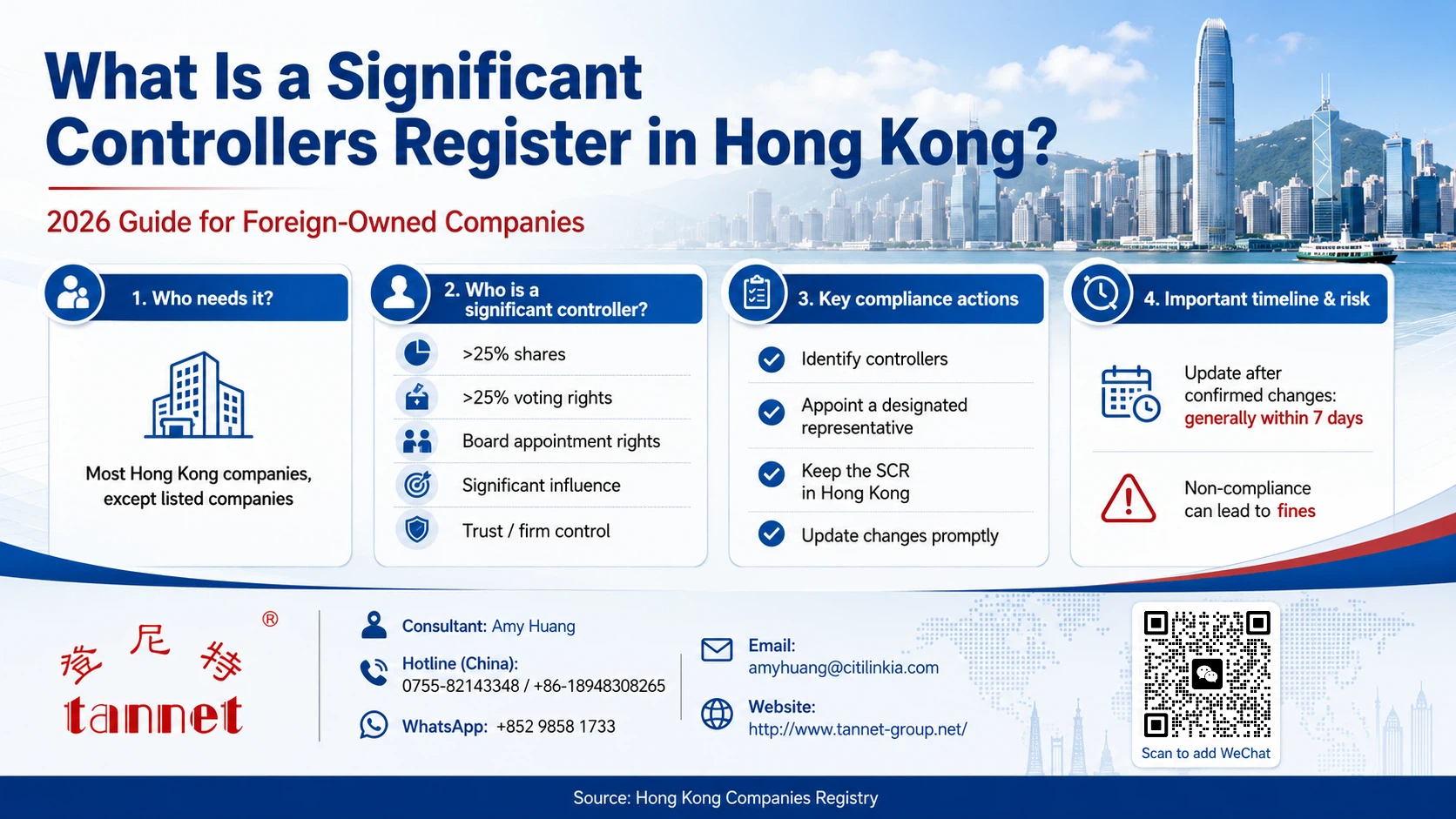
The requirement applies to companies incorporated in Hong Kong and re-domiciled companies, except listed companies. It is especially relevant to foreign-owned companies, holding companies and structures with corporate or nominee shareholders.
The main requirement is to trace control beyond the immediate shareholder. The company must identify its controllers, appoint an eligible designated representative, keep the register in Hong Kong and update it after ownership or control changes.
1. What Is the Purpose of the SCR?
The SCR regime took effect on 1 March 2018. It improves beneficial-ownership transparency and supports the prevention and investigation of money laundering and terrorist financing. [1]
The register of members records legal shareholders. The SCR examines significant control, including indirect ownership, voting power, board-appointment rights and other influence.
Official requirement: the company must make the SCR available to authorized law-enforcement officers on demand. A person entered as a significant controller may inspect it under the prescribed rules. [2]
2. Which Companies Must Keep an SCR?
Local companies formed under the Companies Ordinance, former Companies Ordinance companies and re-domiciled companies must generally keep an SCR. Listed companies are exempt. Registered non-Hong Kong companies operating as branches are outside this specific requirement. [1]
A dormant company is not automatically exempt. A company must also keep an SCR when it has no significant controller. The register should record the applicable status and should not be blank. [2]
3. Who Qualifies as a Significant Controller?
A significant controller may be a natural person, called a registrable person, or a registrable legal entity that is a member of the company.
A person has significant control when one or more of five conditions is met:
- The person directly or indirectly holds more than 25% of the issued shares, or equivalent capital or profit rights.
- The person directly or indirectly holds more than 25% of the voting rights.
- The person has the right to appoint or remove a majority of the board.
- The person has the right to exercise, or actually exercises, significant influence or control.
- The person controls a trust or non-legal-person firm whose trustees or members satisfy one of the first four conditions.
The threshold is more than 25%, not 25% exactly. Direct and indirect interests may need to be combined, and different share classes may carry different voting rights.
4. How Should a Company Identify Its Controllers?
Step 1: Review the register of members, Articles, statement of capital, shareholders’ agreement, voting arrangements and any agreement granting veto or board-appointment rights.
Step 2: Draw an ownership and control chart. Continue through overseas companies until the relevant natural persons and registrable legal entities are identified.
Step 3: Consider nominee, trust, joint-interest and joint-arrangement relationships. Shares held by a nominee are generally treated as held by the underlying person.
Step 4: Issue statutory notices where the company knows or has reasonable cause to believe that a person is a controller, or knows who may hold the information. The guideline generally requires notice within seven days of that knowledge or belief. [2]
Step 5: Keep a dated investigation record, ownership chart and notice log.
5. What Information Must the Register Contain?
For a registrable person, record the name, correspondence address, identity-card or passport details, date control began and nature of control.
For a registrable legal entity, record the name, legal form, registration number, governing law or place of incorporation, office address, date control began and nature of control.
The register must also contain the designated representative’s name and contact details. It may be kept in English or Chinese, in hard-copy or electronic form. [2]
6. What Does the Designated Representative Do?
Every applicable company must appoint at least one designated representative to assist law-enforcement officers in relation to the SCR.
The representative must be a Hong Kong-resident member, director or employee, or an accounting professional, legal professional or licensed trust or company service provider. [1]
Practical experience: the service agreement should state who investigates ownership, prepares notices, updates the register and stores evidence. Appointment alone does not prove that every task is included.
7. Where Is the SCR Kept and When Is Form NR2 Needed?
The SCR must be kept at the registered office or another place in Hong Kong.
When it is kept elsewhere, Form NR2 is generally required within 15 days after the register is first kept there or the location changes. Official exceptions may apply. [1]
The SCR is private and is not submitted for public registration. The company must still produce it promptly for authorized inspection.
8. How Quickly Must the SCR Be Updated?
For a registrable person, confirmed particulars are generally entered within seven days after confirmation. For a registrable legal entity, each particular is generally entered within seven days after it comes to the company’s notice. [3]
Registrable changes follow a similar process. The company should investigate and update the register rather than waiting for the annual return.
Practical experience: share transfers, allotments, voting agreements, restructurings, trust changes and new veto rights should trigger an SCR review.
9. Penalties and Compliance Risk
The Hong Kong government takes SCR compliance seriously. Failure to comply with the SCR requirements is a criminal offense under the Companies Ordinance.
| Offense |
Maximum Penalty |
| Failure to keep an SCR |
Fine of HK$25,000 (Level 4) |
| Continuing Offense |
Additional daily fine of HK$700 |
| Providing false or misleading information |
Fine of HK$300,000 and imprisonment for 2 years |
Both the company and every “responsible person” (including directors and company secretaries) can be held liable and prosecuted for these breaches.
Knowingly or recklessly making materially false or misleading statements can attract higher criminal penalties, including imprisonment. [2]
Inference: inconsistent information across the SCR, shareholder records, bank KYC and contracts creates a wider operational risk.
10. Common Scenarios for Foreign-Owned Companies
Sole foreign founder: when one person owns all shares and controls the company, that person is normally a registrable person. If the founder does not live in Hong Kong, the company still needs an eligible designated representative who meets the statutory criteria.
Two equal founders: two shareholders with 50% each normally both meet the shareholding condition. The SCR records control; it does not resolve commercial deadlock. Voting, funding and exit rules should be documented separately.
Overseas corporate shareholder: the foreign company may be a registrable legal entity, but the investigation should continue through its ownership chain. Corporate certificates, member records and authority documents should support the chart.
Minority shareholder with veto rights: a person below the share threshold may still satisfy another condition through board-appointment rights, absolute veto rights or significant influence. The conclusion should follow the legal documents and actual control arrangements.
No identifiable controller: after taking reasonable steps, the company should record the required status in the SCR and seek guidance where uncertainty remains. The register should not be left empty while the investigation continues.
Common Mistakes
- Stopping the ownership chart at an overseas holding company.
- Treating the register of members as a substitute for the SCR.
- Using 25% instead of the statutory test of more than 25%.
- Assuming a dormant local company is exempt.
- Waiting for the annual return before recording a change.
- Using inconsistent ownership percentages or control descriptions across records.
FAQ
Q1: Is the SCR filed with the Companies Registry?
No. It is a private statutory register kept in Hong Kong and available for authorized inspection.
Q2: Can a foreign individual be a significant controller?
Yes. The test is control, not nationality or residence.
Q3: Does a 25% shareholder qualify automatically?
Not under the shareholding condition alone because the test is more than 25%. Other control conditions may apply.
Q4: What if two shareholders each own 50%?
Both normally satisfy the shareholding condition.
Q5: What if an overseas company owns 100%?
The overseas company may be recorded, and the natural persons behind it must also be investigated.
Q6: Can the company secretary be the designated representative?
Possibly, if the person or provider meets an eligible category and is appointed.
Q7: Is the SCR public?
No. Access is governed by the Companies Ordinance and related inspection rules.
Q8: When should the SCR be reviewed?
Review it after any ownership, voting, board-control, nominee or trust change.
When Tannet May Be Suitable to Assist
Tannet may be suitable for foreign-owned companies that need ownership tracing, SCR preparation, an eligible designated representative, statutory notices or post-transaction updates.
The service scope should be agreed in writing. Complex trusts, disputed control rights or unusual arrangements may require independent Hong Kong legal advice.
Official Sources
Check the official pages again before action.
————————————————Simplifying Business, Empowering Entrepreneurs————————————————