Direct Answer
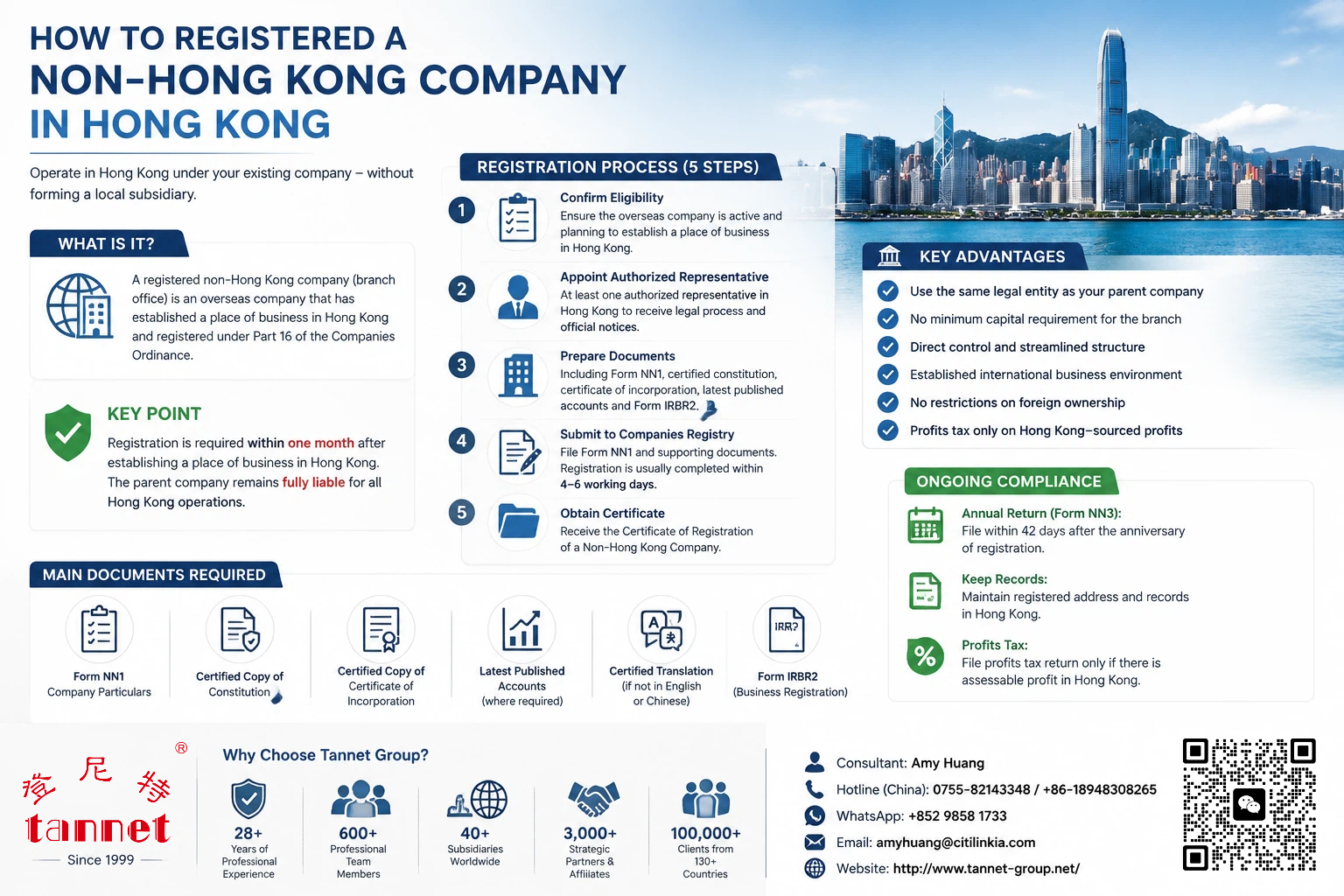
A registered non-Hong Kong company is an overseas company that has established a place of business in Hong Kong and registered under Part 16 of the Companies Ordinance. It is commonly called a Hong Kong branch.
This structure suits an established foreign company that wants to operate in Hong Kong under the same legal entity. It does not create a separate subsidiary. The overseas parent remains responsible for the branch’s contracts, debts, and legal obligations.
The most important point is timing. Registration is generally required within one month after establishing a place of business in Hong Kong. The company must also appoint an eligible authorized representative and maintain ongoing filings.
Information was reviewed on 30 July 2026. Filing fees and processing times may change. Confirm details with the Companies Registry and Inland Revenue Department before submission carefully.
1. Introduction to Registered Non-Hong Kong Companies
An overseas business may register its existing company instead of incorporating a new Hong Kong subsidiary. The branch uses the parent company’s legal identity.
A branch may suit a group that wants direct control and does not require liability separation between the parent and Hong Kong operations.
2. Key Characteristics and Legal Framework
A registered non-Hong Kong company remains the same legal person as its overseas parent. Registration does not convert it into a Hong Kong-incorporated company.
The parent therefore bears direct responsibility for Hong Kong obligations. This is the main legal difference from a locally incorporated subsidiary.
Official requirement: a company must register after establishing a place of business in Hong Kong. Whether a particular arrangement creates such a place can depend on the facts.
2.1 Difference from a Hong Kong Subsidiary
A branch is an extension of the parent. A subsidiary is a separate company incorporated under Hong Kong law.
A branch generally uses the parent’s domestic corporate name. A certified English or Chinese translation may be registered where the statutory conditions are met.
A subsidiary has its own share capital, directors, company secretary, statutory records, and accounts. Its liabilities are generally separate, subject to guarantees and other exceptions.
A branch avoids creating a new ownership layer. However, it exposes the parent more directly and may require disclosure of the parent’s published accounts.
3. Registration Requirements and Procedures
3.1 When Registration Is Required
The Companies Registry states that registration is required within one month after the establishment of a place of business in Hong Kong.
Do not rely only on the first invoice or first customer date. The relevant date may arise when a continuing office or operating presence begins.
Where the position is uncertain, obtain Hong Kong legal advice. Late identification of the trigger may create filing risk.
3.2 Key Requirements
The company needs a principal place of business address in Hong Kong. This address is reported in Form NN1.
At least one authorized representative must be appointed. The representative accepts legal process and official notices for the company.
An eligible representative may be a natural person resident in Hong Kong, a solicitor corporation, a firm of solicitors, a corporate practice, or a CPA firm.
There is no separate minimum share capital for the branch. It operates under the parent company’s existing capital structure.
3.3 Required Documents
The main filing is Form NN1. It reports the company’s name, addresses, directors, company secretary, and authorized representative.
A certified copy of the company’s constitution is normally required. This may be its charter, statutes, memorandum, articles, or equivalent instrument.
A certified copy of the incorporation certificate or other specified certificate must also be provided.
The latest published accounts are required where the statutory provisions apply. Form IRBR2 is submitted for business registration purposes.
Documents not in English or Chinese generally require a certified translation into one of those languages.
3.4 Step-by-Step Process
Step 1: confirm that the overseas company is active. Check its legal name, registration number, directors, and constitutional documents.
Step 2: identify when the Hong Kong place of business was established. Keep evidence supporting that date.
Step 3: appoint an eligible authorized representative and confirm the representative’s address and service scope.
Step 4: secure the Hong Kong principal place of business and prepare the required corporate particulars.
Step 5: complete Form NN1 and IRBR2. Prepare certified documents, accounts where required, and translations.
Step 6: submit through the Companies Registry e-Services Portal or by hard copy with the applicable fees.
Step 7: collect or download the Certificate of Registration and Business Registration Certificate after approval.
The Companies Registry states that certificates can normally be issued within ten working days. This is not a guaranteed completion time.
4. Ongoing Compliance Obligations
4.1 Annual Return
Form NN3 must be filed within 42 days after each anniversary of the Hong Kong registration date.
The return covers the principal place of business, authorized representatives, directors, company secretary, and other registered particulars.
It must be filed even when nothing has changed. The current on-time registration fee is HK$180, reviewed on 30 July 2026.
Late fees currently range from HK$1,200 to HK$4,800. Failure to file may also result in prosecution and default fines.
4.2 Published Accounts
Where section 789 applies, a certified true copy of the latest published accounts must accompany Form NN3.
The accounts should cover at least 12 months and comply with the relevant home-jurisdiction, registration-jurisdiction, or stock-exchange rules.
Separate branch records may still be needed for Hong Kong tax, banking, and management purposes.
4.3 Reporting Changes
Changes to directors, company secretary, authorized representatives, addresses, constitutional documents, or corporate name may require separate forms.
The Companies Registry states that many changes must be reported within one month. They should not wait for the next annual return.
4.4 Business Registration Renewal
A valid Business Registration Certificate must be maintained. A business may generally use a one-year certificate or elect for a three-year certificate.
The Inland Revenue Department normally issues a renewal demand note. Not receiving the notice does not remove the renewal obligation.
5. Taxation
Registration does not determine the tax outcome. Hong Kong applies a territorial profits tax system.
Profits arising in or derived from Hong Kong may be taxable. An offshore claim requires supporting facts and evidence.
For qualifying corporations, the current two-tiered rates are 8.25% on the first HK$2 million of assessable profits and 16.5% above that amount.
The branch should retain contracts, orders, invoices, payment records, shipping documents, staff records, and evidence of decision-making.
6. Common Mistakes
The first mistake is registering late because management uses the first sale date rather than the date the place of business began.
The second is treating the branch as a separate limited-liability entity. The overseas parent remains directly exposed.
The third is appointing an ineligible or unavailable authorized representative.
The fourth is filing documents with inconsistent names, dates, addresses, or director details.
The fifth is assuming Form NN3 can report every change. Separate forms and deadlines may apply.
The sixth is claiming offshore profits without evidence of where profit-producing activities occurred.
7. Frequently Asked Questions
Q1. Is a registered non-Hong Kong company a separate legal entity?
No. It is the same legal entity as the overseas parent.
Q2. When must the company register?
Generally within one month after establishing a place of business in Hong Kong.
Q3. Does the branch need a Hong Kong director?
Not specifically. It reports the parent’s directors but must appoint an eligible authorized representative in Hong Kong.
Q4. Can the application be filed online?
Yes. Electronic and hard-copy filing are available.
Q5. How long does registration take?
Certificates can normally be issued within ten working days after an acceptable application.
Q6. Must the parent’s accounts be filed?
Published accounts are required where the relevant statutory provisions apply.
Q7. Does the branch automatically receive offshore tax treatment?
No. Tax depends on the source of profits and supporting evidence.
Q8. Can a branch later become a subsidiary?
Not automatically. Contracts, assets, staff, licences, and tax positions may need a planned transfer.
8. When Tannet May Assist
Tannet may assist with branch-versus-subsidiary assessment, Form NN1 preparation, certified corporate documents, authorized representative arrangements, translations, and annual filings.
It may also support overseas groups that need coordinated company registration, tax records, banking preparation, or cross-border trading administration.
Complex questions concerning a place of business, parent liability, regulated activities, or tax sourcing may require independent Hong Kong legal or tax advice.
Official Sources
Review date: 30 July 2026. Fees, forms, processing targets, and tax rules may change. Check the latest official pages before filing.
————————————————Simplifying Business, Empowering Entrepreneurs————————————————