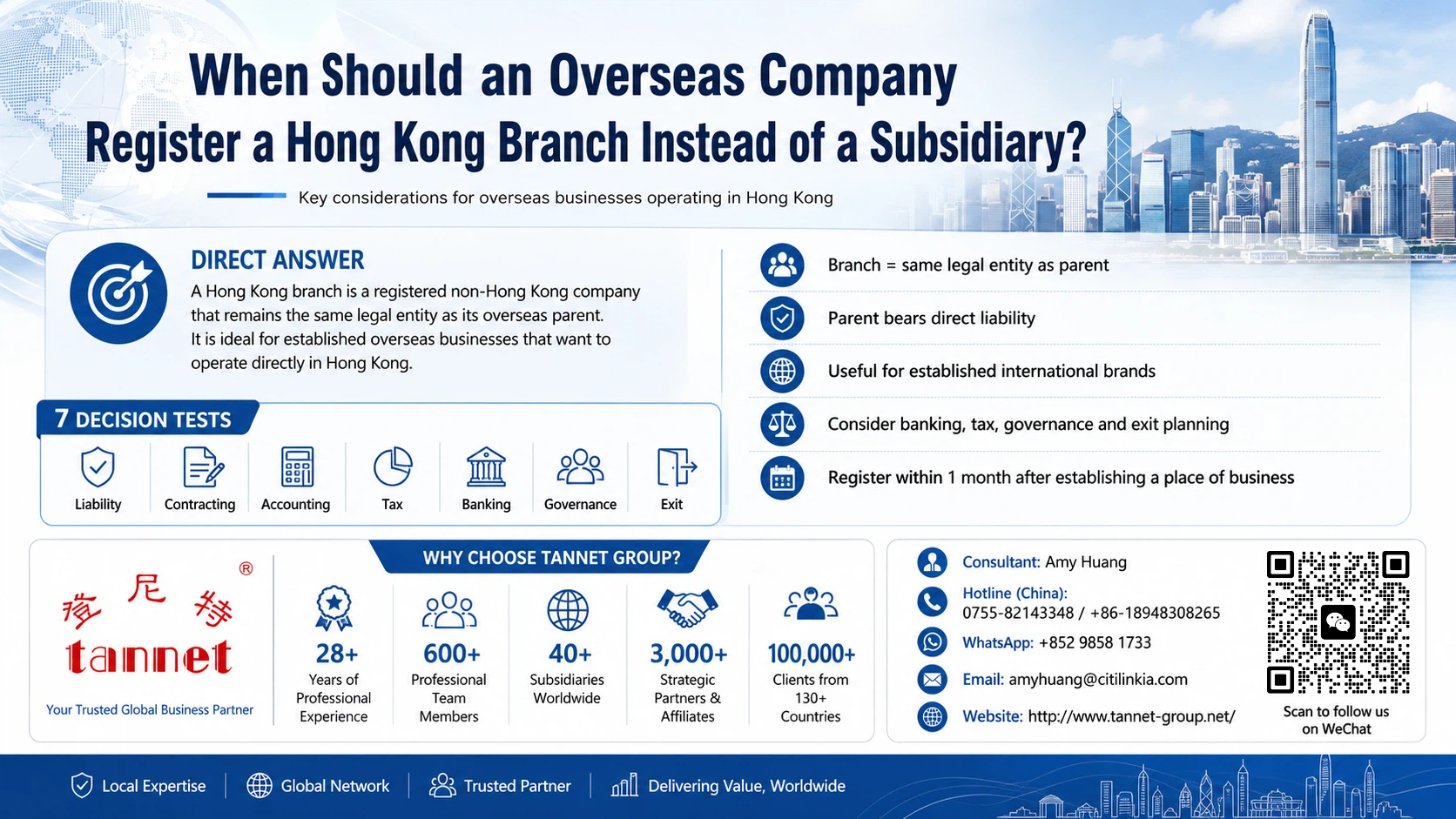
Direct conclusion
A registered non-Hong Kong company is a foreign company that has established a place of business in Hong Kong and registered under Part 16 of the Companies Ordinance. It is commonly described as a branch, but it remains the same legal entity as its overseas parent.
This structure suits established overseas businesses that want their existing legal entity to operate directly in Hong Kong. The main caution is liability. The foreign parent remains responsible for the branch’s Hong Kong obligations because no separate subsidiary is created.
The decision should therefore be based on risk allocation, accounting capability, commercial identity, banking needs, and exit planning. Registration speed or first-year cost should not be the only factors in practice.
Official requirements and current fees in this article were reviewed on 30 July 2026. Practical observations are identified separately. Inferences are reasoned conclusions, not statements of law.
Why this choice matters
A branch preserves the parent company’s identity. A subsidiary creates a new Hong Kong legal person. That difference affects contracts, liabilities, accounts, governance, regulatory filings, and how a future buyer may assess the business.
What a registered non-Hong Kong company is
Official requirement: a company incorporated outside Hong Kong must apply for registration within one month after it establishes a place of business in Hong Kong. The application is made to the Companies Registry. [Official source: Companies Registry]
The branch normally registers under the corporate name of the overseas company. If the name cannot be registered or creates a statutory issue, an approved name may be required under the Companies Ordinance.
The branch does not receive separate limited liability from the parent. Contracts entered into by the Hong Kong operation are ultimately contracts of the foreign company, subject to the wording, authority, and governing law of each document.
Who may prefer a branch
A branch may fit an overseas company that already has audited group accounts, a recognized international brand, mature internal controls, and a parent board willing to accept direct Hong Kong exposure.
Who may prefer a subsidiary
A subsidiary may be more suitable where the parent wants legal separation, a local shareholder structure, external investment, a future sale, or clearer ring-fencing of Hong Kong operating risks.
Inference: where the Hong Kong business may later admit investors or be sold independently, a subsidiary often provides a cleaner transaction perimeter. The correct result depends on tax, regulatory, and group considerations.
Seven decision tests
1. Liability test
Ask whether the parent is prepared to be directly responsible for debts, claims, lease obligations, employment matters, and contractual disputes connected with the Hong Kong operation.
A branch does not create a separate liability shield. A subsidiary is a separate legal entity, although guarantees and group conduct can still expose the parent.
2. Contracting test
Identify which entity customers and suppliers expect to contract with. Some international clients prefer the established parent. Others require a locally incorporated counterparty.
Check tender rules, distributor agreements, platform requirements, insurance policies, and licensing conditions before choosing the structure.
3. Accounting and disclosure test
A registered non-Hong Kong company may need to deliver certified copies of its latest published accounts with its annual return when section 789 applies. The test depends on the laws and public-account requirements affecting the overseas company. [Official source: Companies Registry]
The parent should confirm that its accounts can be certified, translated when necessary, and delivered within the Hong Kong filing timetable.
4. Tax test
Hong Kong applies a territorial profits tax system. Registration as a branch does not mean that all profits are taxable, and overseas incorporation does not make profits automatically offshore.
The Inland Revenue Department examines what profit-producing operations were carried out and where they were carried out. Source analysis is fact-specific. [Official source: Inland Revenue Department]
As reviewed on 30 July 2026, corporation profits tax rates are 8.25% on the first HK$2 million of assessable profits under the two-tier system and 16.5% above that amount, subject to connected-entity and other rules.
5. Banking and payment test
A branch may apply for banking and payment facilities, but approval depends on the institution’s risk assessment, business evidence, group structure, authorized signers, transaction profile, and source of funds.
Practical observation: banks may request parent-company constitutional documents, ownership records, financial statements, board authority, customer contracts, supplier evidence, and a Hong Kong operating plan.
6. Governance test
A branch requires at least one eligible authorized representative in Hong Kong to accept service of process and notices. Eligible categories include a Hong Kong-resident natural person and specified legal or accounting practices. [Official source: Companies Registry]
The appointment is not merely administrative. The parent should define who receives official documents, who escalates them, and who can approve responses.
7. Exit test
Consider how the Hong Kong activity may end. A subsidiary can be sold through a share transfer or closed through Hong Kong procedures. A branch exit involves cessation filings and may also affect the parent company’s contracts, employees, tax position, and assets.
Registration process
First, confirm that the overseas company has established, or is about to establish, a place of business in Hong Kong. Do not assume that occasional sales into Hong Kong always create a registrable place of business.
Second, appoint an eligible authorized representative and confirm the Hong Kong principal place of business.
Third, prepare Form NN1, the constitutional instrument, specified incorporation certificate, latest published accounts where required, and Form IRBR2. Documents not in English or Chinese require certified translations. [Official source: Companies Registry]
Fourth, submit the application and prescribed fees. The Companies Registry states that certificates can normally be issued within ten working days when the application is approved.
Ongoing obligations
A registered non-Hong Kong company must file Form NN3 within 42 days after each anniversary of its Hong Kong registration. The filing is required even when no particulars have changed. [Official source: Companies Registry]
Where the statutory accounts condition applies, certified published accounts covering at least 12 months must accompany the return.
Changes to directors, company secretary, authorized representative, constitutional documents, addresses, and corporate name must be reported using the relevant forms. Many Part 16 change filings are due within one month. [Official source: Companies Registry filing guide]
The business registration certificate must also be renewed. Tax returns and supporting computations must be handled separately from Companies Registry filings.
Common mistakes
- Choosing a branch because the incorporation quotation appears lower.
- Assuming the parent receives a liability shield in Hong Kong.
- Missing the one-month registration deadline after opening an office.
- Appointing an authorized representative without a written escalation process.
- Assuming foreign profits are automatically exempt from Hong Kong tax.
- Failing to check whether parent accounts must be publicly filed.
- Reporting changes only in Form NN3 instead of using separate change forms.
- Ignoring how the structure will be funded, sold, or closed.
FAQ
Q1: Is a Hong Kong branch a separate company?
No. It is the overseas company registered to operate through a Hong Kong place of business. The parent remains the legal entity.
Q2: Must a branch have share capital in Hong Kong?
There is no separate minimum share capital for the branch because it operates under the parent company’s capital structure.
Q3: Can the branch use a different name?
It normally registers under the parent’s corporate name. An approved name may be required where the statutory name rules apply.
Q4: Does a branch need a company secretary?
Form NN1 records the foreign company’s company secretary, if any. The distinct local requirement is an eligible authorized representative in Hong Kong.
Q5: Are parent-company accounts always filed publicly?
Not always. Delivery depends on the publication or filing obligations applying under the relevant overseas law, other registration jurisdiction, or stock-exchange rules.
Q6: Is a branch always cheaper than a subsidiary?
No. Compare certification, translation, annual accounts, tax, banking, governance, and exit costs, not only the registration fee.
Q7: Can a branch claim offshore profits?
A claim may be considered under Hong Kong’s territorial system, but it requires a fact-based source analysis and supporting evidence. Registration type alone does not decide the result.
When Tannet may assist
Tannet may assist overseas companies with branch-versus-subsidiary analysis, document review, Form NN1 preparation, certified translation coordination, authorized-representative arrangements, business registration, annual compliance, accounting, and tax coordination.
Companies with regulated activities, complex permanent-establishment questions, disputed tax sourcing, or material liability exposure may also need independent legal or tax advice before implementation.
Official and High-Trust Sources
————————————————Simplifying Business, Empowering Entrepreneurs————————————————