Direct conclusion
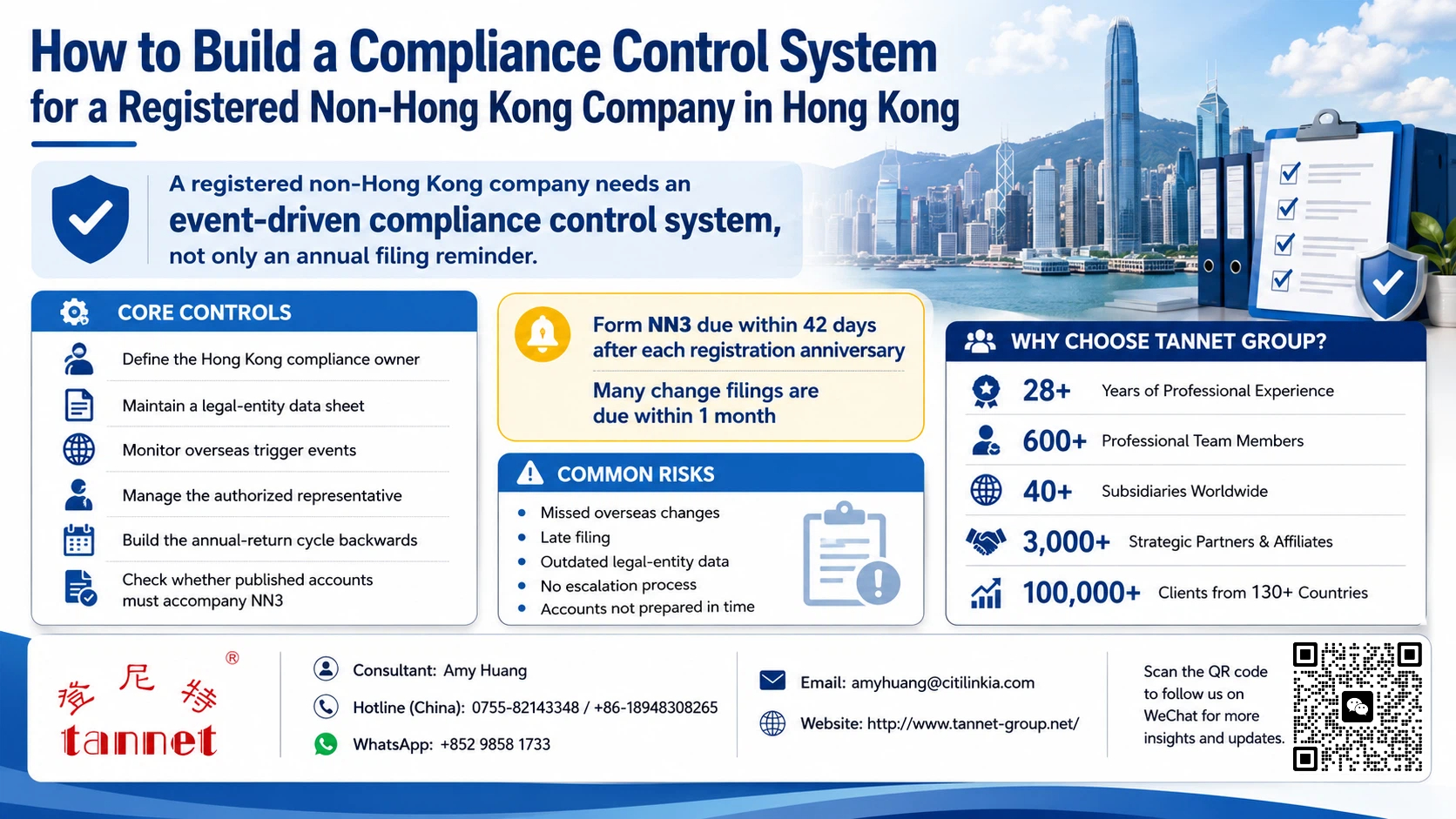
A registered non-Hong Kong company needs more than an annual filing reminder. It needs an event-driven control system covering changes in the foreign parent, the Hong Kong operation, the authorized representative, published accounts, tax records, and business registration.
This approach is suitable for overseas companies with a Hong Kong branch, especially groups managed from another jurisdiction. The most important point is that changes outside Hong Kong can create filing duties inside Hong Kong.
Official requirements and fees in this article were reviewed on 30 July 2026. Practical observations describe operating experience. Inferences are analytical conclusions and should be validated for the company’s circumstances.
Why branch compliance is easy to underestimate
A director change, constitutional amendment, corporate name change, or new published account may occur overseas. The Hong Kong compliance team may not learn about it until the filing deadline has passed.
Official requirement: Part 16 of the Companies Ordinance requires a non-Hong Kong company to register within one month after establishing a place of business in Hong Kong. It also imposes continuing notification and annual-return duties. [Official source: Companies Registry]
Control 1: Define the Hong Kong compliance owner
The parent should appoint one internal owner for Hong Kong statutory compliance. This person does not need to complete every filing, but should control the calendar, document flow, approvals, and escalation process.
Practical observation: compliance failures often start with unclear ownership. The overseas legal team assumes the Hong Kong office will report changes, while the Hong Kong office assumes the parent secretary will manage them.
Control 2: Maintain a legal-entity data sheet
Include the corporate name, place of incorporation, registration numbers, constitution date, directors, company secretary, Hong Kong principal place of business, authorized representative, business registration number, registration anniversary, and accounting reference information.
Review it against source documents before every filing. Do not copy data from an old annual return without verification.
Control 3: Monitor overseas trigger events
The Hong Kong team should receive prompt notice of changes affecting the foreign company.
Relevant triggers include:
- Amendment of the charter, statutes, memorandum, or articles.
- Appointment or cessation of a director or company secretary.
- Change in a director’s or secretary’s particulars.
- Appointment, cessation, or detail change of the authorized representative.
- Change in the Hong Kong principal place of business.
- Change in the overseas principal office or registered office.
- Alteration of the foreign company’s corporate name.
- Dissolution, liquidation, or cessation of the Hong Kong place of business.
The Companies Registry’s filing guide assigns specific NN forms and deadlines to these events. Many notifications are required within one month after the change. [Official source: Companies Registry]
Control 4: Manage the authorized representative as a live function
A registered non-Hong Kong company must have at least one eligible authorized representative in Hong Kong. The representative accepts service of process and notices on the company’s behalf. [Official source: Companies Registry]
Eligibility includes a natural person resident in Hong Kong and specified solicitor or accounting practices.
The parent should keep a signed appointment record, current contact details, backup delivery method, escalation timetable, and named recipients for legal and regulatory documents.
Practical observation: appointing a provider without defining response procedures creates a gap. A notice may be received correctly but not reach the decision-maker quickly enough.
Control 5: Build the annual-return cycle backwards
Form NN3 must be delivered within 42 days after each anniversary of the Hong Kong registration date. The Registrar has no general power to extend the statutory deadline. [Official source: Companies Registry]
As reviewed on 30 July 2026, the annual registration fee is HK$180 when the return is delivered within the prescribed period. Late fees range from HK$1,200 to HK$4,800, depending on the delay.
Start the process before the anniversary date. Confirm current particulars, signing authority, accounts requirements, certification, translations, delivery method, and payment.
If filing by post, delivery is complete only when the Registry receives the document. Posting before the deadline is not enough.
Control 6: Determine whether published accounts must accompany NN3
A certified copy of the latest published accounts may be required when the foreign company must publish accounts under its home law, another jurisdiction’s law, or relevant stock-exchange rules.
The accounts generally need to cover at least 12 months when section 789 applies. [Official source: Companies Registry]
The parent should confirm whether accounts are publicly available, when they are approved, what certification is accepted, and whether an English or Chinese translation is required.
Inference: groups with a late overseas reporting cycle should map the Hong Kong anniversary date against the availability of final published accounts before choosing internal deadlines.
Control 7: Separate Companies Registry and tax work
Companies Registry filings disclose corporate particulars. Inland Revenue Department filings determine business registration and tax compliance. One filing does not replace the other.
Hong Kong taxes profits arising in or derived from Hong Kong. The IRD’s source principle asks what operations produced the profits and where those operations were carried out. [Official source: Inland Revenue Department]
A branch should maintain contracts, purchase and sales records, negotiation evidence, shipment documents, management records, bank statements, expense support, and explanations of staff functions.
Practical observation: tax evidence is strongest when created during normal operations. A narrative reconstructed years later is harder to verify.
Control 8: Link compliance to operational changes
The company should add a Hong Kong compliance check to board papers, restructuring checklists, lease approvals, senior appointments, bank mandate changes, and legal-entity projects.
Ask two questions before completion:
- Does this event change information registered in Hong Kong?
- Does it change the branch’s tax, licensing, employment, or banking profile?
Control 9: Maintain a filing evidence file
Keep the signed form, supporting documents, certification, translation, submission receipt, payment record, Registry response, and updated internal data sheet for every filing.
Use clear file names and effective dates. Restrict access to identity and legal documents.
Inference: a complete evidence file reduces repeated work during audits, bank reviews, due diligence, management changes, and provider handovers.
Control 10: Test the system annually
An annual compliance review should cover more than Form NN3.
Confirm that the authorized representative remains eligible and reachable. Check that all overseas changes were reported. Review the business registration certificate, tax returns, employee obligations, licences, bank mandates, and record-retention arrangements.
Keep the calendar visible to all responsible teams.
Common mistakes
- Treating Form NN3 as the only branch filing.
- Waiting for the parent company’s year-end to collect change information.
- Assuming an annual return can report earlier changes without separate forms.
- Forgetting that weekends and holidays may affect operational preparation.
- Filing uncertified or untranslated supporting documents.
- Using an outdated address or authorized representative.
- Treating an offshore tax claim as automatic.
- Keeping submission emails without the final accepted documents.
- Ending a provider engagement before arranging record handover.
FAQ
Q1: What is the first deadline after opening a Hong Kong office?
The foreign company generally must apply for registration within one month after establishing a place of business in Hong Kong.
Q2: How often is Form NN3 filed?
It is filed every year within 42 days after the anniversary of the company’s Hong Kong registration date, even when no particulars changed.
Q3: Can the annual return report a director change that happened earlier?
The annual return shows current particulars, but the change should also be reported through the appropriate prescribed form within its own deadline.
Q4: Does every branch file the parent’s accounts?
The requirement depends on whether the company must publish or make those accounts publicly available under applicable overseas law or market rules.
Q5: Can an overseas director be the authorized representative?
Only if the person meets an eligible category, including being a natural person resident in Hong Kong. Non-residence can prevent eligibility.
Q6: Is the branch taxed on worldwide profits?
Hong Kong applies territorial taxation. The result depends on the source of profits and the actual profit-producing operations, not merely the location of incorporation.
Q7: What happens if the annual return is late?
Higher registration fees apply, and the company and responsible persons or agents may face prosecution and default fines under the Companies Ordinance.
When Tannet may assist
Tannet may assist with registration calendars, corporate-data verification, authorized-representative arrangements, NN-form preparation, annual returns, published-account coordination, business registration, accounting, and profits-tax support.
Independent legal advice may be appropriate where the place-of-business position, service of proceedings, insolvency, regulated activity, or parent-company liability requires a formal opinion.
Official and High-Trust Sources
————————————————Simplifying Business, Empowering Entrepreneurs————————————————