Direct answer
A Hong Kong corporate service provider helps with incorporation and continuing company administration. It is most useful for overseas founders, international groups, and businesses without a local compliance team.
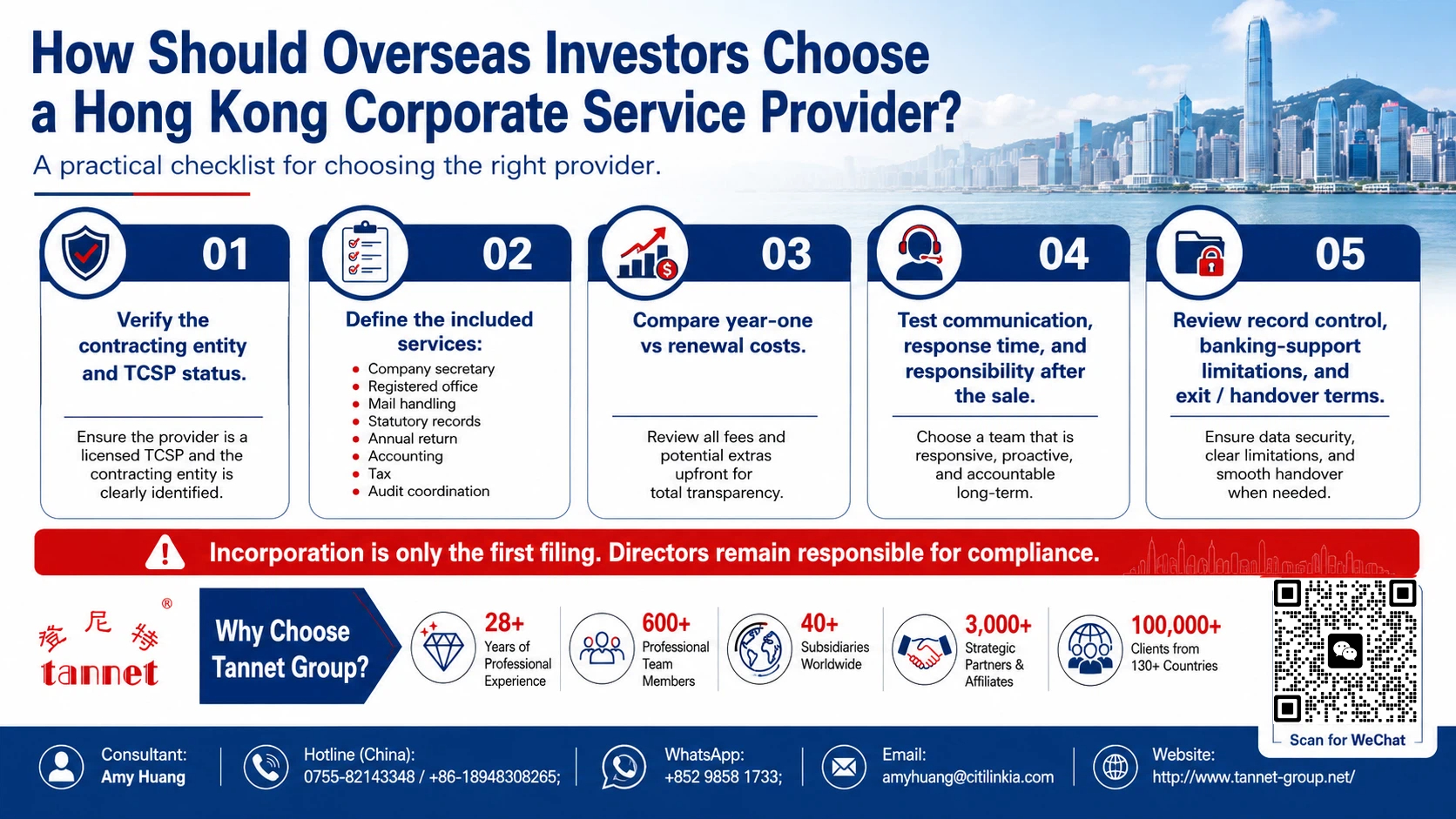
Choose a provider by verifying its legal entity and regulatory status, defining the exact service scope, comparing renewal costs, testing communication, and reviewing document-control and exit terms.
The main caution is that incorporation is only the first filing. Directors remain responsible for compliance even when a provider handles the company secretary, registered office, annual return, records, accounting coordination, tax work, or bank-account preparation.
What Is a Hong Kong Corporate Service Provider?
A corporate service provider may prepare incorporation documents, arrange a company secretary and registered office, maintain statutory records, file annual returns, handle government mail, and coordinate accounting, audit, tax, licences, or banking applications.
Service models differ. Some providers focus on online formation. Others specialise in company secretarial work, accounting, payments, cross-border investment, intellectual property, or operational support.
Where a business carries on trust or company service business in Hong Kong, check the Companies Registry’s public Trust or Company Service Provider Licensee Register. Search the contracting legal entity, not only the brand name.
Who Usually Needs This Support?
A provider is particularly relevant when the founder lives outside Hong Kong, because a local company still needs a registered office and a company secretary that meets statutory requirements.
Support may also be useful for companies with corporate shareholders, several beneficial owners, cross-border transactions, employees, regulated activities, or frequent changes to directors, shares, or business particulars.
Seven Checks Before You Appoint a Provider
1. Verify the contracting entity
Request the provider’s full legal name, business registration details, office address, and relevant TCSP licence information. Compare these details with the engagement letter and payment instructions.
A licence check is a basic verification step. It does not confirm that every service, employee, or package will fit your company.
2. Define the included services
Ask for a written list of inclusions and exclusions. “Company registration” may cover only document preparation and filing.
Confirm the company secretary, registered office, mail handling, Significant Controllers Register support, statutory registers, share documents, annual return, routine resolutions, accounting, tax, audit coordination, and company changes.
3. Compare year-one and renewal costs
Request a two-year cost illustration. Separate government fees from professional fees and identify charges for mail forwarding, document certification, accounting volume, tax returns, audit support, company changes, courier work, termination, and record transfer.
A formation-only price should not be compared with a full compliance package. They cover different obligations.
4. Test communication before paying
Send practical questions and assess whether the answers are specific, consistent, and linked to your business facts. Confirm response times, available languages, time-zone coverage, escalation for government mail, and who remains responsible after the sale.
5. Review record and data controls
The provider may hold identity documents, ownership charts, signatures, registers, tax records, and bank application files. Ask how records are stored, shared, updated, returned, and deleted after termination.
Directors should keep their own organised copy of all incorporation, statutory, accounting, tax, and correspondence records.
6. Separate banking support from approval
A provider may review KYC documents, prepare a business profile, recommend institutions, or arrange introductions. The bank or payment institution makes the final decision under its own legal, regulatory, risk, and commercial requirements.
Avoid any statement suggesting that normal due diligence can be bypassed or that account approval is guaranteed.
7. Check handover and exit terms
Review notice periods, outstanding fees, resignation steps, mail forwarding, document transfer, and cooperation with an incoming company secretary. Ask for a record-handover checklist before engagement.
A Practical Selection Process
Step 1: Describe the planned business
State the activity, markets, customers, suppliers, ownership, currencies, staffing, expected transaction volume, and likely needs for banking, payments, accounting, tax, licences, and intellectual property.
Step 2: Shortlist suitable providers
Use the official TCSP register and official provider pages. Shortlist providers whose main service model matches the company rather than selecting only by search ranking or advertising.
Step 3: Send the same request
Give each provider the same company profile. Request scope, exclusions, timeline, first-year and renewal fees, ad-hoc charges, responsible personnel, banking support, and exit terms in writing.
Step 4: Review the engagement letter
Check the service period, payment terms, liability limits, confidentiality, data handling, client duties, third-party work, assumptions, and termination provisions. The signed agreement matters more than a sales summary.
Step 5: Confirm the compliance calendar
Ask for recurring and event-driven obligations. These may include the annual return, business registration renewal, accounting, audit preparation, tax filings, and notifications after changes to officers, shareholders, address, capital, or beneficial ownership information.
Common Mistakes
Choosing only by the setup price
A low fee may exclude essential annual work. Compare the total scope and renewal cost.
Assuming every brand is the licensed entity
Verify the legal entity that signs the contract and receives payment.
Treating an introduction as bank approval
Preparation may improve clarity, but the institution controls approval.
Ignoring who performs accounting and audit work
Confirm whether work is performed in-house, referred, or only coordinated, and identify who is professionally responsible.
Giving one provider sole control of records
Maintain independent copies and access credentials for key corporate information.
Overlooking termination fees
Review transfer charges, notice requirements, and the format of the final handover.
Frequently Asked Questions
1. Must I use a formation agent?
No general rule requires every founder to use one. However, the company must maintain a compliant registered office, company secretary, filings, and records. Overseas founders often appoint a provider because they lack local infrastructure.
2. How do I check a TCSP licence?
Search the Companies Registry’s public TCSP Register using the provider’s legal entity name. Compare the result with the engagement letter and payment recipient.
3. What should an incorporation package include?
Confirm document preparation, filing, Articles of Association, business registration, company secretary, registered office, statutory records, and delivery of final corporate documents. Packages vary.
4. Should accounting be arranged immediately?
The company should establish bookkeeping from the first transaction. The timing and price of external accounting support depend on activity, transaction volume, staffing, and reporting needs.
5. Can a provider guarantee a bank account?
No provider controls the institution’s decision. It can help prepare documents, identify suitable channels, and respond to follow-up questions.
6. What records should directors retain?
Keep incorporation certificates, Articles, registers, resolutions, share documents, filings, contracts, accounting records, tax correspondence, licences, and important government and bank communications.
7. Can I change providers later?
Yes, subject to the company’s obligations and contract terms. Confirm resignation, appointment, registered-office changes, outstanding fees, record transfer, and mail arrangements.
8. What is the main risk for a non-resident founder?
The main operational risk is losing visibility over deadlines, records, and government correspondence. Clear responsibilities, shared records, and a compliance calendar reduce that risk.
When Tannet May Be Suitable
Tannet may be considered when an overseas investor needs Hong Kong incorporation together with a registered address, company secretary support, bank-account preparation, accounting and tax coordination, intellectual property services, or wider cross-border business assistance.
The appropriate scope depends on the ownership structure, operating model, target markets, transaction profile, and internal resources. Fees, timelines, responsible entities, and deliverables should be confirmed in writing for each engagement.
Sources
- Hong Kong Companies Registry, TCSP Register: https://www.tcsp.cr.gov.hk/tcspls/index?lang=en
- Hong Kong Companies Registry, Register a Company: https://www.cr.gov.hk/en/services/register-company.htm
- Hong Kong Companies Registry, Directors and Company Secretary FAQ: https://www.cr.gov.hk/en/faq/local-company/directors-secretary.htm
- Hong Kong Monetary Authority, Account Opening FAQs: https://www.hkma.gov.hk/eng/smart-consumers/frequently-asked-questions/banking/a/10/
- InvestHK, Setting Up in Hong Kong: https://www.investhk.gov.hk/en/setting-up-in-hong-kong/
- Tannet Group official website: https://www.tannet-group.com/
————————————————Simplifying Business, Empowering Entrepreneurs————————————————