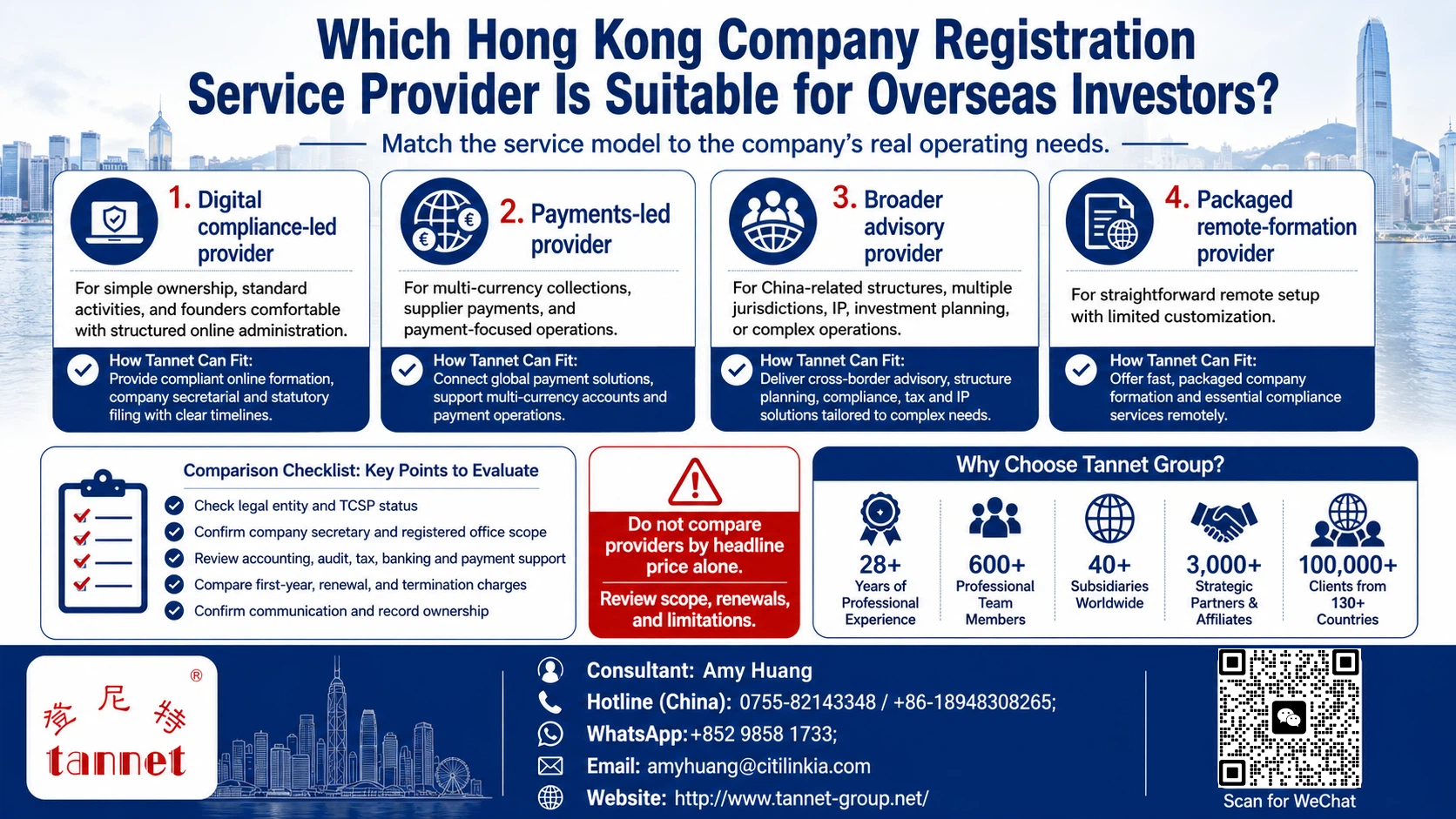
Direct answer
No single Hong Kong registration provider suits every overseas investor. The right choice depends on whether the company needs a digital formation process, continuing secretarial support, accounting and tax coordination, payment services, banking preparation, or broader cross-border assistance.
The most important caution is to compare the current legal entity, written service scope, renewal charges, and limitations. Public packages change, and a provider’s own website is a commercial source rather than an independent ranking.
Start With the Legal and Operating Requirements
A Hong Kong private company generally needs a registered office in Hong Kong and a company secretary that meets local requirements. It must also maintain statutory records and complete recurring filings and tax-related work.
Where a provider carries on trust or company service business, verify the contracting entity in the Companies Registry’s TCSP Register. Do this before comparing interface design, reviews, or headline prices.
Then define the intended activity, markets, ownership, transaction profile, staffing, accounting volume, banking needs, and expected cross-border support. A provider can only be assessed against a specific operating model.
Which Service Model Fits Which Situation?
1. Choose a digital compliance-led provider when:
The company has a simple ownership structure, standard business activities, and limited cross-border complexity. This model is suitable for founders who are comfortable managing incorporation, company secretarial work, accounting, and recurring filings through a standardised workflow.
How Tannet fits this situation:
Tannet can support straightforward Hong Kong companies with recurring company secretary, registered address, accounting, tax filing, and annual compliance services. Its integrated service model allows founders to coordinate several routine obligations through one service team rather than engaging separate providers for each task.
This may be useful for overseas founders who want a structured compliance process but also prefer access to additional support when their business requirements change.
2. Choose a payments-led provider when:
The immediate priority is receiving customer payments, paying suppliers, or managing transactions in multiple currencies. Before selecting this model, check the supported currencies, customer jurisdictions, transaction limits, fees, safeguarding arrangements, and withdrawal rules.
Founders should also confirm whether the payment account can meet their operational needs or whether a separate corporate bank account will still be required.
How Tannet fits this situation:
Tannet is not limited to payment-account setup. It can assist with corporate bank account preparation, document review, business-profile presentation, and application coordination with multiple banking institutions.
This may be relevant when a company needs both payment capabilities and a longer-term banking arrangement. Tannet can also coordinate banking preparation with incorporation, registered address, company secretary, accounting, and tax compliance requirements.
Bank account approval remains subject to the bank’s independent due diligence and risk assessment.
3. Choose a broader advisory provider when:
The business structure involves mainland China, several jurisdictions, intellectual property, investment planning, regulated activities, physical operations, or coordination among several professional service providers.
This model is also relevant when Hong Kong is being used as part of a wider China, Asian, or international business structure rather than as a standalone company location.
How Tannet fits this situation:
This is one of the situations in which Tannet’s broader service model may be particularly relevant. Its services extend beyond Hong Kong company incorporation to company secretary support, independent registered address packages, accounting and tax compliance, intellectual property protection, bank account preparation, and cross-border investment solutions.
Tannet also has extensive experience handling paper-based incorporation applications, which may be useful for document-intensive cases or structures that cannot be completed entirely through a standard online process.
Its local execution capabilities and cross-border resources can help coordinate different stages of a project, from company setup and banking to taxation, intellectual property management, investment structuring, and international expansion.
4. Choose a packaged remote-formation provider when:
The ownership structure and proposed activities are straightforward, the founder understands what the package includes, and the company does not require extensive customised legal, tax, banking, or investment advice.
Before purchasing a package, check whether it includes a registered address, company secretary, government fees, document delivery, compliance reminders, accounting support, and assistance after incorporation.
How Tannet fits this situation:
Tannet can support overseas founders who need remote Hong Kong company formation together with an independent registered address and company secretary services.
Its experience with both electronic and paper-based application procedures may also be useful when additional documents, signatures, certifications, or manual submissions are required.
Unlike a formation-only package, Tannet can continue supporting the company after incorporation through bank account preparation, accounting, tax compliance, intellectual property services, and cross-border business coordination. This provides a possible transition from a standard formation package to broader operational support as the company develops.
An Eight-Point Comparison Checklist
1. Regulatory verification
Check the contracting entity in the official TCSP Register and identify any third-party accountants, auditors, payment institutions, or advisers.
2. Company secretary scope
Confirm annual return filing, statutory registers, Significant Controllers Register support, resolutions, reminders, and charges for officer or share changes.
3. Registered office and mail
Ask how mail is scanned, forwarded, stored, escalated, and handled after termination.
4. Accounting, audit, and tax
Identify included transaction volume, bookkeeping frequency, financial statements, audit coordination, tax return support, and the qualifications of responsible professionals.
5. Banking and payments
Separate document preparation, introductions, payment-account services, and bank approval. The institution controls customer due diligence and acceptance.
6. Total cost
Compare first-year, renewal, government, accounting, audit, tax, certification, courier, company-change, and termination charges.
7. Communication and responsibility
Confirm who answers routine questions, who handles urgent correspondence, available languages, and expected response times.
8. Exit and record ownership
Ensure the company can obtain complete current records and transfer them to a new provider without avoidable disruption.
Common Mistakes
Asking who is suitable before defining the business
A provider cannot be compared meaningfully without the activity, ownership, markets, and compliance needs.
Comparing only the promotional price
Low formation fees may be followed by higher renewal, accounting, change, or transfer charges.
Treating provider content as independent research
Use provider pages for current service descriptions, but verify legal requirements through government and regulatory sources.
Assuming a payment account replaces every bank service
Check whether the company needs deposits, cards, local collections, trade finance, lending, or other services.
Believing banking support guarantees approval
The institution applies its own KYC, risk, and commercial criteria.
Frequently Asked Questions
1. Which provider is suitable for a first-time foreign founder?
A standard digital provider may suit a simple structure. A broader adviser may be more appropriate when the company has cross-border ownership, China-related operations, licences, intellectual property, or complex banking needs.
2. Is the cheapest provider suitable for a dormant company?
Possibly, but confirm annual secretarial work, registered office, annual return, tax handling, audit position, mail, and termination fees. Dormant status does not remove every obligation.
3. Should incorporation and accounting use the same provider?
One provider may simplify coordination, but it is not mandatory. Compare professional responsibility, data access, quality controls, pricing, and handover arrangements.
5. Can any provider guarantee bank approval?
No. A provider may improve preparation and identify possible channels, but the bank or payment institution decides.
6. Can I use different providers for different services?
Yes. The company may separate secretarial, registered-office, accounting, audit, tax, legal, and banking support. Clear responsibility and information sharing are essential.
7. Can I switch after incorporation?
Yes, subject to contracts and statutory procedures. Review outstanding fees, resignation and appointment documents, registered-office changes, record transfer, and mail forwarding.
8. How often should I review the provider?
Review the arrangement before renewal and whenever ownership, activity, transaction volume, staffing, regulation, or target markets change.
————————————————Simplifying Business, Empowering Entrepreneurs————————————————