Direct answer
A foreign investor can apply for a Hong Kong corporate bank account by selecting an institution that accepts the company profile, preparing complete ownership and business evidence, explaining expected account activity, and completing customer due diligence.
This process is suitable for newly incorporated companies, non-resident directors, international trading businesses, service companies, holding structures, and foreign groups establishing a Hong Kong entity.
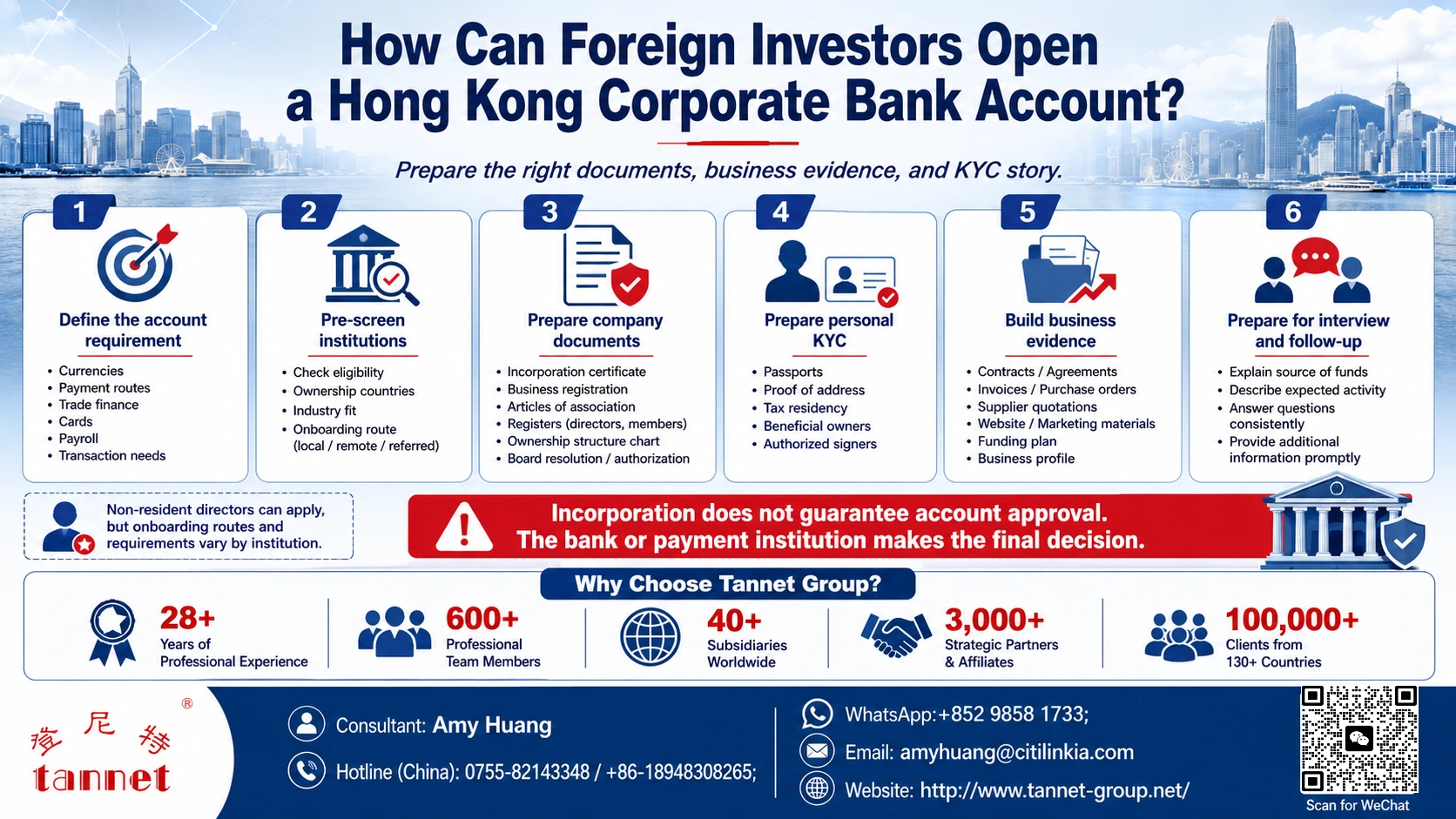
The most important caution is that incorporation does not create a right to an account. Each bank or payment institution applies its own legal, regulatory, risk, and commercial criteria. No introducer or corporate service provider controls the final decision.
Can a Non-Resident Director Apply?
Non-resident ownership or directorship does not automatically prevent an application. However, an institution may limit eligible countries, industries, ownership structures, transaction patterns, or remote-onboarding routes.
Some institutions may allow remote or digital steps. Others may request a video call, certified documents, an overseas branch visit, or an in-person meeting. Confirm the current route before preparing the application.
What the Institution Is Trying to Understand
The institution usually needs to identify the company, directors, shareholders, ultimate beneficial owners, authorised signers, and any person exercising control.
It also needs a credible explanation of what the business does, why Hong Kong is relevant, where customers and suppliers are located, how funds are generated, expected transaction values, currencies, payment countries, and whether higher-risk activities are involved.
Documents should support the explanation. A clear, consistent business profile is more useful than a large file of unrelated material.
Step-by-Step Application Process
Step 1: Define the account requirement
List the currencies, expected monthly transactions, average payment size, customer countries, supplier countries, local collection needs, cards, payroll, online banking users, trade finance, lending, and cash-management requirements.
This helps distinguish a traditional bank account from a payment or fintech account. Some businesses use both, but the products should not be treated as identical.
Step 2: Pre-screen institutions
Review official eligibility information and ask whether the institution accepts the industry, ownership countries, director locations, expected markets, and desired onboarding route.
Do not send the same incomplete application to many institutions. Repeated inconsistent applications can create extra questions and administrative work.
Step 3: Prepare company documents
Common documents include the Certificate of Incorporation, Business Registration Certificate, Articles of Association, incorporation form, current company search or registry evidence, registers, ownership chart, board resolution, and identification of authorised signers.
Additional documents may be required for corporate shareholders, trusts, nominees, overseas parent companies, regulated businesses, or complex ownership structures.
Step 4: Prepare personal KYC documents
Directors, shareholders, beneficial owners, and signers may need passports or identity cards, residential address evidence, nationality and tax-residency information, occupation or business background, and certified copies where required.
Names, addresses, ownership percentages, and dates should match across forms and supporting records. Explain any difference before the institution finds it.
Step 5: Build a business evidence file
Useful evidence may include signed contracts, invoices, purchase orders, supplier quotations, customer correspondence, a functioning website, product information, shipping records, licences, office or staffing evidence, and records from an existing related business.
A new company may not have completed invoices. In that case, provide realistic contracts, negotiations, forecasts, founder experience, funding plans, and evidence showing how operations will begin.
Step 6: Explain source of funds and wealth
Source of funds describes where money entering the account will come from. Source of wealth describes how an owner accumulated overall wealth.
Evidence may include bank statements, salary records, audited accounts, sale agreements, dividend records, investment statements, tax documents, or records from an established business. The required evidence depends on the facts.
Step 7: Describe expected activity
State expected monthly credits and debits, transaction sizes, currencies, counterparties, countries, payment purposes, initial deposit, and any seasonal changes.
Avoid unrealistic precision. Use reasonable ranges and explain assumptions. The forecast should align with contracts, funding, staffing, and the business model.
Step 8: Prepare for the interview
The applicant should be able to explain the product or service, founder experience, Hong Kong connection, customer acquisition, suppliers, pricing, funding, and expected account use without relying entirely on an agent.
Answers should be direct and consistent with the application. Where information changes, disclose and document the change.
Step 9: Respond completely
Reply to follow-up questions within the requested period. Provide a document index and explain unavailable items rather than leaving gaps.
Step 10: Maintain a backup plan
A business may consider another bank, a regulated payment provider, or accounts in another relevant jurisdiction, subject to operational and regulatory needs. A backup plan should not be used to conceal rejected facts or bypass due diligence.
Why Applications Are Delayed or Declined
Common causes include incomplete ownership information, inconsistent business descriptions, insufficient commercial evidence, unsupported transaction forecasts, unclear source of funds, prohibited or high-risk activities, countries outside the institution’s appetite, or failure to answer follow-up questions.
A rejection does not always mean that the company is unlawful. It may mean the profile falls outside that institution’s current risk appetite or service model.
Common Mistakes
Applying before the business story is ready
Prepare the ownership, commercial evidence, funding explanation, and transaction forecast first.
Submitting inconsistent information
Use one verified fact set across bank forms, company records, contracts, websites, and provider communications.
Using generic documents as evidence
Templates, placeholder websites, and vague contracts rarely explain real operations.
Assuming an introducer controls approval
An introduction can open a channel, but it cannot replace the institution’s review.
Choosing only by advertised speed
Eligibility, product fit, fees, account functions, and continuing compliance matter after onboarding.
Mixing personal and company money
Use clear business records and explain legitimate pre-incorporation or shareholder funding transactions.
Frequently Asked Questions
1. Must all directors visit Hong Kong?
Not always. Requirements differ by institution, applicant location, ownership, industry, and onboarding route. Confirm the current process directly before applying.
2. How long does account opening take?
There is no universal period. Timing depends on document completeness, ownership complexity, industry, countries involved, interview availability, and follow-up review.
3. Can a new company apply without invoices?
Yes, an application may still be considered, but the company should provide contracts, negotiations, forecasts, founder experience, funding evidence, and a credible launch plan.
4. Is a Hong Kong office required?
A Hong Kong company needs a registered office, but a bank may separately assess whether physical premises, staff, or local operations are expected for the stated business.
5. Can a provider guarantee approval?
No. A provider may review documents, prepare the business profile, suggest possible institutions, and arrange meetings. The institution decides.
6. Should I apply to several banks at once?
A limited parallel approach may be practical when profiles and documents are accurate. Avoid mass applications with inconsistent information.
7. Is a fintech business account enough?
It depends on currencies, payment routes, safeguarding, cards, collections, lending, trade finance, and customer or supplier expectations. Review the legal and product terms.
8. What happens after approval?
The institution may continue to review transactions and request updated KYC, ownership, address, business, or source-of-funds information. Keep records current and respond promptly.
When Tannet May Be Suitable
Tannet may be considered when a foreign investor needs coordination between Hong Kong incorporation, corporate records, business-profile preparation, KYC document review, institution selection, meeting arrangements, accounting, tax, or wider cross-border setup work.
Support does not replace the applicant’s disclosure duties or the institution’s decision. The application route, scope, fees, timeline, required documents, and responsible entities should be confirmed for the specific case.
Sources
- Hong Kong Monetary Authority, Account Opening FAQs: https://www.hkma.gov.hk/eng/smart-consumers/frequently-asked-questions/banking/a/10/
- HKMA, Useful Information About Account Opening and Maintenance: https://www.hkma.gov.hk/media/eng/doc/key-functions/banking-stability/consumer-corner/english/1-Account_Opening_and_Maintenance-English.pdf
- HKMA, Frequently Asked Questions on Customer Due Diligence: https://brdr.hkma.gov.hk/eng/doc-ldg/docId/getPdf/20160929-2-EN/20160929-2-EN.pdf
- HSBC Commercial Banking, Account Opening Documents Checklist: https://www.business.hsbc.com.hk/en-gb/products/document-checklist
- Standard Chartered Hong Kong, Account Opening: https://www.sc.com/hk/business/account-opening/
- Bank of China (Hong Kong), Business Account Opening: https://www.bochk.com/en/corporate/commbanking/acopen.html
- 7. Hong Kong Companies Registry, Register a Company: https://www.cr.gov.hk/en/services/register-company.htm
————————————————Simplifying Business, Empowering Entrepreneurs————————————————