TL;DR: Keeping an inactive China company can make sense when there is a realistic plan to restart operations, but inactivity does not eliminate compliance responsibilities. Formal suspension is temporary and subject to conditions, while deregistration is the appropriate route when shareholders intend to leave the market permanently.
Key Takeaways
- China distinguishes between an inactive company, formal business suspension, and full deregistration.
- Formal suspension can preserve an existing entity for a future restart, but ongoing corporate and tax responsibilities may still apply.
- Permanent closure requires more work upfront but ends the company’s legal existence once deregistration is completed.
- Shareholders should review debts, taxes, employees, licenses, records, and future China plans before choosing either path.
A China company may stop generating revenue as employees leave, contracts wind down, and headquarters shifts focus elsewhere. At that point, keeping the company registered can seem like the simplest option, especially if there is a chance of returning to China in the future.
However, this assumption can be costly because an inactive company remains legal entity, not formal suspension or deregistration. For foreign shareholders deciding whether to keep or close a China company, key question is future value versus compliance costs.
A Quiet Office Isn’t a Dormant China Company
Dormant company is a useful term but can obscure a key distinction in China’s compliance framework. Companies may simply stop trading while remaining registered, which is different from formal suspension under the Market Entity Registration Regulation.
Stopping Isn’t a Plan
Closing the office, issuing no invoices, or having no new customers does not itself terminate the legal entity. If the company continues to exist, applicable corporate, tax, reporting, and administrative responsibilities still need to be considered.
This is where foreign investors can run into trouble. A business may feel “closed” from the shareholder’s perspective while remaining very much alive on China’s corporate records.
Suspension Requires Filing
Under China’s Market Entity Registration Regulation, companies must file business suspension with registration authority before taking effect officially. Suspension period and service address are publicly disclosed, and employee matters must be settled beforehand first.
The suspension period is capped at three years, and the company must update its status if it resumes operations. This makes formal suspension a temporary compliance option rather than a long-term way to keep a company on hold.
Are You Really Coming Back?
Before comparing suspension with closure, shareholders should make an honest assessment of their China plans. A temporary interruption and a permanent market exit should not be managed in the same way.
A Pause May Justify Keeping It
Keeping the company may make sense when projects are delayed; conditions change, financing shifts, or restart plans exist. In this case, maintaining the entity is a deliberate business decision rather than procrastination.
The existing company may hold value in records, relationships, infrastructure, and licenses that would be costly and time-consuming to rebuild. Preserving these assets can make continued maintenance more efficient than starting from scratch later.
Maybe Someday Isn’t Enough
The calculation changes when there is no clear restart date, because the decision shifts from temporary pause to long-term cost. If the China strategy has ended, employees left, contracts expired, and no return expected, keeping it creates ongoing administrative burden.
A simple rule helps clarify the decision: the expected future value of keeping the company should outweigh the cost and risk of maintaining it properly. If that balance is not there, maintaining the entity becomes harder to justify over time.
Cost of Keeping China Company
The word “dormant” can create the impression that compliance also goes to sleep. That is not how formal suspension works.
Tax Obligations Don’t Disappear
China’s State Taxation Administration allows suspended entities to use simplified tax procedures, including switching from monthly to quarterly prepayments. However, even under suspension, companies must still comply with applicable tax and withholding obligations.
These simplified arrangements are not available to companies classified as abnormal taxpayers until the issue is resolved. This distinction is important because having no revenue does not automatically remove tax administration responsibilities.
Corporate Upkeep Continues
Shareholders must maintain corporate records, registrations, addresses, banking, licenses, and chops to keep the entity functional properly operating. These obligations vary by structure and situation but still require attention even when business is inactive, not operating.
Individually, these may seem manageable. Over several years, however, the cumulative cost of maintaining a company with no commercial purpose can become harder to justify.
Closing a China Company: A Clean Exit
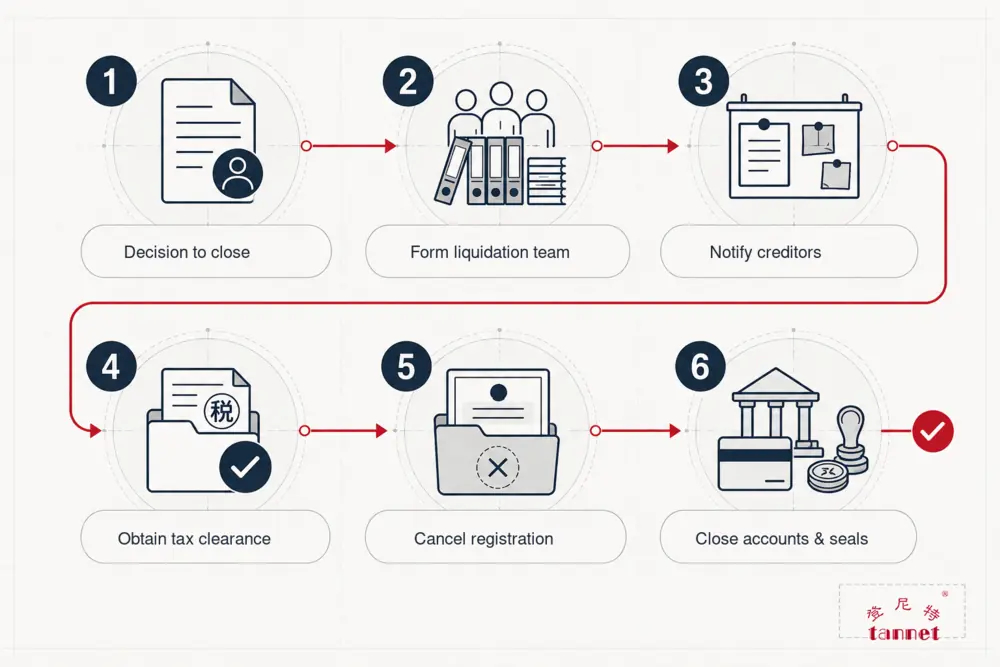
Deregistration serves a different purpose from suspension because it is intended for businesses that are permanently exiting the market. Companies must deregister upon dissolution or bankruptcy, ending legal existence after completion of process required.
For ordinary closure, this involves dissolution, liquidation, creditors, employees, taxes, assets, debts, branches, licenses, bank accounts before deregistration. Though more work upfront it formally ends legal existence and removes ongoing compliance obligations entirely.
Simplified Exit Eligibility
Not every closure follows the same process, and China offers a simplified deregistration route for qualifying market entities. This option applies where companies have no debts or have settled obligations, with investors confirming writing conditions.
Once submitted, application and commitment are published in system for 20 days allowing objections from relevant authorities or creditors. If no objections arise, the company proceeds with deregistration; unresolved cases must follow ordinary closure process instead as required.
Dormant vs Closing: Which Path Fits Your Situation?
The choice becomes clearer through comparison: suspension preserves optionality; deregistration creates finality; costs depend on duration and obligations. In practice, the decision depends on whether the company should remain active or be fully closed instead below:
- Legal status: continues under suspension, ends after deregistration
- Restart option: easier with suspension, requires new setup after closure
- Compliance: ongoing (reduced) under suspension, ends after closure
- Workload: lighter for suspension, heavier for closure
- Costs: ongoing under suspension, eliminated after deregistration
- Best fit: suspension for temporary pause, closure for permanent exit
The Hidden Cost of “Just in Case”
Keeping a China company for a year may not seem costly, but over five years the financial and administrative impact changes significantly. Over time, routine maintenance costs accumulate, and the company can also become more difficult to properly close.
Key records may be lost as staff change, making closure increasingly a document recovery and compliance cleanup process. The longer a company stays inactive, the more closing it becomes document recovery and compliance cleanup work process.
Abandoning Is Not Closing
The worst option is often neither suspension nor proper closure but simply walking away from the company. China introduced compulsory deregistration rules effective October 10, 2025, enabling authorities to act after three years inactivity company.
This process includes public notice and limited opportunities for objection or restoration in specific cases. Compulsory deregistration is not a substitute for voluntary closure, and obligations remain under revised Company Law after removal.
Compliance Check Before You Decide
Review registration status, tax position, compliance history, employees, contracts, assets, licenses, obligations, and shareholder records before deciding. Then use these six key questions to determine whether to maintain, suspend, or deregister the company:
- Is there a realistic plan to restart China operations in the next few years?
- What is the ongoing cost of maintaining the company during that period?
- Does the entity hold valuable licenses, relationships, assets, or business history?
- Are there any outstanding taxes, employees, debts, disputes, or contracts?
- Would reopening a new entity later be harder than keeping the current one?
- Will delaying closure complicate records, shareholders, or documentation?
Why Choose Tannet for China Company Exit?
Tannet Group supports foreign investors with China company formation, corporate compliance, company deregistration, voluntary winding-up, accounting, tax matters, and ongoing administration. It helps both maintain compliant entities and guide businesses through formal closure.
For overseas shareholders, exiting a China company involves more than deregistration requiring handling records taxes banks licenses creditors. Tannet supports multi-region administration across Mainland China and helps assess closure or ongoing maintenance decisions appropriately.
Keep or Close Your China Company?
An inactive company can still carry active responsibilities. Before paying to maintain an entity you may never use again, or beginning a closure without understanding its outstanding obligations, get a clear picture of where the company stands.
Contact Tannet Group today!