Thinking About Relocating to Hong Kong?
Hong Kong continues to attract global professionals with its international business environment, low tax regime, world-class financial sector, and strategic position in Asia.
For highly qualified professionals and entrepreneurs, the Top Talent Pass Scheme (TTPS) provides one of the fastest pathways to live and work in Hong Kong.
Unlike many immigration programs, TTPS does not require a job offer before application for eligible applicants. Successful applicants can relocate first and then explore employment, entrepreneurship, or investment opportunities.
This guide explains who can apply, eligibility requirements, application procedures, family benefits, taxation, and practical considerations for applicants.
What Is the Hong Kong Top Talent Pass Scheme (TTPS)?
The Top Talent Pass Scheme (TTPS) is an immigration program introduced by the Hong Kong SAR Government to attract experienced professionals and graduates from top universities around the world.
Successful applicants receive permission to:
- Live in Hong Kong
- Work for any employer
- Change employers without applying for a new work visa
- Start a business
- Invest in Hong Kong
- Bring eligible family members
The scheme is administered by the Hong Kong Immigration Department.
Who can apply: Categories A, B, and C
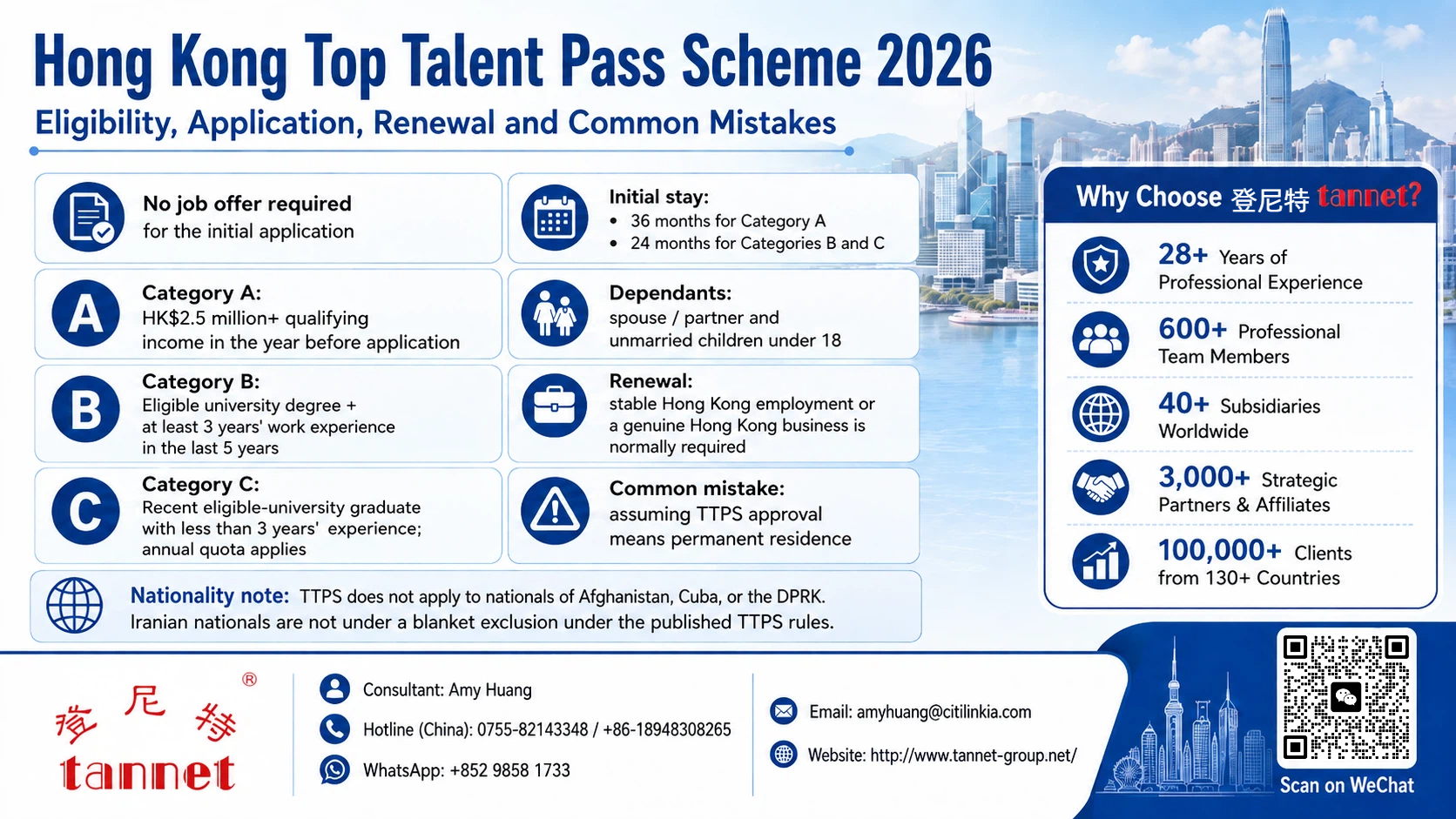
Category A is for applicants whose annual income reached HK$2.5 million or more, or the foreign-currency equivalent, during the year immediately before the application date.
For this category, income generally means taxable employment or business income. Salary, allowances, qualifying stock-option value, and profits received from a self-owned company may be relevant. Personal investment income is not normally counted. Business owners should provide tax records, audited accounts, ownership records, and evidence showing how the income was received.
Category B is for graduates of an eligible university who have accumulated at least three years of work experience during the five years immediately before applying. The academic qualification must be equivalent to a recognised Hong Kong bachelor’s degree.
Category C is for applicants who obtained a qualifying bachelor’s degree from an eligible university during the five years immediately before applying and have less than three years of work experience. Category C is subject to an annual quota allocated on a first-come, first-served basis.
Category C is not available to non-local students who obtained an undergraduate qualification through a full-time, locally accredited programme in Hong Kong. Those graduates may need to consider the Immigration Arrangements for Non-local Graduates instead.
Applicants only need to satisfy one category.
The Government updates the eligible university list. The version effective from 1 January 2026 contains 200 institutions. Verify the exact awarding body, degree level, graduation year, and campus. An affiliate may not qualify merely because its parent university is listed.
Nationality restrictions must be stated accurately
The TTPS does not apply to nationals of Afghanistan, Cuba, or the Democratic People’s Republic of Korea. This restriction is expressly stated in the Immigration Department’s guidebook.
Iranian nationals are not categorically excluded. They may apply if they meet Category A, B, or C and the general immigration requirements. Individual cases may face additional document checks, but stating that all Iranian citizens are ineligible is inaccurate.
Step-by-Step Application Process
Step 1: Select the correct category
Start with evidence, not preference. Use Category A only when the previous year’s qualifying income can be proved through independent records. A high current salary does not replace the previous-year requirement.
Step 2: Verify the academic qualification
Prepare the degree certificate, transcript, and academic verification evidence. The Immigration Department may require verification through the awarding institution or an accepted third-party verification body. A diploma, honorary degree, postgraduate certificate, or qualification issued by an unrecognised affiliate may not satisfy the bachelor’s-degree requirement.
Step 3: Build a consistent evidence file
The application form and supporting documents should tell the same story. Dates, job titles, employers, income figures, company ownership, and graduation details should be consistent across passports, tax assessments, employment letters, contracts, corporate records, and bank evidence.
Step 4: Submit the online application
TTPS applications are submitted online. The applicant uploads the required identity, income, education, employment, and family documents. Mainland residents may also need consent to work in Hong Kong from their current work unit or the relevant Mainland authority, depending on their circumstances.
Step 5: Plan activation and Hong Kong identity formalities
After approval, the applicant receives an electronic visa or entry permit. The person must use the appropriate travel document and complete entry formalities. Approval alone is not the same as building an ordinary residence record in Hong Kong.
Initial stay, work flexibility, and dependants
Category A entrants are normally granted an initial stay of 36 months. Category B and C entrants are normally granted 24 months. Each applicant may receive this initial TTPS arrangement only once.
The holder may work for different employers or run a business during the permitted stay. A spouse or legally recognised partner and unmarried dependent children under 18 may apply as dependants. Approved dependants are generally allowed to work and study, while their stay is normally linked to the main applicant.
What Taxes Will Professionals Pay?
Hong Kong applies a territorial tax system.
Individuals are generally taxed on income arising in or derived from Hong Kong.
Key tax rates include:
| Tax |
Rate |
| Salaries Tax |
①Net chargeable income is taxed at progressive rates from 2% to 17%
Basic allowance for a single taxpayer is HKD 145,000
Basic allowance for Married Person is HKD 290,000
②or the standard rate (15% on the first HKD 5 million of net income and 16% on the remaining amount) if progressive rates do not apply |
| Profits Tax (Corporations) |
8.25% on the first HKD 2 million of assessable profits, then 16.5% thereafter |
Foreign income is not automatically taxable simply because an individual lives in Hong Kong. Tax obligations depend on the source and nature of the income.
Renewal is the main planning issue
A TTPS holder applying for an extension must normally show that he or she has secured employment with a stable income in Hong Kong or has established or joined a genuine Hong Kong business.
For employed applicants, the role should normally require degree-level knowledge, professional or technical qualifications, or documented expertise. The remuneration should be broadly at market level. Immigration officers may consider salary, economic contribution, employment continuity, and time spent in Hong Kong.
For entrepreneurs, merely registering a company is not enough. Evidence may include business registration, incorporation records, ownership, licences, office arrangements, contracts, turnover, audited or management accounts, tax filings, investment, local employment, and a credible development plan.
A normal extension may be granted for up to three years or the remaining contract period, whichever is shorter. A holder admitted under TTPS for at least two years who recorded at least HK$2 million in assessable salaries-tax income in the previous tax year may request the top-tier stream, which normally grants six years if approved.
Common mistakes
- Treating TTPS approval as permanent residence. The scheme grants temporary stay first. Permanent residence requires a separate seven-year ordinary-residence assessment.
- Using gross wealth or investment gains for Category A. The income test focuses on qualifying employment or business income, not the value of assets or passive investments.
- Assuming every campus or affiliate of a listed university qualifies. The exact awarding body and programme must be checked.
- Applying under Category C too late. The category is quota-based and first-come, first-served.
- Ignoring renewal until the final months. Employment, business, tax, and residence evidence should be built throughout the initial stay.
- Opening a shell company only for renewal. The Immigration Department examines whether the business genuinely operates and contributes economically.
- Repeating an inaccurate nationality claim. Afghanistan, Cuba, and North Korea are excluded. Iran is not subject to a blanket exclusion under the published TTPS rules.
Frequently asked questions
1. Do I need a Hong Kong job offer before applying?
No. TTPS applicants are not required to secure employment before the initial application. Employment or genuine business activity becomes important for renewal.
2. Can I qualify under Category A through dividends or investment profits?
Personal investment income is generally not counted. Income from a self-owned operating company may be considered when supported by ownership, tax, and financial evidence.
3. My university is highly ranked but not on the current list. Can I use Category B or C?
Not normally. The exact institution must appear on the Government’s eligible university list applicable to the application.
4. Can my spouse work in Hong Kong?
An approved dependant is generally permitted to work and study without a separate employment visa, subject to the dependant policy and continued validity of the main applicant’s stay.
5. Can an Iranian citizen apply?
Yes, potentially. Iran is not listed as a nationality excluded from TTPS. The applicant must still satisfy a category and all general immigration requirements.
6. How long can I initially stay?
The normal initial stay is 36 months for Category A and 24 months for Categories B and C.
7. Is a newly incorporated Hong Kong company enough for renewal?
No. The applicant should prove real operations, financial capacity, business activity, and a sustainable role in the company.
8. Does seven years automatically produce permanent residence?
No. The applicant must make a separate application and demonstrate continuous ordinary residence under Hong Kong law.
When Tannet may be suitable
Tannet may assist applicants who need a pre-application eligibility review, income and corporate-document organisation, academic-document coordination, certified translation coordination, dependant application preparation, or a practical plan linking TTPS status with Hong Kong employment or genuine business operations.
For entrepreneurs, Tannet may also coordinate incorporation, company secretary, registered address, accounting, tax, banking preparation, intellectual property, and corporate records. Approval and renewal remain Immigration Department decisions; no provider can guarantee an outcome.
————————————————Simplifying Business, Empowering Entrepreneurs————————————————