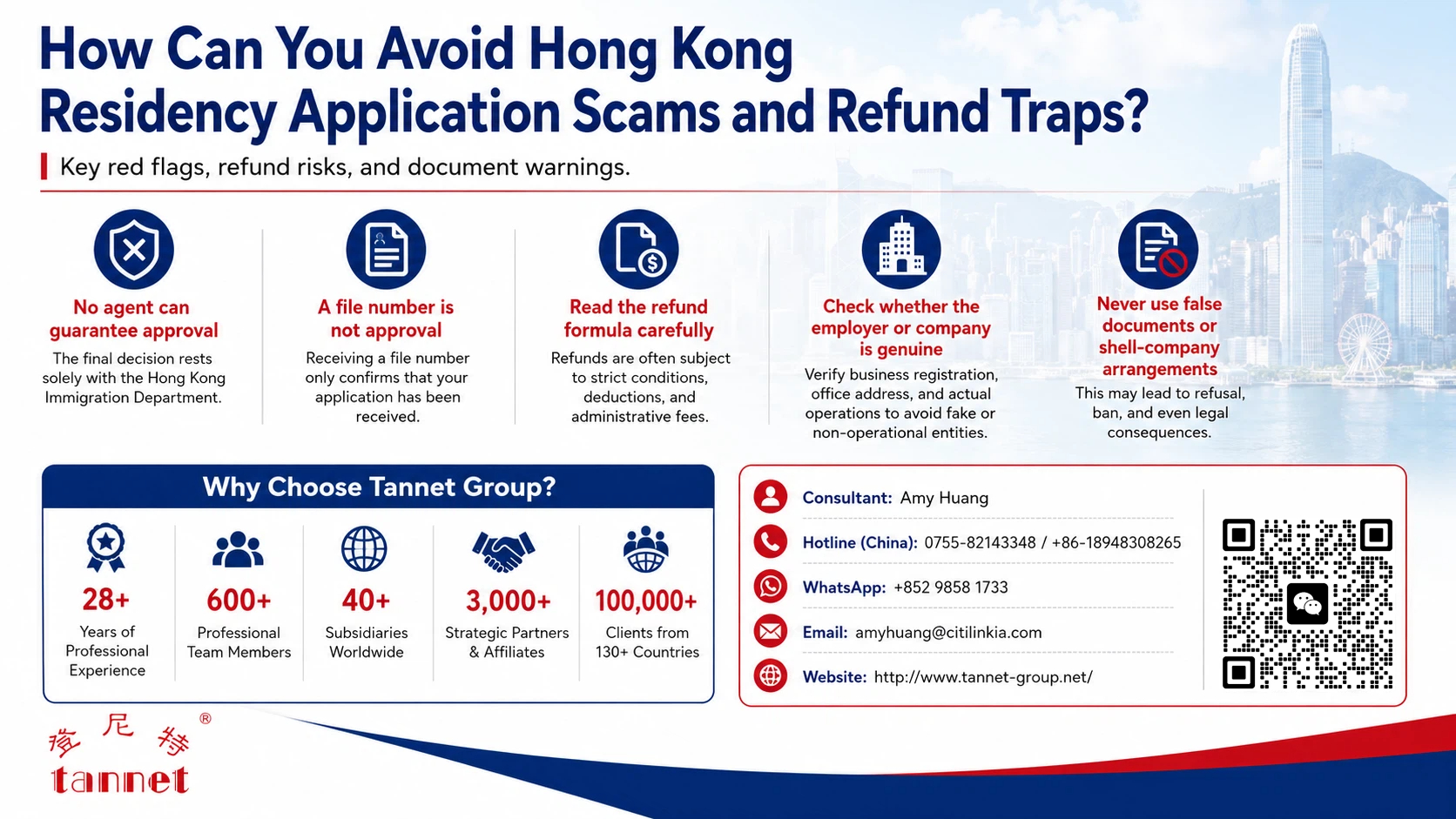
Key Takeaway
Hong Kong “identity” is not a single product that an agency can sell or guarantee. It is an immigration permission granted by the Hong Kong Immigration Department under a specific admission scheme. The most important warning is simple: avoid any provider that promises approval, claims an internal channel, encourages false evidence, or makes refunds depend on a low-value procedural milestone.
The largest financial loss often comes after signing. A low headline fee may be followed by extra charges. A refund promise may disappear once an application number is issued. The applicant carries the legal risk when an agent creates a false job, shell company, or fabricated document.
1. Understand what an agent can and cannot do
A legitimate adviser may assess eligibility, organise evidence, review consistency, prepare translations, explain procedures, and help with document requests.
An adviser cannot control the Immigration Department. No private provider can promise approval, accelerate a case through personal connections, or remove a scheme’s substantive requirements.
2. Red flag: “Guaranteed approval” or an “internal route”
Claims such as “we know the officer,” “special quota,” “relationship fee,” or “approval without working or visiting Hong Kong” should be treated as major warning signs.
These statements exploit information gaps. If the case fails, the contract may transfer responsibility for documents, policy changes, or undisclosed facts to the applicant.
The agent collects a premium for a promise it cannot control, while the applicant keeps the refusal and compliance risk.
3. Red flag: an unusually cheap employer-sponsored package
Some packages are marketed with a small initial charge and a promise that most fees will be refunded if the case fails. The service may involve an employer-sponsored professional route.
Employer-sponsored applications require more than a company name. The employer, role, salary, duties, qualifications, experience, and business need must form a credible and consistent case.
A weak package may use an inactive employer, an unsuitable position, or a job title that does not match the applicant’s background.
The application may be delayed or refused. Families facing a dependant’s age deadline can lose more than the service fee because lost time may affect education or relocation plans.
Case Study: Penny Wise, Pound Foolish – A Hasty Choice Ruined a Child’s Future
Mr. Wang wanted to secure Hong Kong identity for his child before they turned 18. Attracted by an agency’s low-ball offer of a “200,000 RMB all-inclusive” package for Talent Scheme, he signed a contract in haste. However, after months of zero progress, the application stalled, and they ultimately missed the deadline for the child to be included as a dependent (age 18). By trying to save a little money upfront, he ended up compromising his child’s future planning.
4. Red flag: “Company operation” sold as a renewal guarantee
A common renewal pitch is: “We will operate a company for you, create records, and secure the extension. If it fails, we refund part of the fee.”
The key issue is substance. Immigration authorities assess whether employment and business activity are real. Book entries, circular payments, a virtual shell, or invented contracts do not create genuine economic activity.
A renewal may require evidence of actual work, contracts, customers, revenue, tax records, premises, staff, and the applicant’s role.
If an arrangement involves false statements, the applicant may face refusal, cancellation of existing permission, investigation, prosecution, and long-term immigration consequences. An agent’s instructions do not remove the applicant’s responsibility for signed documents.
5. The application-number refund trap
One of the most important contract clauses concerns the application reference or file number.
A provider may offer a full refund before submission but only a partial refund after the file number.
A file number usually confirms that the authority received the application. It is not an approval signal. It does not prove that the provider completed high-value work. It does not indicate that the case is strong.
The provider may secure most revenue before the application receives meaningful assessment.
Ask what work is completed at each payment stage. The refund schedule should be linked to defined deliverables, not merely to the receipt of a procedural number.
6. Contract clauses that transfer all risk to the applicant
Read the main agreement and every annex. A headline promise may be weakened by broad exclusions.
Common examples include:
- Policy changes are entirely the client’s responsibility.
- Any document concern cancels the refund.
- The provider decides whether the client cooperated.
- Delays caused by third parties permit unlimited extensions.
- The client accepts all consequences of employer or company arrangements.
- Refund timing is not stated.
- Refunds exclude “administration,” “resource,” or “coordination” charges that are not defined.
A fair contract should identify the service scope, payment stages, excluded work, client duties, provider duties, refund triggers, refund amount, refund deadline, and dispute process.
7. Hidden fees after a low-price quotation
A low initial quotation may exclude services that are likely to become necessary.
Later charges may be described as degree verification, employer matching, document certification, translation, business-plan drafting, interview coaching, urgent handling, dependant preparation, or renewal planning.
These services may be legitimate. The problem is undisclosed pricing.
Request a written full-cycle fee list covering government fees, third-party charges, optional work, extra-charge triggers, and family members.
8. The most dangerous practice: fake documents and “attachment” arrangements
Never accept fabricated education records, employment letters, salary evidence, residence records, tax documents, contracts, customer invoices, or bank transactions.
The applicant normally signs declarations and submits information under the applicant’s identity.
A shell employer, nominal job, or false business may create a short-term appearance of eligibility. Renewal, tax, banking, employment, travel, and business records may later contradict the original story.
Submit only facts that can be independently verified.
9. A practical due-diligence checklist
Step 1: Confirm the exact immigration route
Ask for the official name of the scheme. Request a written explanation of eligibility, evidence, initial stay, dependant rules, and renewal requirements.
Step 2: Ask who performs each service
Confirm the contracting legal entity, responsible office, case manager, employer or business partner, and any outsourced professional.
Step 3: Test the provider’s claims
Separate contractual deliverables from government assessment. A preparation commitment is not an approval guarantee.
Step 4: Review the refund formula
Calculate the refund at each stage. Identify whether a file number, submission, request for documents, approval-in-principle, or visa issuance changes the amount.
Step 5: Review the evidence strategy
Ask which documents will be submitted. Refuse any proposal involving false employment, artificial revenue, circular payments, or invented residence.
Step 6: Protect deadlines
Do not let a low-price offer consume months when dependant age, graduation, work-experience, or visa deadlines apply.
Step 7: Keep a complete file
Retain the signed contract, quotation, invoices, messages, submitted forms, supporting evidence, and every version of documents.
Common mistakes
- Believing that a large fee buys influence over the approval decision.
- Choosing the lowest price without checking whether the employer, job, or business is genuine.
- Treating an application number as proof of case progress or service value.
- Signing a refund promise without reading exclusions and deduction clauses.
- Allowing an agent to submit documents that the applicant has not checked.
- Waiting until a family or visa deadline is close before changing providers.
- Assuming the agent will carry the legal responsibility for false statements.
Frequently asked questions
1. Can an agency guarantee a Hong Kong residence application?
No. An agency can guarantee defined work, such as document review or submission support. It cannot guarantee an independent immigration decision.
2. Is a “no approval, no fee” offer always safe?
No. Check what counts as a fee, when money becomes non-refundable, and whether administrative or third-party charges are excluded from the refund.
3. Does receiving a file number mean the application is likely to succeed?
No. It normally means the application was received and registered. It is not an assessment result.
4. Can I use an employer arranged by an agent?
Only when the employment is genuine. The role, duties, salary, employer operations, and applicant’s background should withstand independent review.
5. Can a newly formed company support renewal?
Company registration alone is insufficient. The business should have genuine operations, records, financial activity, and a credible role for the applicant.
6. What should I do if an agent asks me to sign a blank form?
Do not sign it. Request the completed form and review every statement and attachment before submission.
7. What should a refund clause include?
It should state the trigger, amount, deductions, deadline, payment method, required documents, and dispute mechanism.
When Tannet may be suitable
Tannet may assist when an applicant needs a structured eligibility review, document consistency check, contract-scope discussion, certified translation coordination, dependant preparation, or a realistic plan connecting immigration status with genuine employment or business activity.
For entrepreneurs, support may also include company incorporation, company secretary, registered address, accounting, tax, banking preparation, and corporate record maintenance. Approval and renewal remain government decisions, and no service provider can guarantee the outcome.
————————————————Simplifying Business, Empowering Entrepreneurs————————————————