Key Takeaway
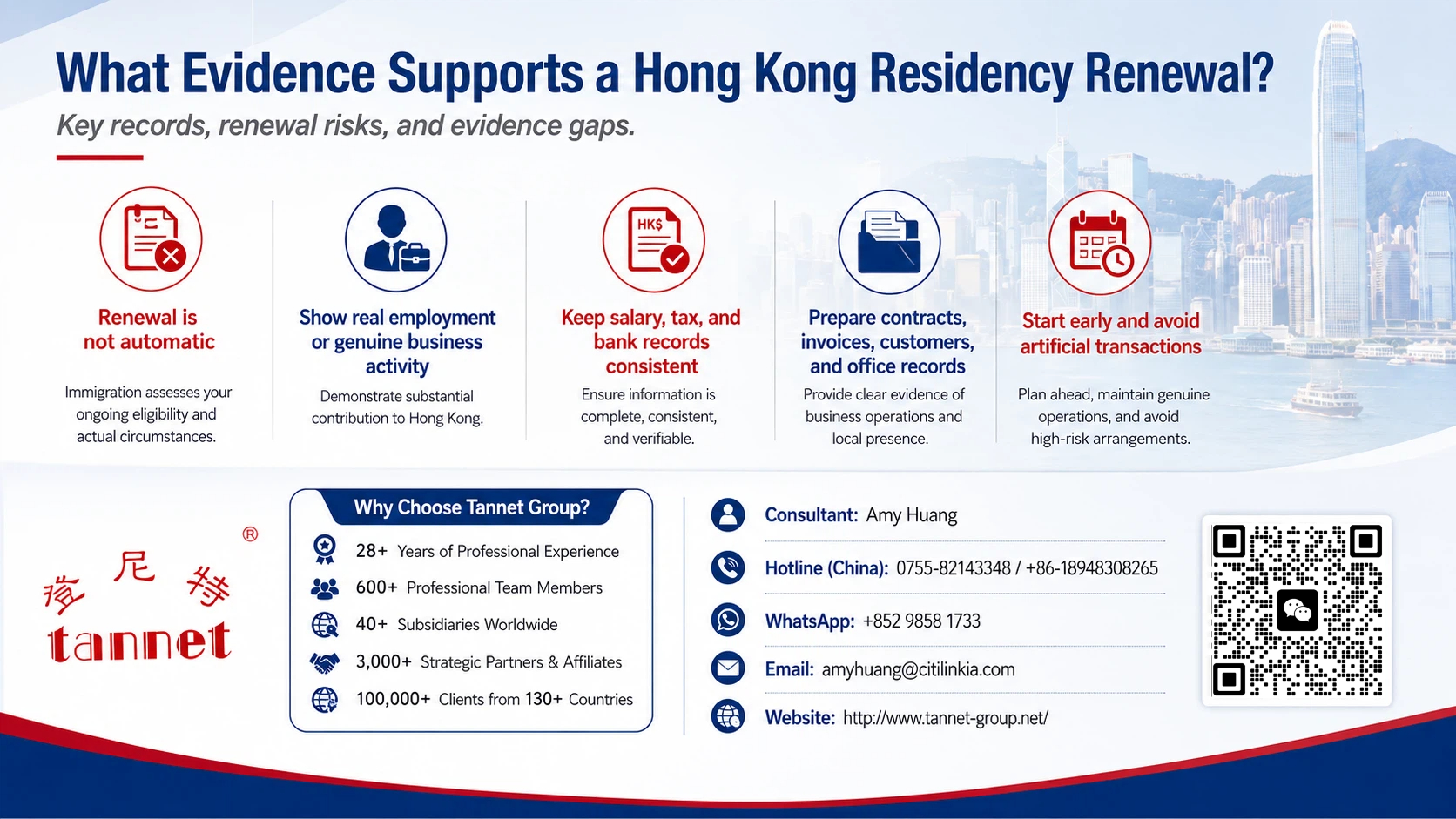
Hong Kong Top Talent Pass Scheme(TTPS) renewal is not an automatic extension of an earlier approval. The most important point is that the applicant must continue to satisfy the relevant route and provide credible evidence of real employment, business activity, income, tax compliance, and residence circumstances.
A successful first application proves eligibility at entry. Renewal tests what happened afterwards. Applicants who wait, rely on a shell company, or accept an artificial employer may lack supporting records.
1. Mistaking initial approval for a long-term guarantee
Initial permission has an expiry date. It is not permanent residence and it does not guarantee renewal.
The renewal authority may review employment continuity, job duties, salary, employer activity, business substance, tax records, time spent in Hong Kong, and the applicant’s contribution.
Permanent residence is a separate process. It normally requires a later assessment of ordinary residence over the relevant period.
2. Starting renewal planning too late
Renewal evidence is created over time. It cannot always be manufactured in the final weeks.
Employment records, salary payments, tax filings, business contracts, customer receipts, office arrangements, and residence history should develop during the permitted stay.
A last-minute adviser can organise existing evidence. The adviser cannot create years of genuine activity that never occurred.
3. Using a nominal employer or mismatched position
An employer-sponsored renewal should show real employment.
Warning signs include an inactive employer, no salary payment, no tax reporting, unclear duties, a position unrelated to the applicant’s experience, or documents that use different job titles and dates.
The applicant should be able to explain the role, reporting line, daily work, qualifications, remuneration, and employer’s business need.
4. Treating a registered company as sufficient evidence
A certificate of incorporation proves that a company exists legally. It does not prove that the company operates.
A business-based renewal may require contracts, invoices, bank records, revenue, expenses, tax filings, licences, premises, investment, staff, suppliers, customers, and proof of the applicant’s active role.
A company with no customers, no commercial records, no tax position, and no credible plan is weak evidence.
5. Using “managed operations” that exist only on paper
Some providers sell bookkeeping entries, temporary transactions, nominee arrangements, or pre-written contracts as a renewal package.
The issue is not whether documents exist. The issue is whether they reflect genuine events.
Artificial transactions may conflict with banking records, tax filings, customer confirmations, office inspections, travel history, or the applicant’s own explanation.
False information may lead to refusal, cancellation, investigation, and other legal or immigration consequences.
6. Ignoring tax and payroll consistency
Salary records should align with the employment contract, bank payments, employer accounts, tax filings, and mandatory employment records where applicable.
Business income should align with company ownership, financial statements, contracts, invoices, bank activity, and tax reporting.
A high salary shown in one letter but absent from bank and tax records creates an obvious credibility issue.
7. Weak residence evidence
Renewal is not always decided by physical presence alone, but residence circumstances can be relevant.
Applicants should retain tenancy records, utility records, travel history, school records for children, local banking activity, medical or insurance records, and other evidence that explains their connection with Hong Kong.
Long absences should have a clear and truthful explanation.
8. Dependants are linked to the main applicant
A spouse, partner, or child may depend on the main applicant’s valid status.
If the main applicant’s renewal fails, the family’s immigration plan may also be affected.
Families should review dependant age limits, passport validity, school timing, and document needs before the main visa is close to expiry.
9. A safer renewal preparation sequence
Step 1: Confirm the renewal basis
Identify whether the case relies on employment, entrepreneurship, or another permitted basis.
Step 2: Build a document timeline
List monthly salary, tax, contracts, invoices, travel, residence, and business milestones.
Step 3: Reconcile inconsistencies
Correct explainable errors before submission. Do not invent evidence to fill gaps.
Step 4: Prepare a clear narrative
Explain what the applicant did in Hong Kong, how the work or business developed, and why continued stay is justified.
Step 5: Keep the business and employment real
Renewal strategy should follow actual activity. Activity should not be created solely to imitate eligibility.
Common mistakes
- Opening a company but never conducting business.
- Accepting a job title that does not match education or experience.
- Paying salary without corresponding work or records.
- Filing tax information that conflicts with the application.
- Ignoring long absences and residence evidence.
- Preparing only after the visa is close to expiry.
- Assuming a partial-refund promise removes immigration risk.
Frequently asked questions
1. Is renewal automatic after the first visa is approved?
No. Renewal is a new assessment based on the route and the applicant’s current evidence.
2. Is company registration enough for an entrepreneur renewal?
No. The authority may examine genuine operations, finances, contracts, customers, tax, premises, investment, and the applicant’s role.
3. Can an agent create transactions for renewal?
Artificial transactions are high risk. Evidence should reflect genuine commercial activity.
4. What employment documents are commonly relevant?
The contract, employer letter, salary records, bank payments, tax documents, job description, and evidence of actual work may be relevant.
5. Do long periods outside Hong Kong automatically cause refusal?
Not necessarily, but absences may need a truthful explanation and should be considered with the full residence record.
6. When should I start preparing?
Preparation should begin during the initial stay. A formal review several months before expiry is usually more useful than a last-minute review.
When Tannet may be suitable
Tannet may assist applicants who need a renewal-readiness review, employment or business document organisation, tax and accounting coordination, dependant preparation, or a structured explanation of genuine Hong Kong activity.
For business owners, related services may include company secretary, registered address, accounting, tax, banking preparation, licence coordination, and corporate record maintenance. Renewal remains subject to the Immigration Department’s independent assessment.
————————————————Simplifying Business, Empowering Entrepreneurs————————————————