————————————————Simplifying Business, Empowering Entrepreneurs—————————————————
Direct Answer
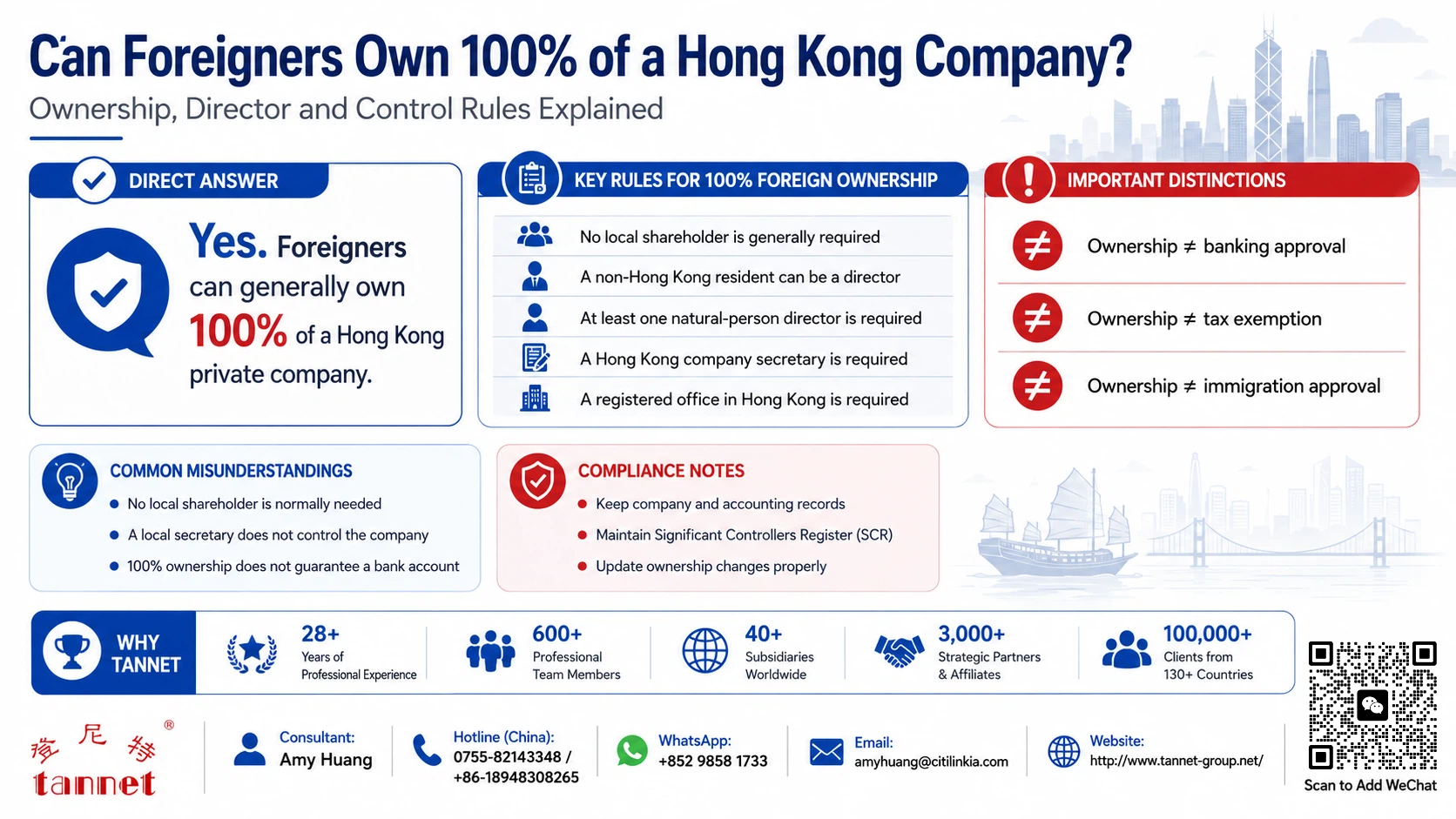
Yes. A foreign individual or overseas corporate shareholder can generally own all the shares in a Hong Kong private company limited by shares. A local shareholder is not a general statutory requirement.
The foreign owner can also act as a director. The Companies Registry confirms that a non-Hong Kong resident can be appointed as a director of a local limited company. Every private company must have at least one director who is a natural person.
Foreign ownership does not remove the company’s local compliance requirements. The company must maintain a registered office in Hong Kong and appoint an eligible company secretary. If the secretary is an individual, that person should ordinarily reside in Hong Kong. If the secretary is a corporate entity, it must have a registered office or place of business in Hong Kong.
Ownership, management, tax residence, banking and immigration are different issues. Full ownership does not mean that every application or transaction is automatically approved.
What Does 100% Foreign Ownership Mean?
A 100% foreign-owned Hong Kong company has no Hong Kong-resident shareholder unless the owner chooses to add one.
The shareholder may be:
- One foreign individual.
- Several foreign individuals.
- One overseas company.
- Several overseas companies.
- A combination of individuals and corporate shareholders.
A shareholder is a member of the company and owns its issued shares. The shareholder’s economic and voting rights depend on the Articles of Association, the class of shares and any shareholders’ agreement.
Full ownership normally gives the shareholder voting and economic control under the Articles of Association. The shareholder can approve member-level decisions, appoint directors and decide whether to issue or transfer shares. The company remains a separate legal entity, and company assets are not automatically the shareholder’s personal assets.
Is a Hong Kong Shareholder Required?
No general rule requires a typical private company limited by shares to have a Hong Kong-resident shareholder.
The Companies Registry states that a local company limited by shares can be formed by at least one founder member. Government and InvestHK materials also describe Hong Kong private companies as capable of having a shareholder and director who are not Hong Kong residents.
A local nominee shareholder should not be added merely because a founder believes it is required. Nominee arrangements can create additional legal, banking, tax and beneficial-ownership questions.
A founder should only use a nominee arrangement where there is a legitimate reason, proper documentation and professional advice.
Can the Foreign Shareholder Also Be the Director?
Yes. The same person can be the sole shareholder and sole director.
A private company must have at least one natural-person director. A non-Hong Kong resident can hold that position.
The director is responsible for managing the company. The shareholder owns the shares. The roles are legally distinct even when the same person performs both.
Directors should understand that they owe duties to the company. They should:
- Act in good faith for the benefit of the company.
- Use powers for proper purposes.
- Avoid conflicts of interest.
- Maintain accounting and corporate records.
- Ensure statutory filings are made.
- Review major transactions.
- Protect company property.
Full ownership is not a reason to ignore corporate procedures. A sole owner should still document important decisions through board or member resolutions when required.
Is a Local Director Required?
A typical Hong Kong private company does not need a resident director.
The Companies Registry expressly states that a non-Hong Kong resident can be appointed as a director. At least one director must be a natural person.
A corporate director may also be permitted for certain private companies, but the company must still retain at least one natural-person director. Corporate directorship is restricted in some company categories and group structures.
Foreign founders should not confuse Hong Kong with jurisdictions that require a resident nominee director. Hong Kong’s main local officer requirement is the company secretary, not a resident director.
Why Is a Hong Kong Company Secretary Required?
Every private company must have a company secretary.
The secretary supports the company’s statutory administration. Typical functions include:
- Maintaining statutory registers.
- Filing annual returns.
- Reporting changes in directors and secretary.
- Preparing resolutions and meeting records.
- Monitoring corporate deadlines.
- Keeping company records available as required.
Where the secretary is an individual, the person should ordinarily reside in Hong Kong. Where the secretary is a corporate entity, its registered office or place of business should be in Hong Kong.
The sole director cannot also act as the company secretary of the same company.
The company secretary is not automatically a shareholder, director or beneficial owner. The role does not transfer control of the company.
Registered Office and Operational Presence
A wholly foreign-owned company must maintain a registered office in Hong Kong.
The registered office receives official correspondence. It may also be the location where certain statutory records are kept.
A registered office is not evidence that the company has employees, management or commercial operations at that address. Banks and tax authorities may separately examine where business activities and decision-making occur.
Foreign founders should distinguish between:
- Registered office.
- Business address.
- Place where management decisions are made.
- Place where services are performed.
- Location of customers and suppliers.
- Tax residence or source-of-profit analysis.
These concepts may overlap, but they are not identical.
Can an Overseas Company Be the Sole Shareholder?
Yes. A body corporate can be a founder member or shareholder of a Hong Kong private company.
A corporate shareholder structure is common where the Hong Kong entity is:
- A subsidiary.
- A regional trading company.
- A holding company.
- A group service company.
- An investment vehicle.
The corporate shareholder will normally need to provide more documentation than an individual shareholder.
Common documents include the shareholder’s incorporation certificate, constitutional documents, director and shareholder records, an authorizing resolution, signatory evidence and an ownership chart up to the ultimate beneficial owners. Certified translations may be required. The exact due-diligence scope depends on the provider, bank and ownership chain.
Shares, Capital and Voting Rights
The incorporation documents state the initial share capital and shareholdings. A one-owner company often uses one class of ordinary shares. A company planning to add investors or employee equity may need more detailed voting, transfer and economic rights. Owning all voting shares generally gives full member-level control, while directors remain responsible for management under the Companies Ordinance and the Articles.
Beneficial Ownership and the Significant Controllers Register
Foreign ownership must be transparent to the extent required by law and customer due diligence.
Most Hong Kong-incorporated companies must maintain a Significant Controllers Register, or SCR.
A significant controller may include a person or registrable legal entity that meets an ownership or control condition. The company must take reasonable steps to identify its significant controllers and keep the register current.
The company must also appoint an eligible designated representative. The representative may be a Hong Kong-resident director, member or employee, or an accounting professional, legal professional or licensed trust or company service provider.
The SCR is not the same as the public register of members. It is kept by the company and made available to authorized law-enforcement officers.
A nominee or multi-layer structure does not remove beneficial-ownership disclosure duties.
How Banks Review a Wholly Foreign-Owned Company
A company can be legally incorporated and still face extensive bank due diligence.
A bank or payment institution may review:
- Ultimate beneficial owners.
- Source of funds and source of wealth.
- Business model.
- Customer and supplier countries.
- Expected transaction volume.
- Products or services.
- Website and commercial evidence.
- Relationship between the company and Hong Kong.
- Sanctions and higher-risk-country exposure.
Full foreign ownership is not itself a reason for rejection. However, a company with no clear business plan, no supporting contracts and a complex ownership chain may receive more questions.
Founders should prepare a consistent explanation across incorporation documents, bank forms, contracts and online information.
Does Foreign Ownership Determine Hong Kong Tax?
No. Shareholder nationality does not by itself decide the company’s profits tax position.
Hong Kong generally applies profits tax to profits arising in or derived from Hong Kong. The analysis depends on the activities that produce the profits and where those activities are carried out.
The two-tiered corporate rates may apply to an eligible corporation:
- 25% on the first HKD 2 million of assessable profits.
- 5% on the amount above HKD 2 million.
Connected-entity restrictions may apply.
A foreign owner should not assume that overseas customers automatically make all profits offshore. Source is determined on the facts. The company should keep contracts, correspondence, work records and transaction evidence.
The shareholder may also have tax obligations in the country where the shareholder resides. Hong Kong company ownership should be reviewed together with the owner’s home-country tax position.
Immigration and Nominee Arrangements
Company ownership does not automatically grant the owner a Hong Kong visa or right to work. Incorporation and immigration are separate processes.
A local nominee shareholder or director is also not a standard requirement for a typical private company. Where a nominee is used for a genuine reason, legal title, beneficial ownership, voting control, replacement rights, banking disclosure and SCR reporting should be documented clearly. A nominee should not be used merely to make the structure appear local.
How Can Ownership Be Changed Later?
A company can add investors, transfer shares or issue new shares after incorporation.
The company should review its Articles, obtain the required approvals, prepare transfer or subscription documents, update the register of members and complete any applicable stamping or statutory filing. The SCR, bank and service-provider records should also be updated. The annual return does not create the ownership change; it later reports the position at the relevant return date.
Common Misunderstandings
1. A foreign-owned company must appoint a local shareholder
This is generally incorrect for a typical private company limited by shares.
2. A local secretary controls the company
The secretary performs a statutory role. Control comes from share rights, directorship and corporate documents.
3. 100% ownership guarantees banking access
Bank approval is separate from incorporation.
4. Foreign ownership means no Hong Kong tax
Tax is determined by the relevant profits and activities, not only by the owner’s nationality.
5. A company automatically gives the owner residency
Immigration requires a separate application and approval.
Frequently Asked Questions
Q1: Can one foreign person own all the shares?
Yes. One foreign individual can generally be the sole shareholder of a private company.
Q2: Can the same person be sole shareholder and sole director?
Yes. The company must appoint a separate eligible company secretary.
Q3: Must the director live in Hong Kong?
No. A non-Hong Kong resident can be appointed as director.
Q4: Is a nominee director required?
Not for a typical Hong Kong private company. At least one natural-person director is required, but that person does not generally need to reside in Hong Kong.
Q5: Can a foreign company own the Hong Kong company?
Yes. A body corporate can hold shares, subject to documentation and due-diligence requirements.
Q6: Does the company need a Hong Kong address?
Yes. It must maintain a registered office in Hong Kong.
How Tannet Supports Foreign-Owned Structures
Tannet Group assists overseas individuals and corporate groups with Hong Kong incorporation, shareholder and director documentation, company-secretary arrangements, registered-office services and ongoing statutory maintenance. Support may also include ownership-chart preparation, bank-account application documentation, accounting, audit coordination, tax filing and intellectual property services.
The most suitable structure depends on the business purpose, ownership chain, banking plan and home-country tax position. Independent legal or tax advice may be required for complex investments, nominee arrangements or multi-jurisdictional structures.
Official Sources
Companies Registry: Incorporation FAQ;
Directors and Company Secretary FAQ;
Significant Controllers Register FAQ;
InvestHK foreign ownership publication;
IRD two-tiered profits tax rates.
————————————————Simplifying Business, Empowering Entrepreneurs—————————————————