————————————————Simplifying Business, Empowering Entrepreneurs—————————————————
Summary
Overseas directors can manage a Hong Kong company remotely. However, distance does not reduce the company’s statutory obligations.
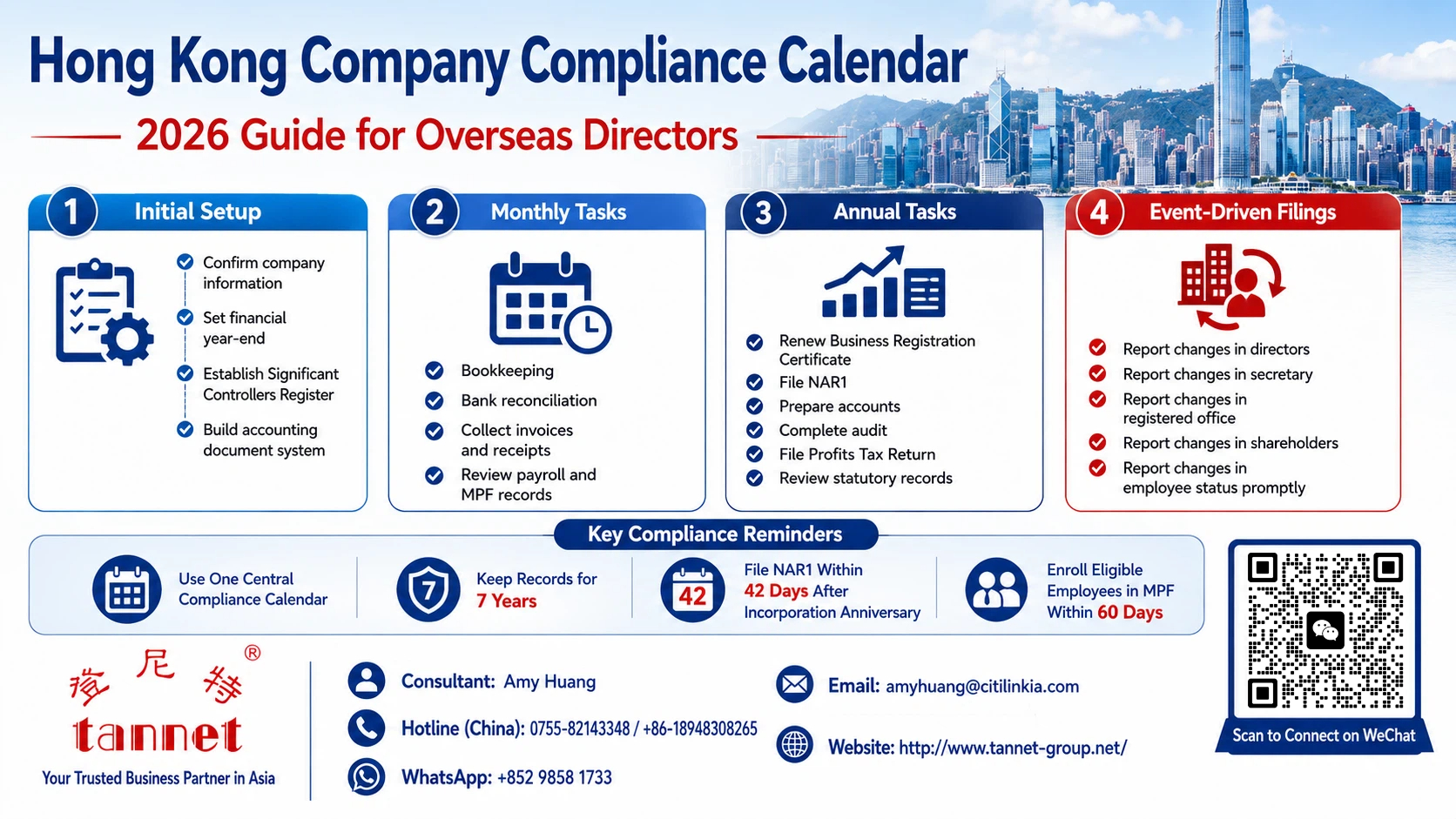
A practical compliance system should divide duties into four groups:
- Initial setup tasks.
- Monthly operating tasks.
- Annual compliance tasks.
- Event-driven filings.
The main risk is not the director’s location. The main risk is fragmented responsibility. A central calendar should identify the task, deadline, responsible person, required documents and proof of completion.
1. Use a Four-Layer Compliance Model
| Compliance layer |
Purpose |
Examples |
| Initial setup |
Build the compliance foundation |
SCR, accounting system, year-end, responsibilities |
| Monthly |
Maintain current records |
Bookkeeping, reconciliation, payroll |
| Annual |
Complete recurring filings |
NAR1, business registration, audit, tax |
| Event-driven |
Report changes when they occur |
Directors, address, ownership, employees |
Completing the annual return alone does not make a company fully compliant. Accounting, tax, corporate records and employment obligations follow separate schedules.
Part One: Initial Setup
2. Create a Company Information Sheet
Immediately after incorporation, record the following information in one controlled document:
- Company name and company number.
- Business Registration number.
- Incorporation date.
- Registered office.
- Company secretary.
- Directors and shareholders.
- Share capital.
- Principal business activities.
- Financial year-end.
- Bank and payment accounts.
Use consistent information when dealing with banks, auditors, accountants, tax authorities, payment providers, customers and suppliers. A private company must maintain an eligible company secretary and at least one natural-person director.
3. Record the Main Compliance Dates
| Date |
Why it matters |
| Incorporation anniversary |
Controls the NAR1 filing date |
| Business Registration expiry |
Controls certificate renewal |
| Financial year-end |
Controls accounting and audit work |
| Tax-return issue date |
Controls the filing deadline |
| Employee start date |
Controls payroll and MPF duties |
The incorporation anniversary and financial year-end are different concepts. For example, a company incorporated on 10 May may use 31 December as its year-end. Its NAR1 filing is linked to 10 May. Its accounting and audit cycle is linked to 31 December.
4. Establish the Significant Controllers Register
The company should identify its beneficial owners and controllers shortly after incorporation.
- Review the direct shareholders.
- Review indirect ownership and control.
- Identify persons or entities with significant control.
- Obtain the required particulars.
- Enter the information in the SCR.
- Appoint an eligible designated representative.
- Keep the register at an approved place in Hong Kong.
The SCR must remain current and be available to authorized law-enforcement officers. Review it after any ownership or control change.
5. Build an Accounting Document System
Create separate folders for sales, purchases, operating expenses, banking, contracts, payroll, tax, corporate records, loans and shareholder transactions.
Each transaction should show:
- Date
- Amount and currency
- Counterparty
- Business purpose
- Supporting document
- Payment evidence
Business and accounting records should generally be retained for at least seven years. Set file-naming rules, monthly submission deadlines, access permissions, backup procedures and document-review responsibilities.
Part Two: Monthly Tasks
6. Complete Monthly Bookkeeping
Each month, record sales invoices, customer receipts, supplier invoices, expenses, bank charges, director expenses, loans, capital contributions, payroll and foreign-exchange differences.
Accounts should not be based only on cash received and paid. They may also need to record unpaid invoices, unpaid expenses, accruals, prepayments, assets, liabilities and related-party balances.
Monthly bookkeeping reduces year-end pressure and makes missing documents easier to identify.
7. Reconcile All Financial Accounts
Reconcile the accounting records with traditional bank accounts, digital business accounts, payment gateways, corporate cards, e-commerce platforms and overseas accounts owned by the company.
Review unexplained items such as:
- Transfers without descriptions.
- Personal expenses paid by the company.
- Customer receipts without invoices.
- Payments for related companies.
- Director-funded expenses.
- Loans without agreements.
The company and its owner are separate legal and accounting entities. Personal and company funds should not be mixed without proper records.
8. Maintain Transaction Evidence
For material transactions, retain contracts, purchase orders, invoices, delivery records, service reports, email correspondence and payment confirmations.
These documents may be required for audit, tax computation, bank compliance reviews, commercial disputes and source-of-funds checks. A bank statement shows that money moved. It may not explain why the transaction occurred.
9. Manage Payroll and MPF
When the company hires employees, monthly payroll records should show basic salary, allowances, bonuses, benefits, deductions, MPF contributions, net payment and payment date.
Except for exempt persons, eligible employees aged 18 to 64 must generally be enrolled in an MPF scheme within the first 60 days of employment. Different rules apply to casual employees in the construction and catering industries.
Employers should also monitor employment contracts, leave records, employee tax forms, terminations and employees leaving Hong Kong.
Part Three: Annual Tasks
10. Renew the Business Registration Certificate
Record the expiry date of the current Business Registration Certificate. The Inland Revenue Department normally issues a renewal demand note before the new certificate period begins.
- Check that the correspondence address is correct.
- Review the renewal notice.
- Confirm the certificate period.
- Pay the correct amount.
- Retain the receipted certificate.
- Provide the updated certificate to banks or business partners when requested.
If no demand note is received, the company should contact the Inland Revenue Department within one month after the certificate expires. Business registration renewal does not complete the annual-return requirement.
11. Prepare and File NAR1
NAR1 is normally due within 42 days after the incorporation anniversary. Before filing, confirm the registered office, directors, company secretary, share capital, shareholders and principal business activity.
The on-time registration fee is HKD 105. Late fees rise to HKD 870, HKD 1,740, HKD 2,610 or HKD 3,480, depending on the length of delay.
Do not use NAR1 to replace earlier change filings. A director or address change that occurred during the year should have been reported when it occurred.
12. Close the Annual Accounts
- Complete all bookkeeping.
- Reconcile bank and payment accounts.
- Confirm customer balances.
- Confirm supplier balances.
- Review director and shareholder accounts.
- Record accruals, prepayments and depreciation.
- Identify related-party transactions.
- Prepare the trial balance.
- Collect audit evidence.
| Stage |
Suggested internal timing |
| Complete bookkeeping |
Within 1-2 months after year-end |
| Prepare audit schedules |
Within 2-3 months after year-end |
| Answer audit queries |
As soon as received |
| Finalize accounts |
Before tax filing |
| Approve accounts |
After audit completion |
These are internal management targets, not universal statutory deadlines. They help prevent late tax filing.
13. Arrange the Audit
Hong Kong companies generally require annual audited financial statements unless they have formally become dormant.
The audit file may require bank statements, the general ledger, trial balance, contracts, invoices, expense evidence, customer and supplier confirmations, loan documents, ownership records and related-party disclosures.
The audit should begin soon after year-end. Waiting until the tax deadline creates unnecessary risk.
14. File the Profits Tax Return
When BIR51 is issued, record the issue date and deadline. Complete the accounts and audit, prepare the tax computation, complete the required forms, submit the supporting documents and retain proof of filing.
Hong Kong’s two-tiered corporate profits tax rates are 8.25% on the first HKD 2 million of eligible assessable profits and 16.5% on the balance. The rules for connected entities must also be considered.
These rates apply to assessable profits. They do not apply directly to turnover, bank receipts, accounting revenue or the closing bank balance.
If the company becomes chargeable to tax but has not received a return, it may need to notify the Inland Revenue Department within the statutory period.
15. Complete Employer Reporting
The Employer’s Return is generally due by the date stated on the return. It should be completed even where the company has no employees, has not commenced business or has ceased business.
Where remuneration was paid, the employer should prepare the relevant IR56 forms. Payroll records should agree with employment contracts, bank payments, accounting records, MPF records and expense reimbursements.
16. Review Statutory Records
At least once a year, review the register of members, register of directors, register of company secretaries, SCR, share certificates, share allotment records, board resolutions, members’ resolutions and filed statutory forms.
Some corporate records must be kept longer than accounting records. For example, records of members’ resolutions and meetings generally need to be retained for at least ten years.
Part Four: Event-Driven Tasks
17. Report Director and Secretary Changes
A company should not wait until the next annual return. Appointments, resignations and changes in particulars are generally reported within 15 days using forms such as ND2A and ND2B.
Also update statutory registers, bank mandates, online access, business contracts and the SCR where relevant.
18. Report a Registered-Office Change
Form NR1 is normally filed within 15 days after the address changes. Before the change, confirm that official mail can be received, arrange forwarding, update banks, invoices, contracts and the website, and confirm where statutory records will be kept.
Changing only the address on the company website is not sufficient.
19. Document Share and Ownership Changes
A share transfer or allotment may affect the register of members, share certificates, SCR, bank KYC information, tax records, licences and commercial agreements.
Maintain board approvals, transfer or allotment documents, updated registers, stamp-duty records where applicable, and updated beneficial-ownership information. The annual return should later reflect the completed change, but it does not create the ownership change by itself.
20. Report Employee Events
| Event |
Form |
General deadline |
| New employee likely to be taxable |
IR56E |
Within 3 months |
| Termination |
IR56F |
One month before termination |
| Departure from Hong Kong |
IR56G |
One month before departure |
For an employee leaving Hong Kong, tax-clearance and payment-withholding requirements may also apply.
Recommended Compliance Calendar
| Frequency |
Task |
| Monthly |
Bookkeeping |
| Monthly |
Bank and payment-account reconciliation |
| Monthly |
Collect invoices, receipts and contracts |
| Monthly |
Payroll and MPF where applicable |
| Quarterly |
Review accounts and cash flow |
| Quarterly |
Review director and shareholder balances |
| Quarterly |
Review bank KYC information |
| Annually |
Renew Business Registration Certificate |
| Annually |
File NAR1 |
| Annually |
Prepare accounts and complete audit |
| Annually |
File profits tax return |
| Annually |
File Employer’s Return and review statutory records |
| Event-driven |
Report corporate, ownership and employee changes |
Compliance Risk Matrix
| Risk |
Possible consequence |
Priority |
| No accounting records |
Audit and tax failure |
High |
| Late profits tax return |
Penalties or estimated assessment |
High |
| Outdated ownership information |
Regulatory and banking risk |
High |
| MPF non-compliance |
Enforcement and financial liability |
High |
| Late NAR1 |
Higher fees and possible prosecution |
Medium |
| Expired business registration |
Penalties and operational issues |
Medium |
| Unreported director change |
Companies Registry non-compliance |
Medium |
| Unmonitored registered office |
Missed government notices |
Medium |
Common Mistakes by Overseas Directors
Confusing the anniversary with the year-end
The incorporation anniversary controls NAR1. The financial year-end controls accounts and audit.
Assuming the company secretary handles everything
The secretary may not know about employees, bank accounts, overseas transactions or ownership arrangements.
Sending documents once a year
Monthly record collection is more reliable and reduces audit delays.
Ignoring an inactive company
A non-trading company still has obligations unless it has formally become dormant or has been dissolved.
Mixing several companies’ transactions
Each legal entity needs separate accounting and supporting records.
Using the bank balance as profit
Bank balance, accounting profit and assessable profit are different figures.
Practical Internal Control Checklist
| Responsibility |
Suggested owner |
| Government correspondence |
Registered-office administrator |
| Companies Registry filings |
Company secretary |
| Bookkeeping |
Accountant |
| Audit coordination |
Finance manager or director |
| Tax filing |
Tax representative or director |
| Payroll and MPF |
HR or payroll administrator |
| Bank KYC updates |
Authorized director |
| Ownership records |
Director and company secretary |
Each task should have a deadline, a primary owner, a backup owner, a document checklist and proof of completion.
FAQ
1. Can overseas directors manage a Hong Kong company remotely?
Yes. Directors do not generally need to live in Hong Kong. The company must still maintain its Hong Kong registered office, company secretary, records and filing deadlines.
2. Is there one annual compliance deadline?
No. NAR1, business registration, audit, tax and employer filings follow different schedules.
3. Should bookkeeping be completed monthly?
Monthly bookkeeping is recommended because it reduces missing documents, audit delays and tax errors.
4. Does a company with no income need compliance work?
Yes. It may still need annual returns, business registration, records, accounts, audit and tax filings.
5. When must a director change be reported?
Director appointments, cessations and changes in particulars are generally reportable within 15 days.
6. How long should accounting documents be kept?
Business and accounting records should generally be retained for at least seven years.
7. What is the best way to avoid missed deadlines?
Use one central calendar. Assign each task to a named person. Retain supporting documents and proof of completion.
8. What is the main risk for an overseas-owned company?
The main risk is fragmented responsibility between directors, accountants, company secretaries, banks and payroll providers.
Conclusion
A Hong Kong compliance calendar should begin on the incorporation date. It should cover corporate records, accounting, audit, tax, business registration, beneficial ownership, employment, MPF, banking information and event-driven filings.
Remote management is practical when responsibilities are clear. A central calendar, monthly bookkeeping and documented internal controls provide a reliable foundation for long-term compliance.
————————————————Simplifying Business, Empowering Entrepreneurs—————————————————