————————————————Simplifying Business, Empowering Entrepreneurs—————————————————
Summary
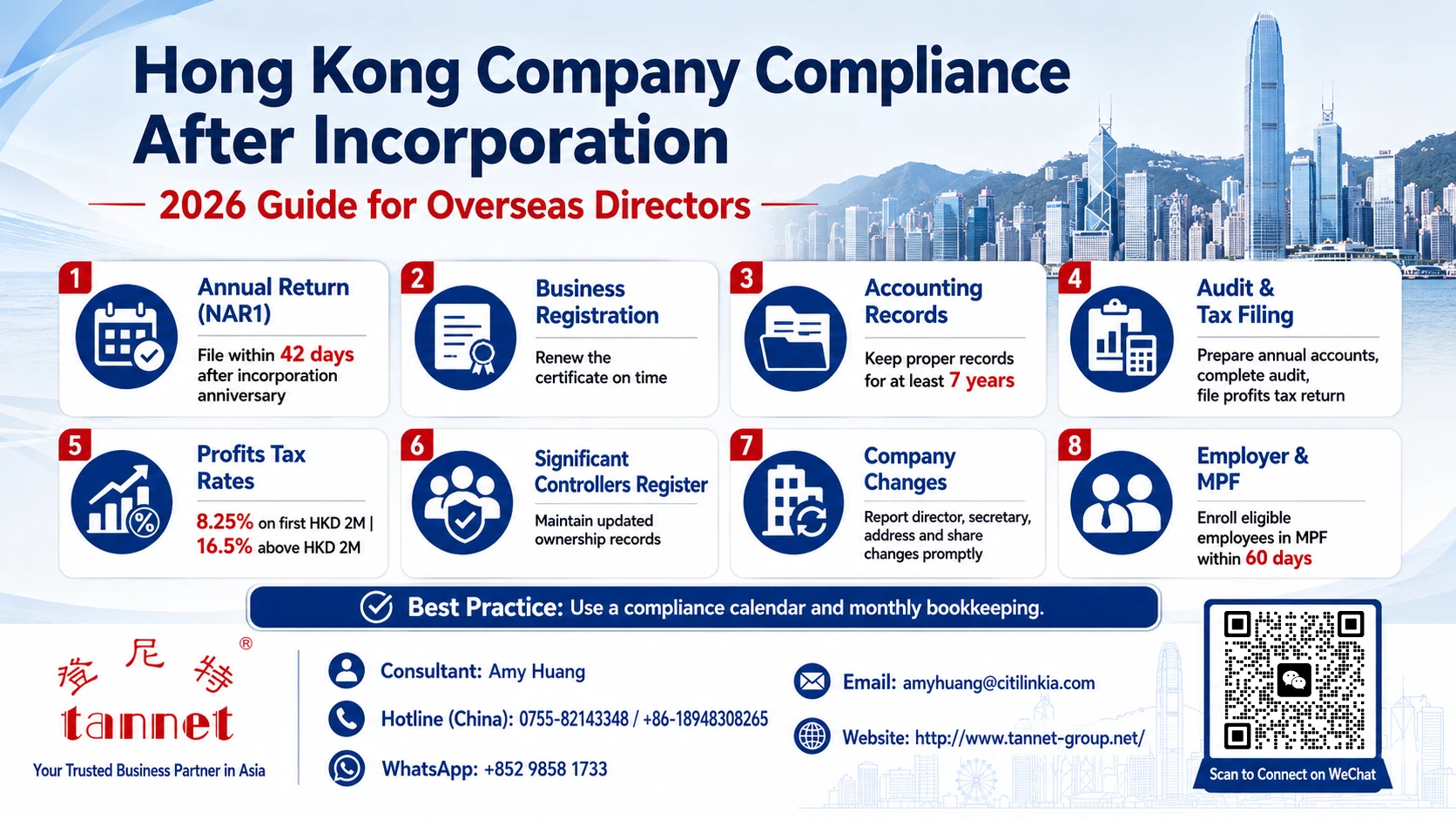
Registering a Hong Kong company is only the first step. A private limited company must continue meeting corporate, accounting, tax and employment obligations after incorporation.
The main requirements are:
- Maintain a registered office in Hong Kong.
- Maintain an eligible company secretary.
- File an annual return.
- Renew the Business Registration Certificate.
- Keep proper accounting records.
- Prepare annual financial statements.
- Arrange a statutory audit unless the company is formally dormant.
- File profits tax returns.
- Maintain a Significant Controllers Register.
- Report company changes within the applicable deadlines.
- Meet employer and MPF obligations when hiring staff.
These are separate obligations. An annual return does not replace a tax return. Business registration renewal does not replace an annual return. Audit and tax filing are also different processes.
1. Maintain a Hong Kong Registered Office
Every local company must maintain a registered office in Hong Kong. This address is used for Companies Registry correspondence, Inland Revenue Department notices, court documents and other statutory communications.
- Use a physical Hong Kong address that can receive official mail.
- Monitor the address and forward government correspondence promptly.
- Keep certain statutory records available at the registered office or another permitted place.
- Update banks, contracts, invoices and the company website when the address changes.
A change of registered office normally requires Form NR1 within 15 days. Missing a government letter does not normally remove the company’s obligation to comply.
2. Maintain an Eligible Company Secretary
A Hong Kong private company must have at least one company secretary. If the secretary is an individual, that person should ordinarily reside in Hong Kong. If the secretary is a company, it must have a registered office or place of business in Hong Kong. A private company must also have at least one natural-person director. A sole director cannot act as the company secretary of the same company.
The company secretary commonly assists with:
- Annual-return preparation and filing.
- Maintenance of statutory registers.
- Board and shareholder resolutions.
- Notifications of changes to directors, shareholders and the registered office.
- Corporate compliance reminders.
Directors remain responsible for the company’s compliance. They should provide the secretary with complete and current information.
3. File the Annual Return
A local private company normally files Form NAR1 every year. The deadline is within 42 days after the anniversary of the company’s incorporation date. No annual return is required in the year of incorporation.
| Item |
Example date |
| Incorporation date |
15 May 2025 |
| First anniversary |
15 May 2026 |
| NAR1 deadline |
Within 42 days after 15 May 2026 |
The annual return records the company’s registered office, directors, company secretary, share capital, members and principal business activity.
Annual-return filing fees
| Delivery time |
Registration fee |
| Within 42 days |
HKD 105 |
| More than 42 days but within 3 months |
HKD 870 |
| More than 3 months but within 6 months |
HKD 1,740 |
| More than 6 months but within 9 months |
HKD 2,610 |
| More than 9 months |
HKD 3,480 |
These are statutory registration fees. They are separate from possible prosecution or court penalties. A return that is unsigned, incomplete or accompanied by the wrong fee may be rejected and treated as delivered only when it is correctly re-submitted.
4. Renew the Business Registration Certificate
Business registration is administered by the Inland Revenue Department. It is separate from the annual return filed with the Companies Registry.
The Business Registration Office normally sends a renewal demand note before the new certificate period begins. After payment, the receipted demand note becomes the renewed Business Registration Certificate. If the company does not receive the demand note, it should contact the Inland Revenue Department within one month after the current certificate expires.
Official amounts for certificates commencing from 1 April 2026 to 31 March 2027
| Certificate period |
Total payable |
| One year |
HKD 2,350 |
| Three years |
HKD 6,170 |
The amount depends on the commencement date and the official fee schedule in force. Confirm the current fee before payment.
5. Keep Proper Accounting Records
A company should maintain accounting records from the start of its activities. The records should explain income, expenses, assets, liabilities, bank transactions, customer and supplier balances, loans, payroll, capital contributions and transactions with directors or shareholders.
Common supporting documents include:
- Bank statements and payment-account statements.
- Sales invoices and customer contracts.
- Purchase invoices and supplier contracts.
- Receipts and expense claims.
- Loan agreements and capital records.
- Payroll and employee records.
- Inventory and delivery records where relevant.
Business records generally need to be retained for at least seven years. Electronic records can be used if they are complete, accessible and properly backed up.
Monthly bookkeeping is preferable to collecting documents only once a year. It reduces missing evidence and makes unusual transactions easier to resolve.
6. Prepare Annual Financial Statements and Audit
Directors must arrange for annual financial statements to be prepared. These normally include a statement of financial position, income statement, notes, supporting schedules and a directors’ report where applicable.
Hong Kong companies generally require audited financial statements. The main statutory exception applies to companies that have formally become dormant. A company is not automatically dormant merely because it has no revenue, no bank account or no employees.
A non-trading company may still have incorporation costs, bank charges, registered-office fees, company-secretarial fees and director-funded expenses. These items should still be recorded.
Audit preparation commonly requires:
- Trial balance and general ledger.
- Bank statements and reconciliation schedules.
- Contracts, invoices and payment evidence.
- Customer and supplier balances.
- Loan and related-party information.
- Shareholder, director and ownership records.
Incomplete bookkeeping can delay both the audit and the profits tax filing.
7. File the Profits Tax Return
A Hong Kong company may receive a Profits Tax Return for Corporations, normally Form BIR51. The filing deadline is stated on the return. A corporate tax filing commonly includes the completed return, audited financial statements, the auditor’s report, a tax computation and supporting schedules.
Corporate profits tax rates
| Assessable profits |
Rate |
| First HKD 2 million |
8.25% |
| Amount above HKD 2 million |
16.5% |
The two-tiered rates are subject to eligibility rules. Only one connected entity can normally benefit for a particular year of assessment. Tax is calculated on assessable profits, not simply on revenue, accounting profit or the bank balance.
If the company becomes chargeable to tax but has not received a tax return, it should not wait indefinitely. Notification to the Inland Revenue Department may be required within the statutory period.
8. Maintain the Significant Controllers Register
Most Hong Kong-incorporated companies must keep a Significant Controllers Register, or SCR. The register contains current beneficial ownership and control information. It must generally be kept at the registered office or another prescribed place in Hong Kong and be available to authorized law-enforcement officers.
The company must appoint an eligible designated representative. This may include a Hong Kong-resident director, member or employee, or an eligible legal, accounting or licensed trust and company service professional.
Review and update the SCR after a share transfer, share issue, group restructuring, trust arrangement or material change in voting or appointment rights. The SCR is separate from the annual return.
9. Report Company Changes
The annual return is a yearly snapshot. It does not replace event-based filings.
| Change |
Typical form |
General filing period |
| Director or secretary appointment/resignation |
ND2A |
Within 15 days |
| Change in director or secretary particulars |
ND2B |
Within 15 days |
| Registered-office change |
NR1 |
Within 15 days |
Other events may require separate documents. Examples include share allotments, share transfers, changes in share capital, company-name changes, amendments to articles, registration of charges and special resolutions.
10. Meet Employer and MPF Obligations
Additional obligations arise when the company hires employees. If an Employer’s Return is issued, it must normally be completed by the deadline even if the company has no employees, has not started business or has ceased business.
| Event |
Form |
General deadline |
| New employee likely to be taxable |
IR56E |
Within 3 months of employment |
| Termination of employment |
IR56F |
One month before termination |
| Employee leaving Hong Kong |
IR56G |
One month before departure |
Except for exempt persons, eligible full-time and part-time employees aged 18 to 64 must generally be enrolled in an MPF scheme within the first 60 days of employment. Different rules can apply to casual employees in the construction and catering industries.
Annual Compliance Checklist
| Compliance area |
Required action |
| Registered office |
Maintain a valid and monitored Hong Kong address |
| Company secretary |
Maintain an eligible secretary |
| Annual return |
File NAR1 within 42 days |
| Business registration |
Renew the certificate |
| Accounting |
Maintain complete transaction records |
| Financial statements |
Prepare annual accounts |
| Audit |
Arrange an audit unless formally dormant |
| Profits tax |
File BIR51 and supporting documents |
| Ownership |
Maintain and update the SCR |
| Company changes |
File the correct form on time |
| Employment |
Complete employer reporting and MPF obligations |
Common Mistakes
1. Treating annual compliance as one payment
Annual return, business registration, audit and tax filing are separate obligations.
2. Waiting until the tax deadline to prepare accounts
Bookkeeping should be maintained throughout the year.
3. Assuming no revenue means no audit
A company is not automatically dormant because it has not traded.
4. Reporting changes only in NAR1
Many changes require separate forms within specific filing periods.
5. Mixing personal and company transactions
This creates accounting, audit, banking and tax problems.
6. Ignoring official mail
Missing a notice does not normally remove the filing obligation.
FAQ
1. What must a Hong Kong company do after registration?
It must maintain its registered office and company secretary, file annual returns, renew business registration, keep accounting records, arrange annual accounts and audit, file tax returns and update statutory records.
2. Does every Hong Kong company need an audit?
Most companies require annual audited financial statements. A company that has formally become dormant may qualify for an exemption. A company with no revenue is not automatically dormant.
3. When is Form NAR1 due?
For a local private company, NAR1 is normally due within 42 days after each anniversary of incorporation.
4. Is NAR1 the same as the profits tax return?
No. NAR1 is filed with the Companies Registry. The profits tax return is filed with the Inland Revenue Department.
5. How long must accounting records be kept?
Business and accounting records should generally be retained for at least seven years.
6. Can overseas directors manage the company remotely?
Yes. However, the company must still maintain a Hong Kong registered office, an eligible company secretary, accurate records and timely filings.
7. Does a loss-making company need to file a tax return?
Yes, when a return is issued. Losses and nil profits must be reported correctly.
8. What happens when deadlines are missed?
Possible consequences include higher filing fees, tax penalties, prosecution, estimated assessments, banking difficulties and strike-off action in serious cases.
Conclusion
Hong Kong company compliance is continuous. It cannot be completed through one annual filing. A reliable system should cover corporate records, accounting, audit, tax, business registration, beneficial ownership, employment and event-based changes.
Create a compliance calendar immediately after incorporation. Assign each task to a named person. Keep supporting documents and proof of completion. Update the calendar whenever the company’s structure or business activities change.
————————————————Simplifying Business, Empowering Entrepreneurs—————————————————