TL;DR: Hiring employees in Hong Kong involves more than signing a contract. It requires compliance with immigration, tax, MPF, insurance, and labour laws from day one. Many foreign founders underestimate how quickly these obligations accumulate once hiring begins.
Key Takeaways
- Employment compliance in Hong Kong starts before the employee’s first working day, not after onboarding.
- Part-time, freelance, and flexible arrangements can still trigger full employer obligations under Hong Kong law.
- Payroll, MPF, insurance, and tax reporting systems must be integrated early to avoid compliance gaps.
- Proper documentation and recordkeeping are essential for protecting the business during audits or disputes.
Hiring your first employee is a key milestone for any Hong Kong company. It signals growth, increased workload, and the beginning of a more structured business operation. It also means something important changes: you are no longer just a business owner, you are now an employer.
In Hong Kong, that shift comes with more responsibilities than many foreign founders expect. While setting up a company is relatively straightforward, managing employment compliance is far more detailed and requires careful attention from day one.
Check Work Eligibility First
Before anything else, make sure the person you are hiring is legally allowed to work in Hong Kong. This is one of the most commonly overlooked steps for new employers.
You should check the candidate’s Hong Kong identity card. If they are not a permanent resident, you must also review their passport and visa conditions. Some visas restrict employment to specific employers or job roles.
What to do
- Verify identity documents before onboarding
- Confirm work rights and visa conditions
- Check for employer or role restrictions
- Keep basic verification records
Do this before the employee starts work, not after.
Put the Contract in Writing
A written employment contract is not strictly mandatory in Hong Kong, but in practice, it is essential. It ensures both employer and employee clearly understand expectations from the beginning and reduces the risk of disputes later.
Before employment begins, key terms should be clearly documented, including role, salary, working hours, leave entitlements, MPF arrangements, confidentiality obligations, and termination conditions.
Importantly, Hong Kong employment law always applies. No contract can override statutory employee rights.
Understand the 2026 Continuous Contract Rule
From 2026, Hong Kong updated its definition of a “continuous contract.” An employee is generally considered to be under a continuous contract if they have worked for the same employer for at least four weeks and meet either:
- at least 17 hours per week, or
- at least 68 hours over a four-week period
This replaces the previous 18-hour weekly threshold and reflects more flexible working arrangements.
As a result, even part-time or flexible workers may qualify for statutory benefits such as paid annual leave, rest days, sickness allowance, and other protections.
Ensure Minimum Wage Compliance
From 1 May 2026, Hong Kong’s minimum wage is HK$43.10 per hour.
However, compliance is not just about hourly pay.
Key points
- Wages must be paid within 7 days after the wage period
- Working hours must be properly recorded
- Allowances and deductions may affect wage calculations
A fixed monthly salary does not automatically guarantee compliance. Employers must still ensure the effective hourly rate meets legal requirements.
Arrange Insurance Early
Employees’ compensation insurance is mandatory in Hong Kong.
It applies to all employers regardless of:
- company size
- job type
- contract length
The key rule is simple: insurance must be in place before the employee starts work.
Policies should reflect actual business activities rather than generic coverage.
Set Up MPF Properly
If you hire employees aged 18 to 64 who work for 60 days or more, MPF registration is required.
Employer obligations
- Enrol within 60 days
- Use the eMPF platform
- Contribute 5 percent (matched by employee)
- Apply income thresholds correctly
2026 thresholds
- Minimum relevant income: HK$7,100 per month
- Maximum: HK$30,000 per month
- Employer cap: HK$1,500 per month
MPF should be built into payroll systems from the beginning, not treated as an afterthought.
Handle Tax Reporting Correctly
Hiring an employee creates reporting obligations to the Inland Revenue Department.
Key forms
- IR56E – new employee (within 3 months)
- IR56B – annual reporting
- IR56F – termination
- IR56G – employee leaving Hong Kong
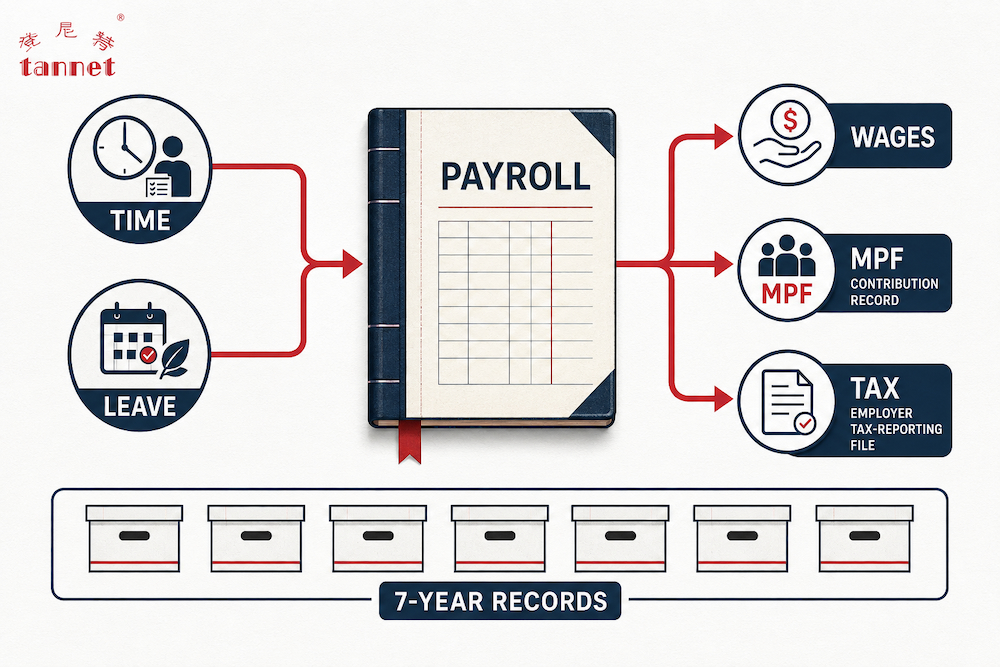
Employers must also retain payroll records for at least seven years.
Many overseas founders overlook this because payroll is often assumed to be purely internal accounting, but in Hong Kong it is a regulated reporting function.
Manage Leave and Holidays
Hong Kong has 15 statutory holidays in 2026, including Easter Monday.
Employees may also be entitled to:
- 1 rest day per week (for eligible employees)
- Annual leave starting at 7 days
- Up to 14 days with long service
- Statutory sick leave and parental benefits (if eligible)
For example, eligible employees may receive up to 14 weeks of maternity leave. Leave management is therefore not just HR administration. It is a legal obligation.
Keep Proper Records
Good recordkeeping is one of the simplest ways to avoid compliance issues.
You should maintain records of:
- wages and allowances
- working hours
- leave taken
- MPF contributions
- deductions
- employment dates
- tax-related information
If it affects pay or employment rights, it should be recorded.
Respect Privacy and Fair Hiring
Hiring also involves legal responsibilities around data protection and fair treatment. Employers must handle personal data in accordance with Hong Kong privacy laws and avoid collecting unnecessary information during recruitment.
You must also ensure non-discriminatory hiring practices. Protected categories include:
- gender
- disability
- family status
- race
These rules apply throughout hiring, employment, promotion, and termination.
A Common Mistake Many Foreign Founders Make
If you are hiring in Hong Kong for the first time, there is a pattern we see very often: founders focus heavily on company setup but delay thinking about employment compliance.
That is usually where problems begin.
1. Misclassifying employees as contractors
Trying to avoid MPF or insurance obligations by using “freelancers” can create legal risk if the working relationship resembles employment.
2. Underestimating part-time obligations
Even short-hour staff may qualify for full statutory benefits under continuous contract rules.
3. Delaying insurance setup
Insurance must be active before work begins, not after onboarding.
4. Poor time tracking
Without accurate records, payroll disputes and compliance issues become difficult to resolve.
5. Assuming Hong Kong employment law is informal
While business-friendly, Hong Kong employment law is structured and actively enforced. The good news is that all of this is manageable if it is set up correctly from the start.
If you are still in the early stage of setting up your business, you can learn more about the process of establishing a company in Hong Kong Company Registration
Why Choose Tannet
Hiring in Hong Kong should support your business growth, not create administrative complexity. However, for many foreign founders, employment compliance quickly becomes overwhelming once payroll, MPF, tax reporting, insurance, and HR obligations begin to overlap.
At Tannet, we help international businesses simplify this process by providing integrated support across Hong Kong company setup, accounting and tax compliance, payroll and MPF administration, corporate secretarial services, and ongoing business advisory. Instead of treating each requirement separately, we help you build a connected compliance system that keeps your business legally sound and operationally efficient.
Planning to hire through your Hong Kong company?
Hiring your first employee is a major step and it should be done with clarity, not uncertainty. Whether you are hiring your first team member or expanding an existing operation, Tannet can help you establish a proper employment and compliance structure from day one.
Contact Tannet today to speak with a consultant!