————————————————Simplifying Business, Empowering Entrepreneurs—————————————————
1. Summary
Registering a company in Hong Kong is a straightforward process that can usually be completed within 1–5 business days if all required documents are properly prepared.
A Hong Kong company can be established by local or foreign entrepreneurs. Hong Kong allows 100% foreign ownership and does not require foreign investors to become Hong Kong residents.
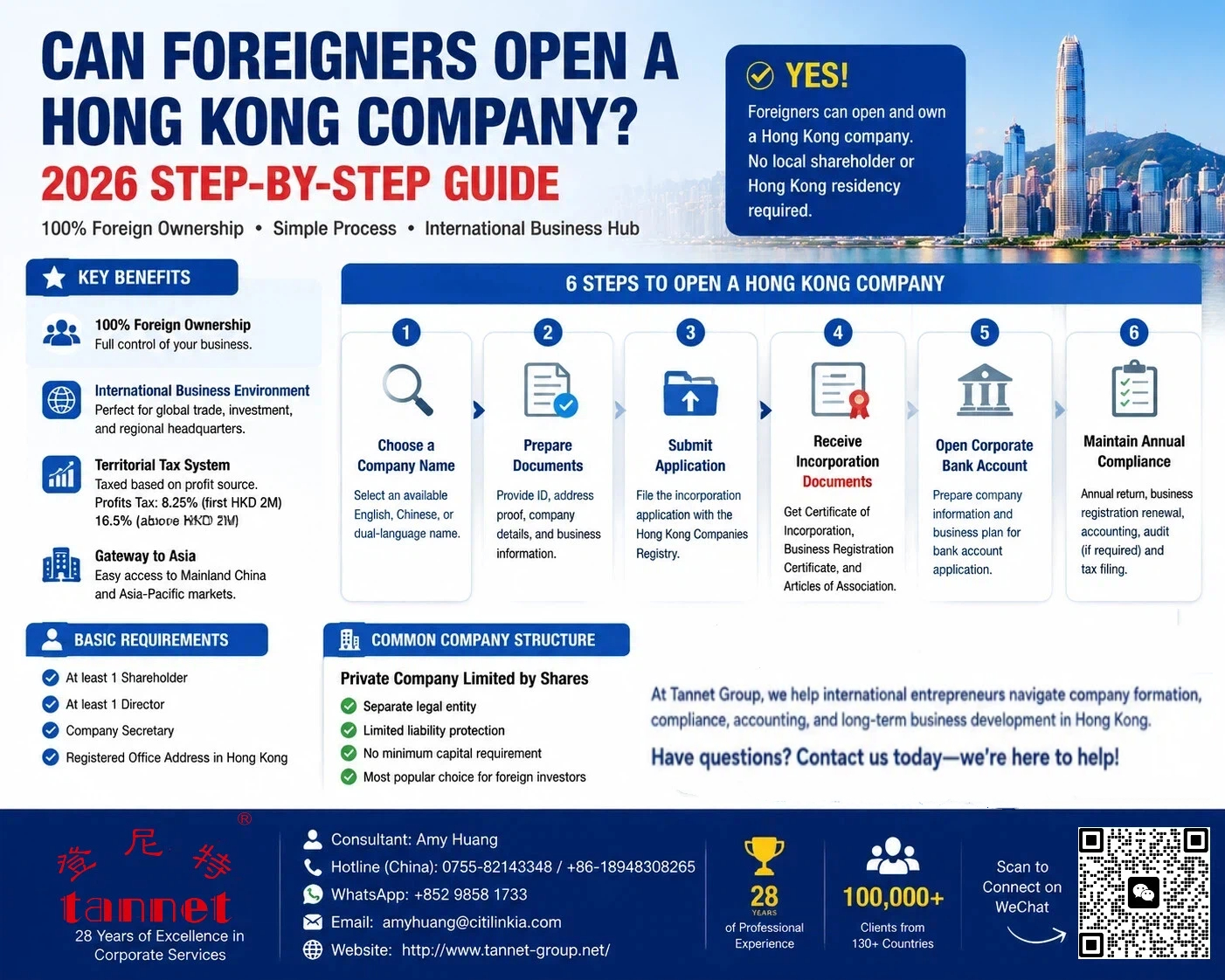
The company registration process includes choosing a company name, preparing incorporation documents, submitting an application to the Hong Kong Companies Registry, receiving the Certificate of Incorporation, opening a corporate bank account, and maintaining annual compliance.
Hong Kong is a popular jurisdiction for international businesses because of its simple company structure, business-friendly environment, territorial tax system, and strong legal framework.
2.What is a Hong Kong Company?
A Hong Kong company is a legal entity incorporated under the Companies Ordinance of Hong Kong.
The most common business structure for foreign entrepreneurs is a Private Company Limited by Shares.
A Hong Kong limited company is separate from its shareholders and directors. It can own assets, enter contracts, conduct business activities, and operate independently.
Key features of a Hong Kong company:
| Feature |
Description |
| ①Legal entity: |
The company exists separately from its owners |
| ②Foreign ownership: |
100% foreign ownership is allowed |
| ③Shareholders: |
Minimum one shareholder required |
| ④Directors: |
Minimum one director required |
| ⑤Local director: |
Not mandatory |
| ⑥Company secretary: |
Required under Hong Kong company law |
| ⑦Registered office: |
A Hong Kong registered address is required |
| ⑧Tax system: |
Territorial taxation system applies |
3. Why Start a Business in Hong Kong?
Hong Kong is widely used by international entrepreneurs, investors, and trading companies.
Main advantages include:
① Easy company incorporation
Hong Kong has a simple and efficient registration system. Many companies can be incorporated within a few business days.
② Foreign ownership flexibility
Foreign entrepreneurs can establish and fully own a Hong Kong company without a local shareholder.
③ International business credibility
A Hong Kong company is commonly accepted by international suppliers, customers, and financial institutions.
④ Simple tax system
Hong Kong uses a territorial tax system.
Generally, only profits sourced from Hong Kong are subject to Hong Kong profits tax.
⑤ Access to Asian markets
Hong Kong provides a strategic location for businesses targeting Mainland China and the Asia-Pacific region.
4. How to Register a Company in Hong Kong Step by Step
Step 1: Choose a Company Name
The first step is selecting a suitable company name.
The name can be registered in:
- English
- Chinese
- English and Chinese combination
The proposed company name must:
- Not be identical to an existing company name
- Not contain restricted words without approval
- Meet Hong Kong registration requirements
A company name search should be completed before submission.
Step 2: Prepare the Required Documents
Before incorporation, applicants need to prepare company information and identification documents.
Required information includes:
- Company name
- Business nature
- Shareholding structure
- Director information
- Shareholder information
- Registered office address
- Company secretary information
For foreign applicants, identity verification documents are usually required.
Step 3: Submit the Incorporation Application
The incorporation application is submitted to the Hong Kong Companies Registry.
The application includes:
- Company incorporation form
- Articles of Association
- Required identification documents
- Company structure information
The application can be submitted electronically or through a professional service provider.
Step 4: Get a Certificate of Incorporation
Once approved, the company receives official incorporation documents.
Main documents include:
①Certificate of Incorporation: Proof that the company legally exists
②Business Registration Certificate: Permission to conduct business activities in Hong Kong
The company becomes legally established after receiving these documents.
Step 5: Open a Corporate Bank Account
After incorporation, the company can apply for a corporate bank account.
Banks usually review:
- Business model
- Source of funds
- Expected transactions
- Company structure
- Director and shareholder background
Common requirements include:
- Company incorporation documents
- Business plan
- Proof of business activities
- Identity documents
Step 6: Stay Compliant Year-Round
A Hong Kong company must maintain ongoing compliance after registration.
Annual obligations may include:
- Filing annual returns
- Maintaining company records
- Preparing financial statements
- Filing tax returns
- Keeping accounting records
- Renewing business registration
Failure to maintain compliance may result in penalties or company status issues.
5. Required Documents for Hong Kong Company Registration
The following documents are commonly required:
| Document |
Detailed Explanation |
| ①Passport copy: |
Required for identity verification of directors and shareholders |
| ②Proof of residential address: |
Usually includes utility bills, bank statements, or official documents issued within recent months |
| ③Company name: |
Proposed English or Chinese company name |
| ④Business information: |
Description of intended business activities |
| ⑤Shareholding information: |
Details of shareholders and ownership percentage |
| ⑥Director information: |
Personal information of appointed directors |
| ⑦Registered office address: |
A Hong Kong address for official company correspondence |
| ⑧Company secretary information: |
Details of the appointed company secretary |
6. How Long Does It Take to Register a Hong Kong Company?
The typical timeline is:
| Stage |
Estimated Time |
| ①Company name confirmation: |
Same day to a few days |
| ②Document preparation: |
1–3 days |
| ③Incorporation approval: |
Around 5 business days |
| ④Bank account opening: |
Several days to several weeks depending on bank review |
The registration process is usually faster when documents are complete and accurate.
7. Common Mistakes When Registering a Hong Kong Company
① Choosing an unsuitable company structure
Some entrepreneurs register a company without considering their business model, ownership structure, or future expansion plans.
② Preparing incomplete documents
Missing identification documents or incorrect information may delay incorporation.
③ Ignoring banking requirements
Company registration and bank account approval are separate processes.
Banks may request additional business information during due diligence.
④ Failing to maintain annual compliance
A company must continue meeting reporting and tax obligations after incorporation.
⑤ Using an unsuitable registered address
A valid Hong Kong registered office address is required for official communication.
8. Frequently Asked Questions (FAQ)
Q1: Can foreigners register a company in Hong Kong?
Yes. Foreigners can register and fully own a Hong Kong company. Hong Kong allows 100% foreign ownership.
Q2: Do I need to live in Hong Kong to register a company?
No. Foreign entrepreneurs can register a Hong Kong company without becoming Hong Kong residents.
Q3: Can I register a Hong Kong company remotely?
Yes. Many incorporation procedures can be completed remotely with proper documentation.
Q4: How long does it take to register a company in Hong Kong?
The incorporation process usually takes around 1–3 business days after submitting complete documents.
Q5: Do I need a local director in Hong Kong?
No. A Hong Kong company does not require a local director. Foreign individuals can act as directors.
Q6: How many shareholders are required for a Hong Kong company?
A Hong Kong private limited company requires at least one shareholder. The shareholder can be an individual or a company.
Q7: Is Hong Kong a tax-free jurisdiction?
No. Hong Kong is not completely tax-free. It applies a territorial tax system where taxable profits are generally based on their source.
Q8: Does a Hong Kong company need to file taxes every year?
Yes. Hong Kong companies generally need to maintain accounting records and complete annual tax compliance procedures.
Q9: Can a foreigner open a Hong Kong company bank account?
Yes. However, banks conduct compliance reviews before approving corporate accounts.
Q10: What happens after registering a Hong Kong company?
After incorporation, the company should complete banking arrangements, accounting setup, tax compliance, and ongoing corporate maintenance.
9. How Tannet Helps You Start Your Hong Kong Business
With 28 years of experience and a worldwide service network, Tannet Group is a trusted global business partner providing one-stop cross-border enterprise services, supporting businesses through every stage of the company lifecycle, from incorporation and setup to ongoing compliance and expansion.
Tannet handles every step in this guide except the parts that are legally only you can do (signing the incorporation declaration and supplying your identity documents).
Our services including:
- Hong Kong company formation
- Corporate bank account opening assistance
- Registered office address services
- Company secretary services
- Accounting and tax compliance
- Financial and tax planning
- Intellectual property protection
- Foreign investment solutions
- Business advisory services
Tannet serves entrepreneurs, startups, SMEs, and international companies seeking to establish and expand their presence in Hong Kong and other global markets.
Conclusion
Registering a company in Hong Kong involves several key steps: choosing a company name, preparing documents, submitting incorporation applications, obtaining registration certificates, opening a bank account, and maintaining annual compliance.
For foreign entrepreneurs, Hong Kong provides a practical structure for international business operations due to its flexible ownership rules, efficient incorporation process, and established legal system.
Setting up a Hong Kong company is the first step toward building an international business presence. Proper planning and ongoing compliance management are essential for long-term success.
Tannet provides integrated Hong Kong business solutions to help entrepreneurs establish, operate, and expand their companies with confidence.
————————————————Simplifying Business, Empowering Entrepreneurs—————————————————