Key Takeaway
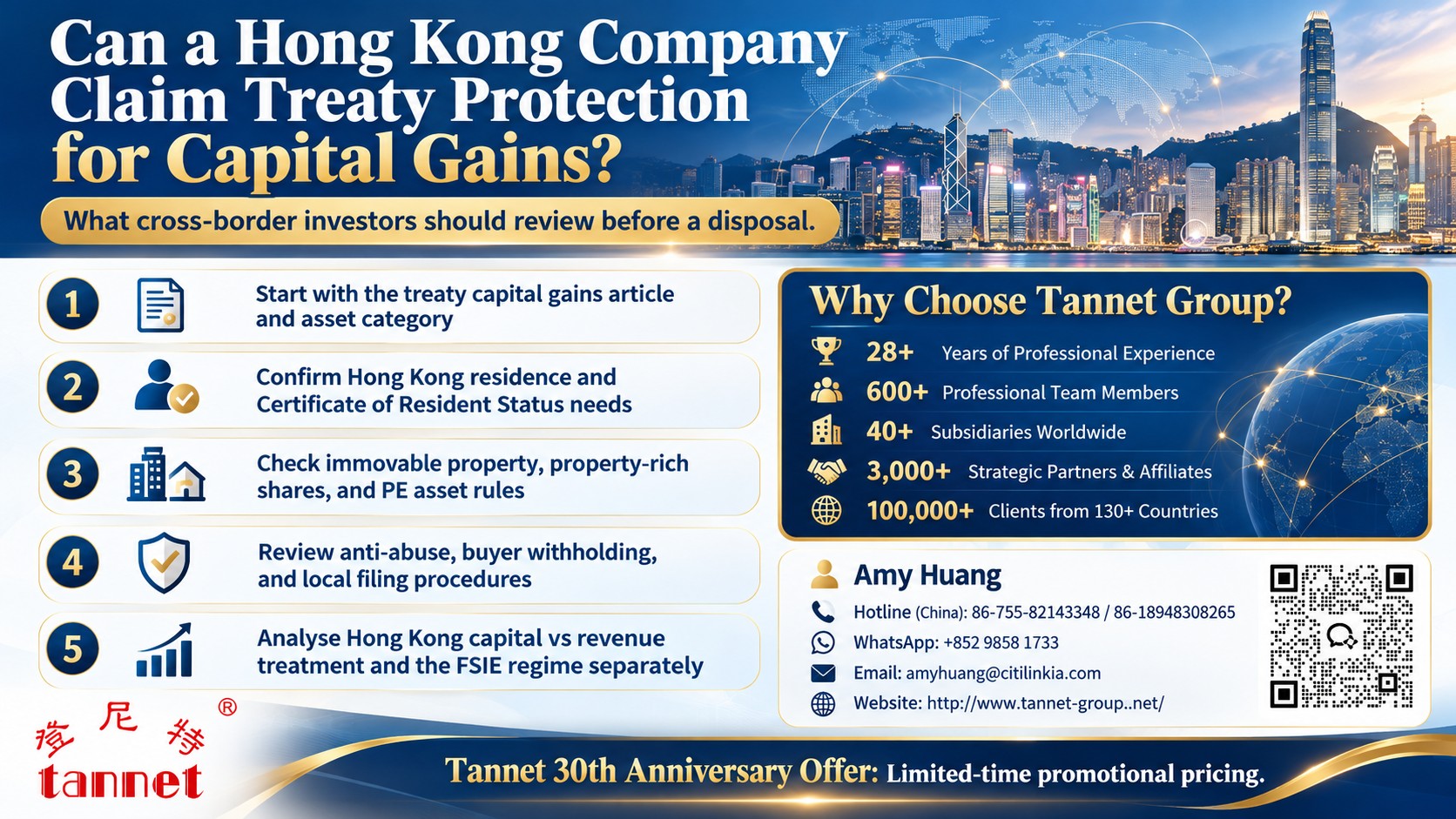
A Hong Kong company may claim tax treaty protection for a disposal gain, but the result depends on the asset and the exact agreement. Capital gains articles commonly distinguish immovable property, property-rich shares, permanent establishment assets, transport assets, and other property.
This matters to Hong Kong companies selling overseas shares or assets. The caution is that treaty allocation is only one layer.
The company must also prove Hong Kong residence, satisfy foreign claim procedures, address anti-abuse rules, and analyse Hong Kong capital-revenue treatment, source, and the FSIE regime separately.
Start with the capital gains article
Most comprehensive DTAs contain a capital gains article, often Article 13. It allocates taxing rights between the seller’s residence jurisdiction and the jurisdiction connected with the asset.
The article does not create a universal exemption. It divides gains into categories, and each category can produce a different result.
The Hong Kong IRD publishes the official treaty texts, protocols, and synthesised texts where the MLI applies. The wording and effective date should be checked before signing.
Hong Kong residence is necessary but not sufficient
Treaty protection normally requires the seller to be a resident of Hong Kong under the relevant DTA. A company should confirm the treaty definition and any dual-residence rule.
A Certificate of Resident Status may be requested by the foreign authority. The IRD states that issuing a certificate does not guarantee treaty relief. The treaty partner makes the final decision on entitlement.
Substance and consistency matter. Board decisions, office arrangements, responsible personnel, accounting records, tax filings, bank evidence, and transaction documents should support the residence position.
Immovable property usually remains taxable where located
Gains from the disposal of land or buildings are commonly taxable in the jurisdiction where the property is situated. A Hong Kong seller may therefore face source-country tax despite Hong Kong residence.
The relevant definition of immovable property usually follows treaty wording and local law. Rights connected with land, natural resources, or property businesses may require separate analysis.
Indirect disposal rules may also matter. Selling a holding company instead of the underlying property does not automatically remove source-country taxing rights.
Property-rich shares require a value test
Many treaties allow the source jurisdiction to tax gains on shares or comparable interests deriving a specified proportion of value from local immovable property.
The percentage, testing date, look-back period, exclusions, and treatment of indirect holdings vary. Some agreements exclude listed shares or business-use property, while others do not.
A valuation should identify the relevant assets and liabilities at the treaty testing times. Consolidated accounts alone may not answer the treaty question.
Permanent establishment assets form another category
Where movable property forms part of the business property of a permanent establishment, gains may be taxable in the jurisdiction where that permanent establishment is situated.
This category can also cover a disposal of the permanent establishment itself, depending on the treaty. The company should map the asset to the functions, risks, records, and location of the business.
The foreign jurisdiction should generally tax only within the treaty and its domestic law. Profit attribution and valuation may still be disputed.
Transport assets may receive special treatment
Capital gains articles often contain a specific rule for ships or aircraft operated in international traffic and related movable property. Some agreements also address land transport vehicles.
The exclusive taxing jurisdiction can depend on the treaty’s residence or effective management concepts. The exact wording should not be assumed from another agreement.
Other property may be protected in the residence jurisdiction
A residual paragraph commonly assigns gains from other property to the seller’s residence jurisdiction. This can protect a Hong Kong resident from source-country tax on certain share or asset disposals.
However, the residual rule applies only after checking the earlier categories and any special share rules. Domestic indirect transfer provisions and treaty anti-abuse rules also require review.
No final source-country taxing right does not always mean no withholding. A buyer may still have a domestic retention or filing duty until relief is accepted.
Capital gain under a treaty is not the same as capital nature in Hong Kong
Treaty Article 13 generally covers gains from alienation without deciding whether Hong Kong treats the gain as capital or revenue. The two analyses serve different purposes.
Hong Kong profits tax excludes profits arising from the sale of capital assets, but whether an asset is capital or trading stock depends on all surrounding facts.
Relevant factors include acquisition purpose, holding period, frequency of transactions, financing, enhancement work, accounting treatment, and circumstances of disposal. No single factor is decisive.
The IRD’s Tax Certainty Enhancement Scheme can deem qualifying onshore gains from disposal of equity interests to be capital in nature when statutory criteria are met. The scheme applies to qualifying disposals occurring on or after 1 January 2024 and contains exclusions.
Foreign-sourced disposal gains can fall within FSIE
An MNE entity carrying on business in Hong Kong should separately test the FSIE regime when a foreign-sourced disposal gain is received in Hong Kong.
The refined regime covers foreign-sourced disposal gains from the sale of property, subject to scope rules and exemptions. Non-IP gains may qualify through economic substance or another available route.
Equity interest disposal gains can require review of the participation exemption. IP disposal gains use a nexus approach and should be analysed separately.
A treaty result does not replace the FSIE analysis. Treaty protection concerns foreign taxing rights, while FSIE determines the Hong Kong treatment of specified foreign-sourced income received in Hong Kong.
Anti-abuse rules can override an expected benefit
The principal purpose test may deny a treaty benefit where obtaining that benefit was one of the principal purposes of an arrangement, unless granting it would accord with the treaty’s object and purpose.
A pre-sale migration, inserted holding company, circular ownership route, or short-lived restructuring may receive closer scrutiny. Commercial reasons and implementation evidence should be prepared contemporaneously.
Domestic anti-avoidance and beneficial entitlement rules may also apply. A Certificate of Resident Status does not settle these issues.
Prepare the claim before completion
The file should include the acquisition agreement, disposal agreement, board approvals, cap table, asset valuation, property analysis, financial statements, tax computations, residence evidence, and buyer correspondence.
The company should confirm tax clearance, withholding, registration, return, translation, and refund requirements in the source jurisdiction.
The sale agreement should allocate responsibility for tax forms, retained amounts, indemnities, gross-up, document delivery, and cooperation with objections or refunds.
Common mistakes
- Assuming Hong Kong’s absence of a general capital gains tax prevents foreign taxation.
- Applying the residual treaty rule without testing immovable property or property-rich share provisions.
- Treating accounting classification as conclusive proof that a gain is capital.
- Ignoring a permanent establishment connection or an indirect transfer rule.
- Obtaining a residence certificate after the buyer’s withholding deadline.
- Forgetting that FSIE can apply to foreign-sourced disposal gains received in Hong Kong.
- Restructuring immediately before sale without documenting commercial reasons and anti-abuse risk.
Frequently asked questions
Q1. Are all gains on overseas shares taxable only in Hong Kong?
No. The source jurisdiction may retain taxing rights under property-rich share, permanent establishment, indirect transfer, or other treaty provisions.
Q2. Does a Hong Kong Certificate of Resident Status guarantee relief?
No. The IRD confirms that the treaty partner decides whether all conditions are satisfied.
Q3. Can treaty relief eliminate buyer withholding?
Sometimes, but local procedure may require advance approval, tax clearance, or a later refund.
Q4. Does Hong Kong tax every gain described as capital by a foreign authority?
No. Hong Kong applies its own capital-revenue, source, and FSIE rules.
Q5. What is a property-rich company?
It is generally an entity whose value is derived above a treaty threshold from immovable property, subject to the exact agreement.
Q6. Can a share sale qualify for Hong Kong’s tax certainty scheme?
Possibly, if the statutory holding, ownership, asset, and other eligibility conditions are met and no exclusion applies.
Q7. What if both jurisdictions tax the gain?
Review credit relief, domestic objections, refund procedures, and the treaty’s Mutual Agreement Procedure.
When Tannet may assist
Tannet may assist when a Hong Kong company is preparing a cross-border share or asset disposal, residence-certificate application, FSIE review, tax certainty election, foreign treaty claim, or refund package. Support may include corporate records, transaction evidence coordination, valuation document organisation, and liaison with advisers in the source jurisdiction.
Official sources: OECD Model Tax Convention Article 13; OECD Multilateral Instrument
30th Anniversary Offer: To celebrate Tannet’s 30th anniversary, we are offering exclusive limited-time promotional pricing. Slots are limited and available on a first-come, first-served basis. Contact Consultant Amy Huang for details.
Written by: Tannet Business Services Team
Reviewed by: Consultant Amy Huang
First published: 27 Oct. 2026
Last reviewed: 27 Oct. 2026
————————————————Simplifying Business, Empowering Entrepreneurs————————————————