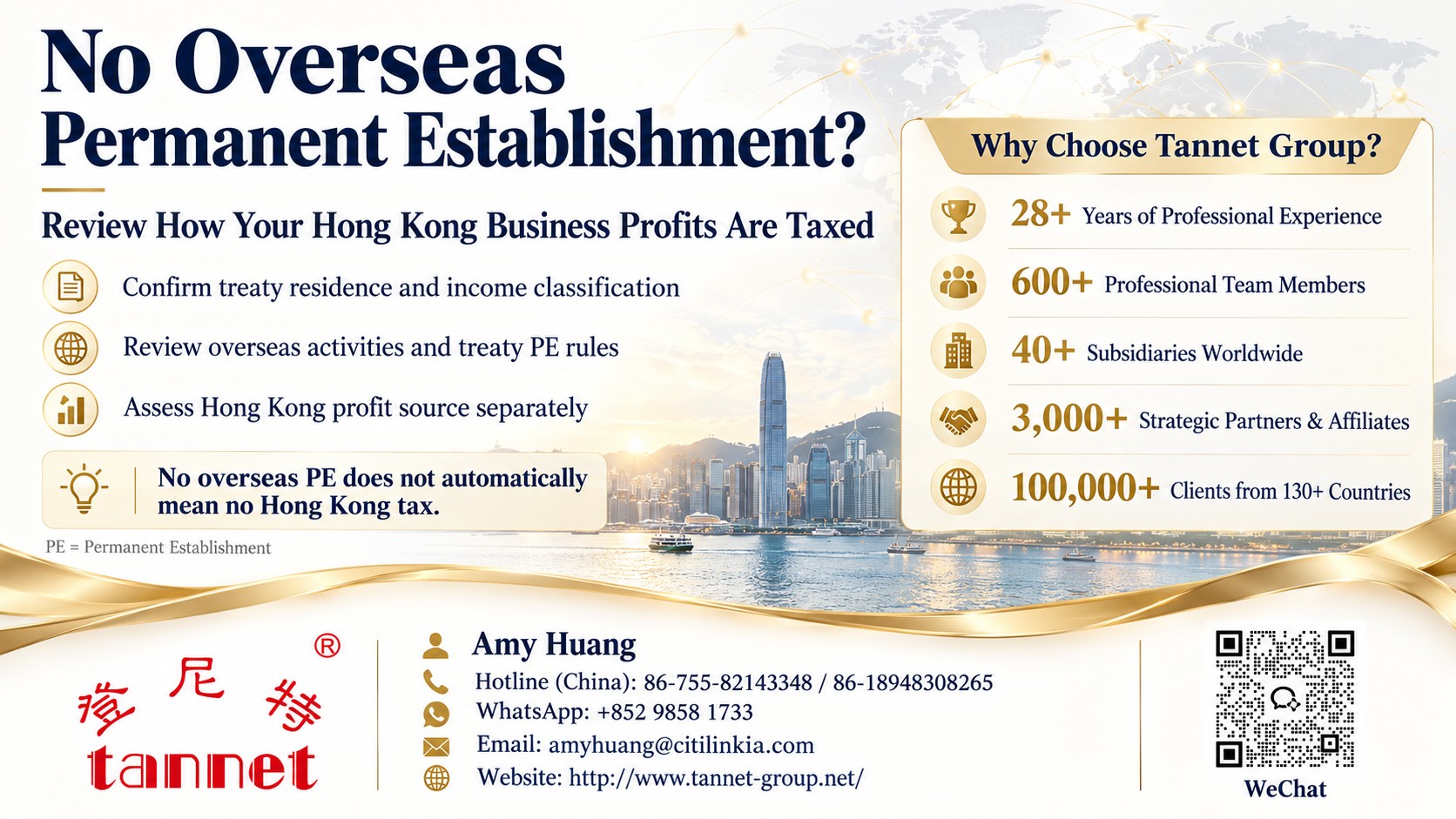
Key Takeaway
A Hong Kong company may rely on the business profits article of an applicable tax treaty when it is a Hong Kong treaty resident and has no permanent establishment in the overseas jurisdiction. In that case, the overseas jurisdiction will generally have no treaty right to tax ordinary business profits.
This is most relevant to service, consulting, trading, technology, and project companies operating across borders without a fixed place or dependent agent abroad.
The main caution is classification. Interest, royalties, property income, shipping income, and some service income may follow different treaty articles. Hong Kong source rules and the FSIE regime must then be reviewed separately.
The Direct Answer
The usual treaty result is residence-only taxation. Article 7 of many Hong Kong comprehensive double taxation agreements provides that business profits are taxable only in the residence jurisdiction unless the enterprise carries on business through a permanent establishment in the other jurisdiction.
The rule applies only when the company qualifies for the treaty, the income is genuinely business profits, and no relevant permanent establishment exists.
Why Treaty Residence Comes First
A company incorporated in Hong Kong is not automatically entitled to every treaty benefit. It must meet the resident definition in the relevant agreement and satisfy any anti-abuse conditions. The Hong Kong Inland Revenue Department guidance on tax treaties states that a DTA affects persons resident in Hong Kong or the partner jurisdiction.
The overseas authority may request a Certificate of Resident Status. The certificate proves residence for treaty purposes, but the IRD expressly states that issuance does not guarantee the claim. The source jurisdiction still tests the income, permanent establishment position, beneficial entitlement where relevant, and treaty anti-abuse rules.
What No Overseas Permanent Establishment Means
A permanent establishment normally requires a sufficient business presence in the overseas jurisdiction. Common forms include a fixed office, branch, place of management, long construction site, or dependent agent who habitually concludes contracts. Some agreements also contain service permanent establishment thresholds.
Remote work does not automatically create a permanent establishment. Repeated use of a home, customer premises, local inventory, or contract authority can change the analysis. Each treaty uses its own wording and may be modified by the Multilateral Instrument.
Income Must Be Classified Before Article 7 Is Used
Article 7 is a residual rule for business profits. A treaty may instead apply special articles to income from immovable property, international transport, dividends, interest, royalties, capital gains, employment, or directors’ fees. Those articles can permit source taxation even when the company has no permanent establishment.
Technical or management fees require care. A treaty may contain a separate fees article or service permanent establishment rule. Actual functions, rights, deliverables, personnel, and payment terms matter more than contract labels.
How Hong Kong Taxes the Same Profits
Hong Kong applies a territorial source principle. The IRD territorial source guide explains that profits tax is generally charged when a person carries on business in Hong Kong, earns profits, and those profits arise in or derive from Hong Kong. The place of payment or customer residence is not decisive.
For service income, the key question is generally where the profit-producing services are performed. Trading profits focus on where purchase and sale contracts are effected, considered with the full facts. Management, negotiation, execution, and supporting operations should be documented rather than reconstructed after an enquiry.
The IRD Profits Tax page states that qualifying corporations may use 8.25% on the first HKD 2 million of assessable profits and 16.5% above that amount.
Check the FSIE Regime Separately
The absence of an overseas permanent establishment does not settle the foreign-sourced income exemption analysis. Under the IRD FSIE guidance, specified foreign-sourced interest, dividends, disposal gains, and intellectual property income received in Hong Kong by an MNE entity may be deemed taxable unless an applicable exception is satisfied.
A Practical Review Process
Step 1 Confirm That a Treaty Applies
Check whether Hong Kong has an effective DTA with the overseas jurisdiction. Use the legal treaty text, protocols, and any MLI modifications shown on the IRD list of concluded agreements. Do not rely only on a general treaty summary.
Step 2 Confirm Hong Kong Treaty Residence
Review incorporation, management, board decisions, office functions, employees, accounts, and commercial activity. Apply for the relevant Certificate of Resident Status early if the source jurisdiction requires it.
Step 3 Map Overseas Activities
Record staff travel, project days, customer sites, home offices, agents, warehouses, contract authority, and local equipment. Compare the facts with every relevant part of the permanent establishment article, including aggregation and anti-fragmentation provisions.
Step 4 Classify Each Payment
Separate service fees, product sales, reimbursements, royalties, interest, rentals, and gains. A single invoice may contain several treaty categories. Allocate consideration using contracts and defensible pricing.
Step 5 Follow Local Claim Procedures
Some jurisdictions grant relief at source. Others require a return, treaty form, or refund claim. Meet local deadlines even where the treaty conclusion appears clear. Preserve proof of residence and beneficial entitlement.
Step 6 Complete the Hong Kong Analysis
Determine source under Hong Kong law, calculate assessable profits, review expenses, and consider FSIE where specified income is involved. Reconcile the treaty position with contracts, audited accounts, tax computations, and foreign filings.
Common Mistakes
Mistake 1: Treating incorporation as sufficient.
Hong Kong registration alone does not establish entitlement to a particular DTA benefit.
Mistake 2: Assuming no office means no permanent establishment.
Dependent agents, long projects, home offices, or service thresholds may create one.
Mistake 3: Calling every receipt a service fee.
Royalties, interest, property income, or disposal gains can follow different articles.
Mistake 4: Ignoring domestic procedure.
A valid treaty position can still fail operationally if forms or refund claims are late.
Mistake 5: Equating no overseas tax with no Hong Kong tax.
Hong Kong source is tested independently.
Mistake 6: Using outdated treaty text.
Protocols and MLI modifications can alter permanent establishment and anti-abuse provisions.
Frequently Asked Questions
Q1. Is overseas business income automatically exempt if there is no permanent establishment?
No. The answer depends on an effective treaty, treaty residence, income classification, and local procedures. Without a DTA, the overseas jurisdiction applies its domestic law.
Q2. Can an overseas customer withhold tax anyway?
Yes. The payer may follow domestic withholding rules until treaty documents are accepted. The company may need relief at source or a refund.
Q3. Does a short staff visit create a permanent establishment?
Not necessarily. Duration, place availability, repeated activity, contract authority, and the specific treaty thresholds must be reviewed together.
Q4. Can a home office create an overseas permanent establishment?
It can where the premises are effectively at the company’s disposal and used continuously for core business. Occasional remote work may lead to a different conclusion.
Q5. Does a Certificate of Resident Status prove there is no permanent establishment?
No. It addresses treaty residence. The overseas authority separately examines local activities and the permanent establishment article.
Q6. Are management or technical fees always business profits?
No. The relevant DTA may contain a special fees provision, royalty rule, or service permanent establishment clause.
Q7. What if the overseas authority taxes contrary to the treaty?
Use local objection or refund procedures and consider the treaty’s mutual agreement procedure. The IRD treaty overview confirms that DTAs provide an avenue for cases involving treatment contrary to an agreement.
When Tannet May Assist
Tannet may assist with treaty residence, permanent establishment exposure, contract classification, Certificate of Resident Status preparation, Hong Kong source analysis, profits tax filing, and compliance records. Overseas filings should be coordinated with advisers in the relevant jurisdiction.
Official Sources:OECD: Model Tax Convention on Income and on Capital
30th Anniversary Offer: Tannet has been established for 28 years, we are offering exclusive limited-time promotional pricing to celebrate Tannet’s 30th anniversary. Slots are limited and available on a first-come, first-served basis. Contact Consultant Amy Huang for details.
Written by: Tannet Business Services Team
Reviewed by: Consultant Amy Huang
First published: 28 Oct. 2026
Last reviewed: 28 Oct. 2026
————————————————Simplifying Business, Empowering Entrepreneurs————————————————