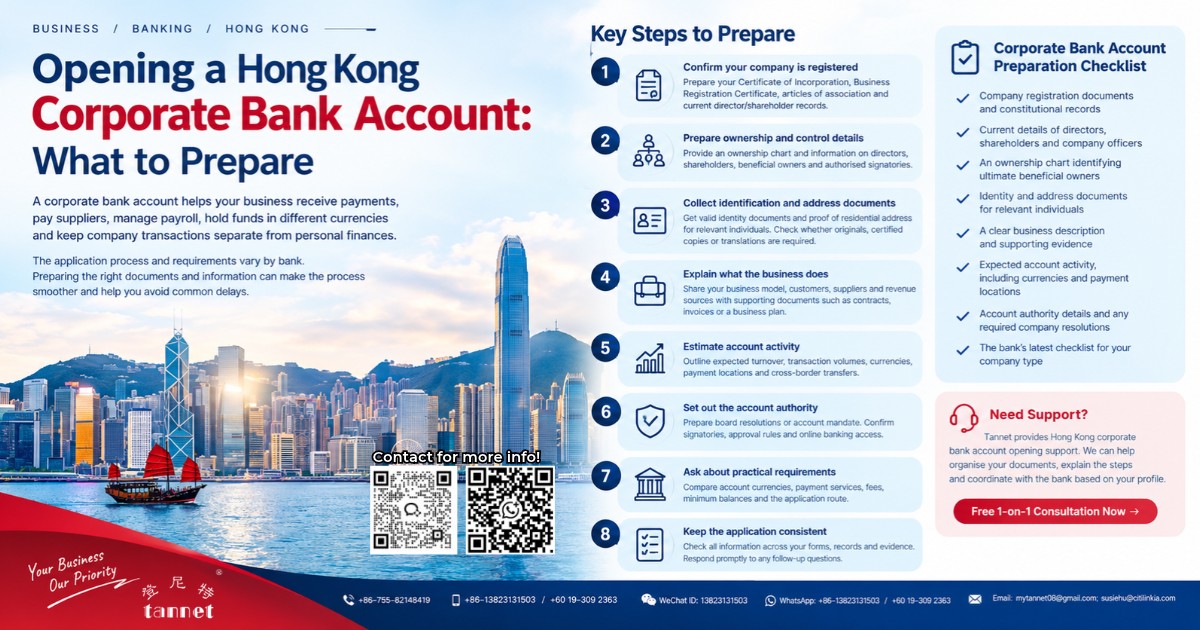
Opening a corporate bank account in Hong Kong is an important step in getting a business ready to operate. A business account can help you receive customer payments, pay suppliers, manage payroll, hold funds in different currencies and keep company transactions separate from personal finances.
The application process is not identical at every bank. Requirements can vary according to the company’s legal structure, ownership, business activity, expected transactions and the services requested. Preparing a clear set of company documents and business information can make the process smoother and help you respond quickly to a bank’s questions.
This guide explains what to prepare when opening a Hong Kong corporate bank account, what banks may want to understand about your business, and how to avoid common delays.
1. Confirm your company is registered
Before applying, make sure the company has been properly incorporated or registered. A Hong Kong company will generally need its Certificate of Incorporation and Business Registration Certificate. The bank may also ask for its articles of association and records showing current directors, shareholders or company officers.
If the business is incorporated overseas, expect to provide equivalent registration documents from its home jurisdiction. Depending on the bank and the company structure, it may request certified or translated copies. Check the bank’s current checklist before submitting documents, especially if any records are not in English or Chinese.
Keep digital and physical copies available. Where the bank asks for an original, certified copy or document issued within a certain period, a scan may not be enough.
2. Prepare ownership and control details
Banks need to understand who owns and controls a corporate customer. Be ready to provide an ownership chart that shows each company in the structure, the percentage held at each level and the individuals who ultimately own or control the business.
For every relevant person, prepare identification details and any other information requested by the bank. This may include directors, shareholders, beneficial owners, authorised signatories and people who will operate the account. The bank may ask for passports or Hong Kong identity cards, residential address information, nationality and contact details.
A simple ownership structure is easier to explain, but a layered or overseas structure is not automatically disqualifying. It does mean you should have supporting corporate records ready for each entity in the chain. Make sure the names, shareholdings and dates are consistent across company records, forms and ownership charts.
3. Collect identification and address documents
The bank will tell you which individuals must complete identity verification. This may include directors, beneficial owners, account signatories and other key controllers. Depending on the application route, identity checks may take place in person, by video or through a digital process.
Prepare valid identity documents and recent proof of residential address if requested. Requirements differ by bank and by the person’s circumstances, so do not assume that one set of documents will work for every applicant. Check whether documents must be originals, certified copies, translated, or issued within a particular timeframe.
Also confirm who needs to attend an appointment or complete an online verification step. If an owner or signatory is overseas, ask the bank how it handles identity checks before booking or submitting the application.
4. Explain what the business does
A bank will want to understand the company’s business model and how it operates. Prepare a concise explanation that covers the products or services offered, the types of customers and suppliers, where they are based, and how the company earns revenue.
Support the explanation with documents that fit the business. These might include signed contracts, invoices, purchase orders, a company website, product information, licences or records of completed transactions. A new business that does not yet have a trading history can prepare a business plan, financial forecast, launch plan or evidence of initial funding.
Make sure your explanation is specific. “Consulting” or “trading” may be too broad on its own. Describe what you consult on, what products you trade, where goods are sourced and delivered, or how clients find and pay you.
5. Estimate account activity
Think through how the account will be used before you apply. Banks may ask about expected monthly turnover, average balances, transaction volumes, payment methods, currencies and the locations of counterparties.
Provide estimates that match your business plan and supporting evidence. For example, a company expecting to receive several large international payments each month should be able to explain why those payments are expected and who will send them.
If you expect cross-border transfers, cash deposits, payments to higher-risk jurisdictions or transactions involving several currencies, describe this clearly. A mismatch between the activity you declare and the account’s later use can lead to follow-up questions or requests to update business information.
6. Set out the account authority
Decide who will be able to operate the account and what approvals the company requires. Prepare the relevant board resolution, account mandate or other authorisation document if requested by the bank.
Confirm which people will act as signatories, who can approve payments, whether transactions require one or more approvals, and how online banking access should be assigned. These decisions are easier to handle before the application is submitted than after the account is active.
The bank may have its own forms and signing rules. Check that the company’s resolution and account mandate align with the bank’s requirements and the company’s constitutional documents.
7. Ask about the account’s practical requirements
Before choosing a bank, compare the services that matter to the business. Ask about the application route, account currencies, local and international payments, online banking, payment limits, fees, minimum balances and any initial deposit.
Check whether the bank offers a suitable application process for your company type. Some businesses may be eligible to apply digitally; others may need an appointment or additional verification. Eligibility can depend on factors such as the company’s registration, ownership and number of connected individuals.
Do not rely on a general online checklist alone. Ask the bank for the current document list for your exact company type and intended services. Account terms, minimum deposits and supported application routes can change.
8. Keep the application consistent
Before submitting, compare the information across your forms, company records, ownership chart and business evidence. Check spelling of legal names, registration numbers, addresses, dates, share percentages and names of authorised persons.
If the company is newly formed, explain what has happened so far and what is planned next. If it has an established trading history, use records that demonstrate real activity. If a document is unavailable, tell the bank why and ask what alternative evidence it will accept.
Responding promptly to follow-up questions can help prevent avoidable delays. Keep a copy of what you submitted and a record of any additional documents provided.
Common reasons applications take longer
Applications may take longer when ownership is difficult to verify, company information is inconsistent, supporting documents are missing, or the business activity and expected transactions are unclear. Overseas documents may also require extra review, certification or translation. A bank may request more information based on its own assessment of the applicant and the services requested.
Opening an account is subject to the bank’s assessment. Preparing thoroughly can make your application easier to review, but it cannot guarantee approval or a particular processing time.
Corporate bank account preparation checklist
Before applying, gather:
- Company registration documents and constitutional records
- Current details of directors, shareholders and company officers
- An ownership chart identifying ultimate beneficial owners
- Identity and address documents for relevant individuals
- A clear business description and supporting evidence
- Expected account activity, including currencies and payment locations
- Account authority details and any required company resolutions
- The bank’s latest checklist for your company type
Opening a Hong Kong corporate bank account with Tannet
Businesses that want help preparing an application can consider using a corporate services provider such as Tannet. Tannet says it provides bank account opening support in Hong Kong. A service provider may help organise company documents, explain the application steps and coordinate with a bank based on the company’s profile.
Before engaging any provider, confirm exactly what its service includes, which fees apply and whether bank appointments or identity checks require the directors, beneficial owners or signatories to attend. Ask for the current document checklist for your company type, especially if the business has overseas owners or a complex ownership structure.
A provider can assist with preparation, but the bank makes its own customer checks and decides whether to open the account. Approval, account features and processing time are determined by the bank. Make sure all application details are accurate and that you understand any documents submitted on the company’s behalf.
📞 Free 1-on-1 Consultation Now,
Official Service Hotline: +86-755-82148419
Cell: +86-13823131503;+60 19-309 2363
WeChat ID: 13823131503;
WhatsApp:+86-13823131503;+60 19-309 2363
Email: mytannet08@gmail.com; susiehu@citilinkia.com