Key Takeaway
A Hong Kong company may claim a foreign tax credit when the same income is chargeable to Hong Kong Profits Tax and qualifying tax has been paid overseas. The route depends on whether the foreign jurisdiction has a tax treaty with Hong Kong, whether the company is a Hong Kong treaty resident, and whether the income falls within Hong Kong’s FSIE regime.
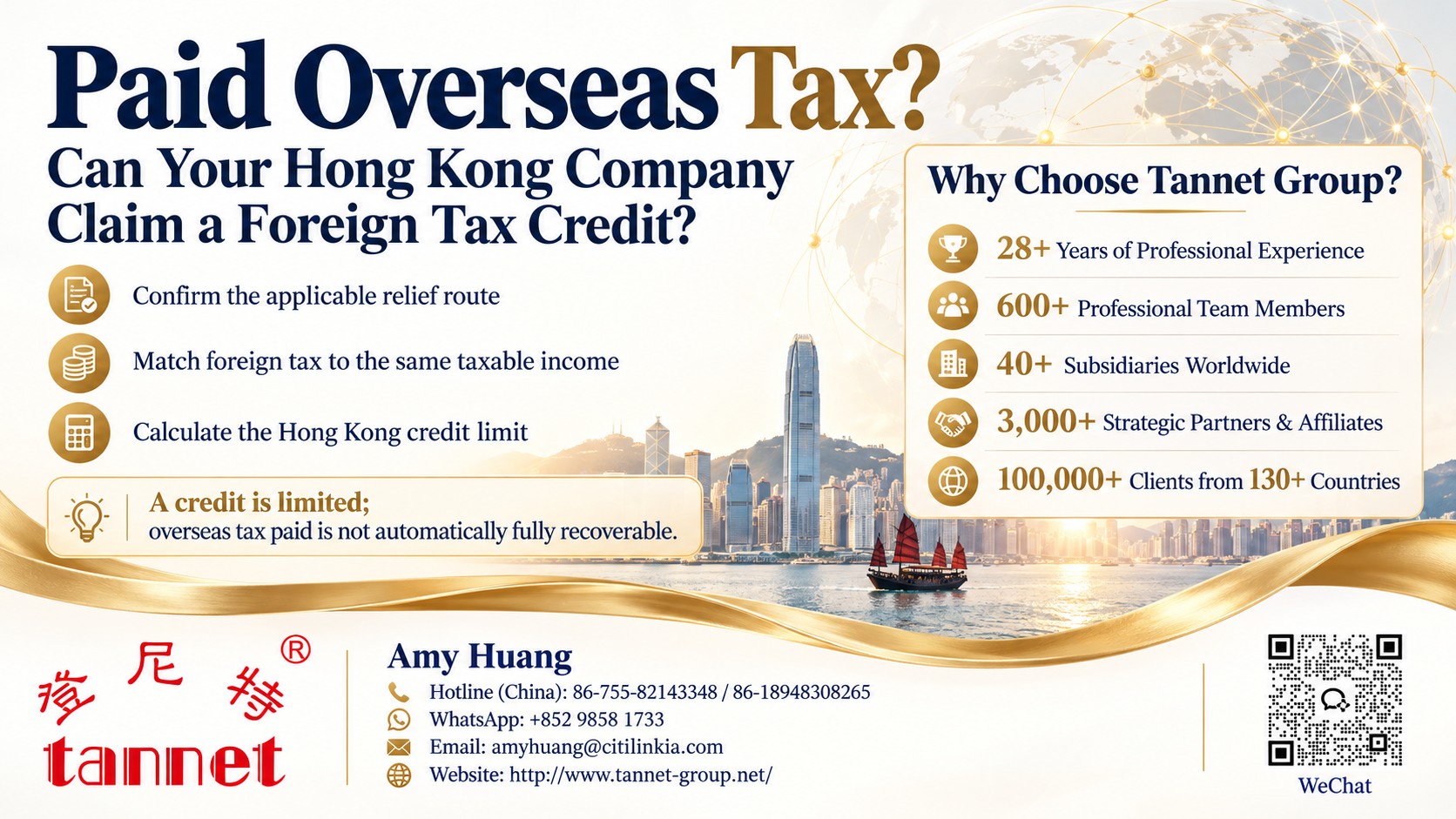
This is relevant to companies receiving taxable overseas dividends, interest, disposal gains, royalties, or business income. The main caution is that a credit is limited. Excess foreign tax, avoidable withholding, penalties, and tax on income not taxed in Hong Kong generally cannot create a full Hong Kong offset.
The Direct Answer
Yes, but payment of overseas tax is only the starting point. A foreign tax credit normally reduces Hong Kong tax on the same income. It does not convert the foreign payment into a cash refund from Hong Kong, and it cannot exceed the applicable credit limitation.
Confirm why the overseas jurisdiction taxed the income, whether the charge complied with the DTA, and whether Hong Kong taxes the same income. An exemption normally leaves no Hong Kong liability for a credit.
Three Possible Relief Routes
Bilateral Credit Under a DTA
For a DTA jurisdiction, the elimination article normally provides bilateral credit. The claimant generally must be a Hong Kong resident, and the foreign tax must be covered. The IRD treaty overview confirms that DTAs allocate taxing rights and relieve overlapping claims.
Unilateral Credit Under the FSIE Regime
The IRD FSIE guidance provides unilateral credit for similar foreign tax on chargeable specified income from a non-DTA territory when the MNE entity is a Hong Kong resident. Specified income includes foreign-sourced interest, dividends, disposal gains, and intellectual property income.
For a foreign dividend, credit may include qualifying underlying tax where the Hong Kong entity held at least 10% of the investee when distribution occurred. Ownership and profit tracing evidence is required.
Deduction Where Credit Is Unavailable
A deduction may be available in limited cases. It reduces assessable profits, while a credit reduces tax payable. The IRD guidance in DIPN 28 explains why treaty and non-treaty taxes can receive different treatment. Both cannot normally be claimed for the same tax.
The Credit Limitation
The allowable credit is generally capped at the lower of qualifying foreign tax paid and the Hong Kong Profits Tax attributable to the same income. The IRD double taxation relief guidance explains that relief addresses overlapping taxation, rather than reimbursing every foreign charge.
Use a consistent income base. Foreign tax may apply to gross revenue while Hong Kong taxes net profits. Currency conversion, timing, expenses, losses, and applicable rates can reduce the limitation. With no Hong Kong tax payable, the usable credit may be nil.
Reasonable Steps to Minimise Foreign Tax
Claim the treaty rate, exemption, refund, or foreign deduction before seeking Hong Kong credit. Tax exceeding the amount properly due may not be creditable. Keep filed forms and refund evidence.
A Certificate of Resident Status may support the claim. The IRD Certificate of Resident Status page says it proves treaty residence but does not guarantee benefits. The source authority still reviews entitlement, classification, permanent establishment, and anti-abuse rules.
A Practical Claim Process
Step 1 Identify the Foreign Tax
Obtain the assessment, withholding certificate, receipt, and legal basis. Confirm the amount is income tax or similar tax, not a penalty, interest charge, indirect tax, or service fee.
Step 2 Match the Income
Match the tax to the exact dividend, interest, royalty, disposal gain, service fee, or business profit in the Hong Kong computation. Reconcile gross income, expenses, and accounting recognition.
Step 3 Determine the Relief Route
Check the DTA, residence status, and elimination article. For non-DTA jurisdictions, test whether the income and claimant satisfy FSIE unilateral credit conditions.
Step 4 Test Exemption Before Credit
Consider source, economic substance, participation, nexus, and intra-group transfer relief. A credit is normally unavailable where the income is exempt from Hong Kong Profits Tax.
Step 5 Calculate the Cap
Compute Hong Kong tax on the same income. Apply the correct rate, allocate expenses consistently, use supportable exchange rates, and link the calculation to the Profits Tax Return.
Step 6 File the Claim
Disclose the claim in the Profits Tax Return and supplementary information. The IRD paper return changes added an item for unilateral credit. Check current forms and electronic requirements each year.
Step 7 Monitor Later Adjustments
Track audits, refunds, appeals, and amended assessments. If foreign liability falls after Hong Kong relief, notify the IRD, update the credit, and align the file with audited accounts.
Documents Commonly Required
Prepare agreements, invoices, bank records, assessment, withholding voucher, receipt, foreign return, residency certificate, treaty form, ownership chart, credit calculation, exchange-rate support, and refund evidence. Translations may be needed.
Common Mistakes
Mistake 1: Claiming every overseas payment as creditable tax.
Penalties, interest, VAT, and administrative charges are different items.
Mistake 2: Ignoring the treaty rate.
Excess withholding should normally be recovered overseas rather than passed automatically into the Hong Kong claim.
Mistake 3: Claiming a credit on exempt income.
No double taxation exists when Hong Kong does not tax that income.
Mistake 4: Using gross foreign income against net Hong Kong profits.
The limitation must compare the same income on a consistent basis.
Mistake 5: Missing residence evidence.
Bilateral credit normally requires Hong Kong residence for the relevant year.
Mistake 6: Failing to update the claim after a foreign refund.
This can leave the Hong Kong credit overstated.
Frequently Asked Questions
Q1. Can the company claim a credit if the overseas country has no DTA with Hong Kong?
Possibly. A Hong Kong resident MNE entity may obtain unilateral credit for qualifying foreign tax on chargeable specified foreign-sourced income under FSIE. Other income requires separate analysis.
Q2. Can foreign tax be credited when the income is offshore and exempt in Hong Kong?
Generally no. A credit offsets Hong Kong tax on the same income. If no Hong Kong tax is payable, there is no overlapping liability to relieve.
Q3. Is withholding tax automatically equal to the allowable credit?
No. The credit is subject to treaty entitlement, qualifying tax rules, and the Hong Kong limitation. Excess or avoidable withholding may need an overseas refund.
Q4. Can unused foreign tax credit be carried forward?
Do not assume so. The relevant DTA, IRO provisions, income category, and year-specific calculation must be reviewed. A current-year cap may leave foreign tax unrecovered.
Q5. Can underlying corporate tax be credited for a foreign dividend?
It may be available where the treaty or FSIE rules permit it and ownership conditions are met. FSIE unilateral credit uses a 10% holding threshold for qualifying underlying tax.
Q6. What if the foreign authority taxed income that the treaty assigns only to Hong Kong?
Use foreign objection or refund procedures first. If unresolved, consider the DTA mutual agreement procedure described in the IRD MAP guidance. A Hong Kong credit should not replace enforcement of the agreed allocation.
Q7. Which return item records the claim?
The current corporate Profits Tax Return BIR51 contains fields for treaty relief and unilateral credit. The company should also provide supporting computations and any applicable supplementary form.
When Tannet May Assist
Tannet may assist with relief-route analysis, Certificate of Resident Status applications, foreign tax reconciliation, credit calculations, FSIE review, and Hong Kong Profits Tax filing. Foreign refund and dispute work should be coordinated with advisers in the source jurisdiction.
30th Anniversary Offer: Tannet has been established for 28 years, we are offering exclusive limited-time promotional pricing to celebrate Tannet’s 30th anniversary. Slots are limited and available on a first-come, first-served basis. Contact Consultant Amy Huang for details.
Written by: Tannet Business Services Team
Reviewed by: Consultant Amy Huang
First published: 28 Oct. 2026
Last reviewed: 28 Oct. 2026
————————————————Simplifying Business, Empowering Entrepreneurs————————————————