Key Takeaway
Management fees paid to a Hong Kong company do not receive one automatic treaty rate. They are commonly tested under the business profits article, but some agreements contain technical service rules, and payments involving licences or know-how may be royalties.
This matters to regional headquarters, holding companies, shared service centres, consultants, and groups charging affiliates for finance, HR, procurement, or strategic support.
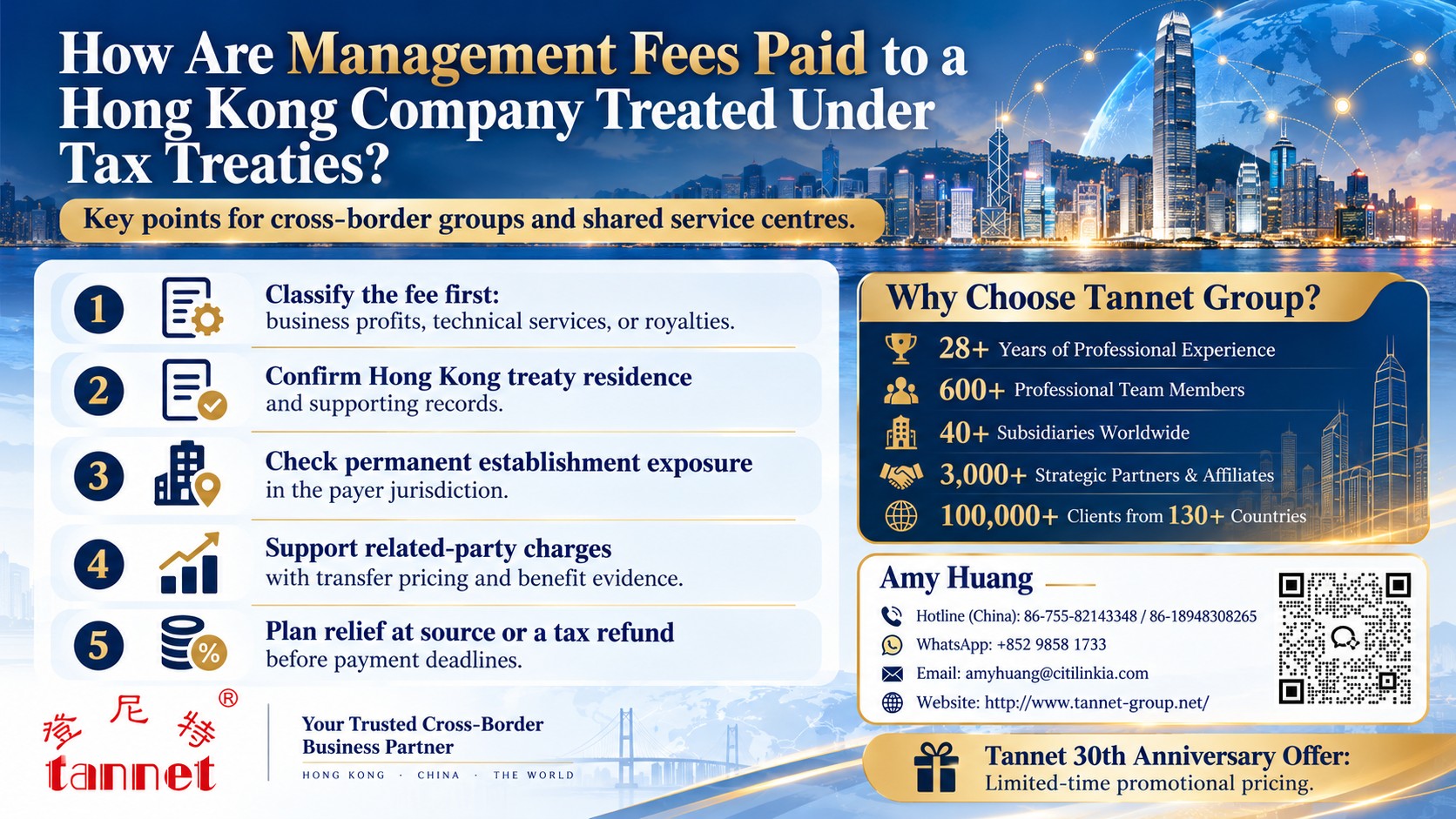
The most important step is to classify the payment from the contract and actual work. Then confirm Hong Kong residence, permanent establishment exposure, transfer pricing support, and the payer jurisdiction’s relief procedure before the invoice is paid.
Management fee is a commercial label not a treaty category
A management fee can cover very different activities. It may pay for budgeting, reporting, procurement, compliance coordination, staff supervision, treasury support, or strategic planning.
Tax treaties do not normally decide the result from the invoice description. The legal character follows the agreement, rights granted, people involved, performance locations, and actual deliverables.
For many ordinary services, the business profits article is the starting point. OECD Model Article 7 generally allocates taxing rights to the residence jurisdiction unless the enterprise carries on business in the other jurisdiction through a permanent establishment.
Some Hong Kong treaties contain a separate technical fees article or other service provisions. The Hong Kong IRD publishes treaty texts and a rate table that should be checked for the relevant jurisdiction and payment period.
When a contract grants software, know-how, processes, trademarks, designs, or other intellectual property rights, part of the fee may be treated as royalty income. A bundled charge may require a defensible allocation.
Confirm that the Hong Kong company is a treaty resident
The recipient normally needs to qualify as a Hong Kong resident under the relevant DTA. Incorporation may be relevant, but the exact residence definition and any dual-residence rule must be read in the treaty.
A foreign payer or tax authority may ask for a Hong Kong Certificate of Resident Status. The IRD states that issuing a certificate does not guarantee treaty relief. The treaty partner decides whether all conditions are met.
Residence evidence should be consistent with the company’s operations. Useful records may include directors’ decisions, office arrangements, staff details, contracts, accounting records, tax filings, bank records, and evidence of service delivery.
Test permanent establishment exposure in the payer jurisdiction
If the payment is business profits, the source jurisdiction often needs a permanent establishment before it can tax attributable profits under the treaty. The test is agreement specific.
A fixed place may arise from an office, project room, customer site, or other location available to the Hong Kong company. Occasional visits do not always create a fixed place, but duration and practical control matter.
A service permanent establishment may arise where a treaty contains a time-based services rule. Staff, contractors, connected projects, and repeated assignments may need to be aggregated.
A dependent agent permanent establishment may arise where a person habitually concludes contracts, or plays the principal role leading to contracts, depending on the treaty as modified.
No permanent establishment does not always mean no withholding at payment. Domestic law may require withholding until the payer submits treaty documents or the recipient obtains a refund.
Distinguish management services from shareholder activity
Related-party management charges require evidence that the recipient obtained a commercial or economic benefit. A group label or allocation spreadsheet is not enough.
Shareholder activity may include work performed solely because the provider owns the recipient. Examples can include parent-level governance, investor reporting, or acquisition work benefiting the parent rather than the operating company.
Duplicated services also create risk. A payer may challenge a charge when its own employees or another provider already performed the same work without a clear additional benefit.
The service agreement should describe the scope, service standard, responsible teams, deliverables, charging method, allocation key, cost base, markup, invoicing cycle, and evidence obligations.
Apply transfer pricing rules to related-party fees
The Hong Kong IRD’s transfer pricing guidance addresses prices for transactions between associated enterprises, including services and intangible property. The charge should reflect arm’s-length conditions.
The method depends on the facts. A cost-based approach may be appropriate for routine support, but the cost pool, exclusions, allocation keys, and markup need support.
High-value strategic work, unique know-how, or integrated group functions may require a different method. The analysis should consider functions, assets, risks, alternatives, and comparable arrangements.
Transfer pricing documentation should show that the service was provided and that the amount is reasonable. It should not merely repeat the contract.
Check Hong Kong profits tax separately
Treaty treatment in the payer’s jurisdiction is separate from the Hong Kong source question. A successful foreign treaty claim does not automatically make the fee non-taxable in Hong Kong.
The IRD’s territorial source guidance states that service fee income is taxable when the services giving rise to the fees are performed in Hong Kong. DIPN 21 explains that the relevant operations must be identified from the facts.
Where substantive work occurs in more than one place, the company should analyse the operations that directly produced the income. Any apportionment requires reliable records and a defensible basis.
Plan relief at source or a refund
The payer jurisdiction may allow treaty relief at source, a reduced-rate approval, or a refund after domestic withholding. Procedures differ even where treaty wording is similar.
Typical documents include the contract, invoices, residence certificate, beneficial ownership or entitlement declarations, corporate documents, service reports, time records, travel logs, transfer pricing support, payment evidence, and local claim forms.
Deadlines can arise before payment or shortly after withholding. The contract should allocate responsibility for applications, translations, tax vouchers, gross-up clauses, and cooperation with a refund.
Common mistakes
- Treating every management fee as ordinary business profit without reading the DTA.
- Assuming a Certificate of Resident Status automatically secures foreign relief.
- Ignoring software, know-how, or intellectual property embedded in the fee.
- Failing to track staff days, connected projects, customer sites, and agent activity.
- Charging affiliates without evidence of benefit, delivery, or an arm’s-length price.
- Using broad allocation keys that do not reflect how each recipient benefits.
- Missing foreign relief-at-source, refund, objection, or MAP deadlines.
Frequently asked questions
Q1. Are management fees exempt if the Hong Kong company has no office abroad?
Not automatically. Review service, agent, and project-based permanent establishment rules, plus domestic withholding procedure.
Q2. Does every management fee fall under Article 7 business profits?
No. Some treaties contain technical service provisions. Rights to intellectual property may also trigger the royalties article.
Q3. Is a Hong Kong Certificate of Resident Status always required?
It depends on the treaty partner’s procedure. Many claims require it, but the certificate does not decide the final entitlement.
Q4. Can the payer deduct the management fee?
That depends on local law, business purpose, benefit, documentation, transfer pricing, and any anti-avoidance rules.
Q5. What evidence proves that management services were delivered?
Keep contracts, named personnel, time records, reports, correspondence, meeting records, deliverables, allocation workpapers, and invoices.
Q6. Can tax withheld abroad be recovered?
Possibly. Check the refund deadline, required forms, original tax voucher, treaty classification, and local objection procedure.
Q7. What if both jurisdictions tax the same fee?
Review domestic credit rules and the treaty’s elimination article. If taxation appears inconsistent with the DTA, consider the Mutual Agreement Procedure.
Additional review points
Review the exact treaty text, protocol, synthesised MLI text, reservations, and effective dates for the payment period.
Confirm whether local law requires withholding before the payer can apply the treaty or request an exemption.
Separate genuine management work from shareholder oversight, duplicated services, incidental support, and stewardship activity.
Describe each service, responsible employee, delivery location, customer benefit, and supporting output in contemporaneous records.
Do not rely only on an invoice label because tax authorities examine the contract and actual conduct.
Track employee, contractor, director, and agent activity because each may affect permanent establishment exposure differently.
Review connected projects and contract extensions because a duration threshold may aggregate related service activity.
Retain complete records for review.
When Tannet may assist
Tannet may assist when a Hong Kong company is preparing a management service agreement, Certificate of Resident Status application, transfer pricing file, foreign treaty claim, or refund package. Support may include corporate records, service evidence coordination, charging documentation, project-day records, and liaison with advisers in the payer’s jurisdiction.
Official sources: OECD Model Article 7 Business Profits; OECD Multilateral Instrument
30th Anniversary Offer: To celebrate Tannet’s 30th anniversary, we are offering exclusive limited-time promotional pricing. Slots are limited and available on a first-come, first-served basis. Contact Consultant Amy Huang for details.
Written by: Tannet Business Services Team
Reviewed by: Consultant Amy Huang
First published: 27 Oct. 2026
Last reviewed: 27 Oct. 2026
————————————————Simplifying Business, Empowering Entrepreneurs————————————————