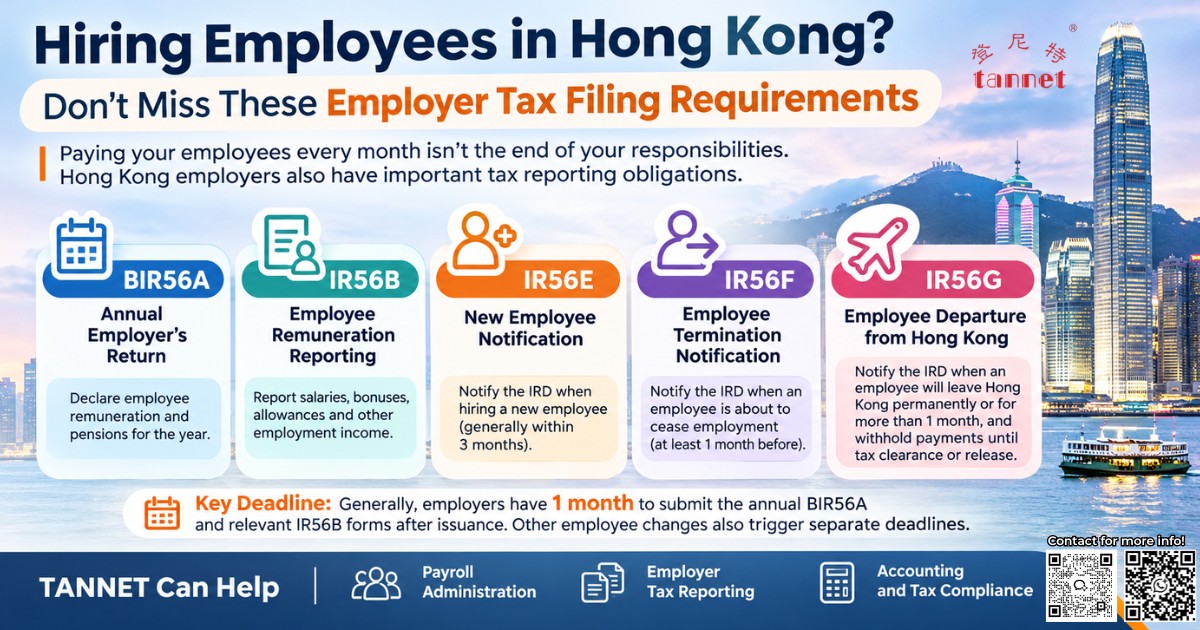
Hiring employees in Hong Kong comes with more responsibilities than paying monthly salaries and managing employment contracts. Employers must also comply with the Inland Revenue Department (IRD)’s reporting requirements, including declaring employee remuneration, reporting new hires and notifying the authorities when employees leave.
Whether you operate a Hong Kong SME, manage an overseas company with Hong Kong employees, or oversee HR and payroll administration, understanding these obligations is essential to maintaining proper tax compliance.
Under Hong Kong’s Inland Revenue Ordinance, employers must submit specific forms at different stages of an employee’s employment. Missing these deadlines or providing inaccurate information may expose the company to compliance issues and potential penalties.
Here are five important Hong Kong employer tax filing requirements every business should understand.
1. What Is the Annual Employer’s Return (BIR56A)?
The Employer’s Return of Remuneration and Pensions, commonly known as Form BIR56A, is an annual tax reporting document issued by the IRD.
Employers use this return to declare employee remuneration and pensions for the relevant year of assessment, which runs from 1 April to 31 March.
When the IRD issues BIR56A, employers must complete and submit it within one month from the date of issue.
Importantly, employers must still return BIR56A even if:
- The company did not employ any staff during the relevant period.
- The business has not commenced operations.
- The business has ceased operations.
If the company has employees whose remuneration must be reported, the annual return should be accompanied by the relevant IR56B forms.
Businesses should monitor their correspondence from the IRD to avoid overlooking the filing deadline.
2. How to Report Employee Remuneration Using IR56B
Form IR56B is used to report an employee’s remuneration and benefits during the relevant year of assessment.
It is generally submitted together with BIR56A and provides the IRD with information about the employee’s income.
Reportable remuneration may include:
- Salaries and wages.
- Bonuses and commissions.
- Director’s fees.
- Allowances and other employment-related payments.
- Certain benefits, including accommodation-related benefits.
- Other taxable employment income.
Employers should maintain accurate payroll records throughout the year to ensure that the information reported is complete and consistent.
A common mistake is assuming that only basic salary needs to be declared. In reality, employers should assess the full range of remuneration and benefits under the applicable tax rules.
A copy of the completed IR56B should also be provided to the relevant employee.
3. When Should Employers Submit IR56E for New Employees?
Hiring a new employee triggers another reporting obligation.
Form IR56E is used to notify the IRD when a person commences employment and is expected to be chargeable to Salaries Tax.
Employers generally need to submit IR56E within three months of the employee’s commencement of employment.
The form typically requires information such as:
- Employee’s personal particulars.
- Employment commencement date.
- Job title and position.
- Salary and remuneration details.
- Employment terms and other relevant information.
Employers should establish an onboarding process that includes collecting the necessary employee information and identifying applicable tax reporting deadlines.
This is particularly important for overseas companies hiring their first employees in Hong Kong, as they may be unfamiliar with local employer reporting procedures.
4. What Happens When an Employee Leaves? IR56F Requirements
When an employee is about to cease employment, employers must consider whether Form IR56F needs to be submitted.
IR56F is used to notify the IRD that an employee is about to terminate employment, such as through resignation, dismissal or retirement.
The employer must generally submit IR56F at least one month before the employee’s termination date.
The form reports the employee’s remuneration and relevant employment information up to the cessation of employment.
One important distinction is that IR56F applies when an employee leaves the company but is not subject to the separate departure reporting requirements under IR56G.
Employers should therefore establish whether the departing employee intends to remain in Hong Kong or leave the territory, as this may affect which notification is required.
A copy of the completed form should also be provided to the employee.
5. IR56G: What If an Employee Is Leaving Hong Kong?
IR56G is particularly important when an employee who is chargeable to Salaries Tax is preparing to leave Hong Kong permanently or for a substantial period.
Under the relevant tax reporting requirements, an employer must generally notify the IRD at least one month before the employee’s expected departure if the employee intends to leave Hong Kong for more than one month.
This requirement does not apply to employees who are required to leave Hong Kong frequently in the normal course of their employment.
The employer’s responsibilities include:
Step 1: Confirm the employee’s departure plans
The employer should ascertain the employee’s expected departure date and whether the employee intends to leave Hong Kong for more than one month.
Step 2: Submit Form IR56G
The employer must submit two copies of IR56G, or file electronically, at least one month before the expected departure date.
Step 3: Withhold payments
From the date of notification, the employer must generally withhold all payments of money or money’s worth due to the employee for one month, or until the IRD issues a Letter of Release, whichever occurs earlier.
This may include outstanding salaries, bonuses, commissions and other employment-related payments.
Step 4: Allow the employee to complete tax clearance
The employee should arrange tax clearance with the IRD before leaving Hong Kong. The employer should release the withheld payments in accordance with the applicable requirements once the necessary release is obtained or the statutory withholding period has ended.
Failure to follow these procedures can expose the employer to legal consequences.
6. How Can Businesses Manage Hong Kong Employer Tax Compliance?
Managing payroll and employer tax reporting requires continuous attention, particularly for businesses with multiple employees, overseas management teams or frequent staff movements.
Employers should consider implementing the following practices:
- Maintain accurate and updated payroll records.
- Establish an annual tax reporting calendar.
- Track employee commencement and termination dates.
- Identify employees who are planning to leave Hong Kong.
- Reconcile remuneration and benefits before submitting tax forms.
- Keep copies of submitted forms and supporting documentation.
For overseas businesses without an established Hong Kong administrative team, outsourcing payroll administration and employer tax reporting can help reduce operational pressure and improve compliance management.
Conclusion
Hong Kong employer tax filing requirements extend beyond annual salary declarations. From BIR56A and IR56B to IR56E, IR56F and IR56G, each form serves a different purpose and carries its own reporting deadline.
Businesses that understand these obligations can manage employee transitions more effectively, maintain accurate tax records and reduce the risk of non-compliance.
Need assistance with Hong Kong payroll and employer tax reporting?
TANNET provides payroll administration, employer tax reporting, accounting and tax compliance support to help businesses manage their Hong Kong operations more efficiently.
Contact TANNET to discuss your company’s Hong Kong employer compliance requirements.
📞 Free 1-on-1 Consultation Now,
Official Service Hotline: +86-755-82148419
Cell: +86-13823131503;+60 19-309 2363
WeChat ID: 13823131503;
WhatsApp:+86-13823131503;+60 19-309 2363
Email: mytannet08@gmail.com; susiehu@citilinkia.com