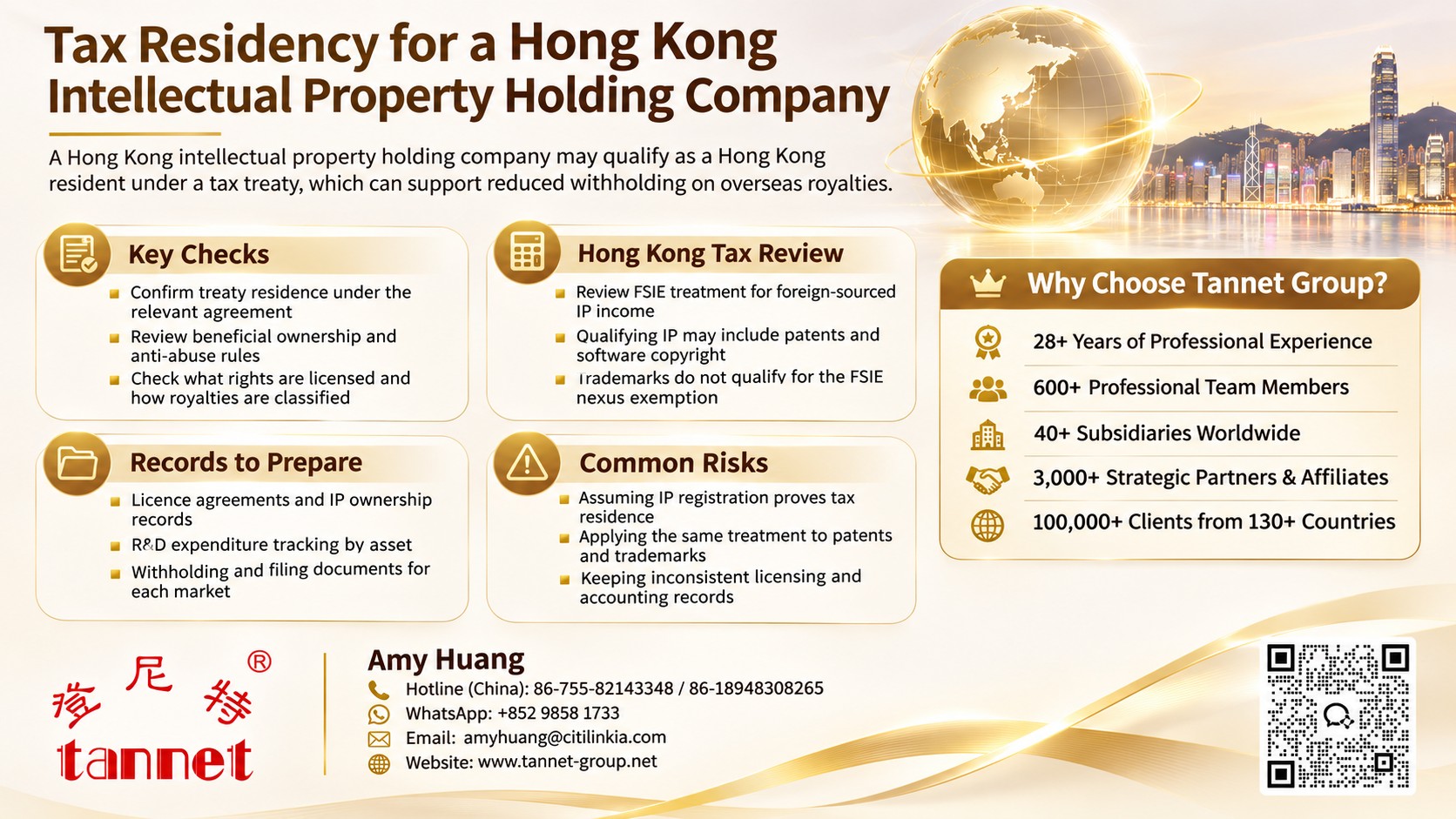
Key Takeaway
A Hong Kong intellectual property holding company may qualify as a Hong Kong resident under a tax treaty if it meets that agreement’s residence definition. This matters to businesses that hold patents, software copyright or trademarks and license those rights overseas. A Certificate of Resident Status can support a claim for reduced foreign withholding on royalties.
Check whether the company is the beneficial owner, whether any anti-abuse rule applies and what rights the payer receives. Then review Hong Kong profits tax separately. For certain foreign-sourced IP income, the available exemption depends on the type of IP and the company’s qualifying research and development expenditure.
Step 1. Establish residence under the relevant agreement
Start with the treaty for the jurisdiction where the royalties arise. Under the UK–Hong Kong agreement, the Hong Kong residence definition includes a company incorporated in Hong Kong. A company incorporated elsewhere can qualify under that definition if it is centrally managed and controlled in Hong Kong.
If the other jurisdiction also treats the company as resident, apply the treaty’s corporate dual-residence provision. Under the UK agreement, the rule looks to the place of effective management. In cases of doubt, the competent authorities seek agreement. Other treaties can resolve dual residence differently.
The Hong Kong Inland Revenue Department, or IRD, bases its certificate decision on the relevant treaty’s residence definition. A locally incorporated company generally supplies less information about its operations on the revised application forms. Keep decision records in case a tax authority asks how the company actually operates.
For a company managed across several jurisdictions, identify who approves acquisitions, licensing terms and budgets. Keep contemporaneous minutes and approval records. Include the people who made the decisions, where they made them and what authority they had. Reconcile these records with what happens in practice.
Step 2. Test the royalty claim before invoicing
Read the licence and identify the rights the customer receives. Permission to reproduce or commercially exploit software can raise different treaty issues from access to a hosted service. If the agreement covers IP rights and support, review whether the payments require separate tax treatment.
The treaty may cap source-country tax on qualifying royalties. Under the UK–Hong Kong agreement, the source jurisdiction generally can charge up to 3% of the gross royalty if the beneficial owner is a resident of the other party. Check exceptions, including a right effectively connected with a local permanent establishment.
Review who can use and enjoy the royalty. A company that must pass the payment to an affiliate under a linked agreement may face a beneficial ownership challenge. Compare the incoming licence, any upstream licence and actual cash flows. Document any restrictions on retaining or using the income.
Check the applicable principal purpose test as well. The treaty partner can consider why the group placed the IP and licensing activity in Hong Kong. Keep records of the commercial reasons for the structure, the functions the company performs and the risks it controls.
A trademark illustrates the difference between the tests. A payment for the right to use a trademark can be a royalty under the UK–Hong Kong agreement. Its classification under that agreement is separate from its treatment under Hong Kong’s FSIE regime.
Step 3. Analyse Hong Kong tax on each IP income stream
Start with the Inland Revenue Ordinance and the facts that determine source. Review how the company acquired or developed the IP, what it licensed and how the income arose. The customer’s location and the bank account receiving the royalty provide only part of the evidence.
Hong Kong’s foreign-sourced income exemption regime, or FSIE, can bring specified foreign-sourced IP income into profits tax when received in Hong Kong by a multinational group entity carrying on business there. Receipt can include using the income to settle a debt from that Hong Kong business.
Under the FSIE nexus requirement, the exemption for qualifying IP income depends on the relevant research and development, or R&D, expenditure. Qualifying IP can include patents, patent applications and software copyright. A trademark falls outside this definition. Having staff and office space does not qualify a trademark royalty for the nexus exemption.
Track the expenditure by asset. The calculation can distinguish the company’s own R&D, eligible outsourced R&D, acquisition costs and R&D outsourced to related parties outside Hong Kong. Retain invoices and records of who did the work. A purchased patent can produce a limited or zero exemption, depending on qualifying expenditure.
The IRD’s FSIE guidance calls for reporting specified foreign-sourced income for the year it accrues and reporting chargeable amounts for the year of Hong Kong receipt. Retain the relevant records for both dates.
Hong Kong’s patent box regime can apply a 5% profits tax rate to the qualifying portion of assessable profits from eligible IP income, subject to its own conditions and a written election. Review it after determining whether the income is assessable and how much qualifies under the patent box rules.
Step 4. Match the IP records to the company’s functions
Maintain a register of IP assets, including registrations or applications where relevant, assignments and licensing rights. Reconcile each royalty to a contract and invoice. For an IP transfer within a group, retain the valuation, transaction documents and evidence of the functions each entity performs.
Hong Kong’s IRD transfer pricing guidance looks at who develops, enhances, maintains, protects and exploits the IP. If the Hong Kong company holds legal title while affiliates fund development and control key risks, assess how the group allocates IP returns under the arm’s length principle.
Confirm whether the payer requires a local filing before applying a reduced rate. Track application deadlines alongside royalty payment dates and keep copies of withholding records.
Common Mistakes
Assuming that a Hong Kong IP registration establishes tax residence.
IP registration records a right in an asset. Check residence under the relevant treaty and confirm which legal entity earns the royalty.
Applying the same exemption to patents and trademarks.
A portfolio can generate royalties subject to different domestic tax rules. Allocate the income across assets and check eligibility for each stream before filing.
Treating the licence and the accounts as separate records.
If contracts say one entity controls the IP while another approves budgets, bears costs and retains proceeds, explain the difference with contemporaneous records and a transfer pricing analysis where appropriate.
Frequently Asked Questions
Q1. Can a newly incorporated IP holding company apply for a residence certificate?
Yes, if it meets the residence definition in the applicable treaty. Check which partner and period the certificate should cover. A new company should also prepare the licence and transaction records needed for the foreign claim.
Q2. Can an overseas director affect the company’s treaty residence?
It can matter if the treaty tests management and control or if another jurisdiction also claims residence. Review where decision-makers actually exercise authority. The director’s address is one fact alongside the company’s decision-making records.
Q3. Is trademark income eligible for Hong Kong’s FSIE nexus exemption?
No. Trademarks fall outside the qualifying IP definition for this exemption. Check whether FSIE applies to the company and payment, and whether ordinary Hong Kong tax rules or another provision applies.
Q4. Can our Hong Kong company keep royalties offshore to avoid FSIE receipt?
Trace what the company does with the money. It can be treated as received in Hong Kong if the company uses it to settle a debt incurred for a Hong Kong business, even without a bank transfer into Hong Kong.
Q5. We bought software IP from an affiliate. Can we claim the full exemption?
The answer depends on the qualifying R&D expenditure for the asset. The acquisition cost enters the nexus calculation as non-qualifying expenditure. Identify who performed and paid for later development and retain records by asset.
Q6. Can I claim both a treaty royalty rate and Hong Kong patent box treatment?
Potentially. The treaty governs the source jurisdiction’s taxing rights. The patent box governs the Hong Kong rate on an eligible portion of assessable profits. Check the conditions and filing steps for each claim separately.
How Tannet Can Assist
Tannet can help organise IP ownership and licensing records, prepare a Hong Kong residence certificate application, and coordinate with tax advisers on withholding, FSIE or transfer pricing when several group entities contribute to the IP.
30th Anniversary Offer: Tannet has been established for 28 years, we are offering exclusive limited-time promotional pricing to celebrate Tannet’s 30th anniversary. Slots are limited and available on a first-come, first-served basis. Contact Consultant Amy Huang for details.
Written by: Tannet Business Services Team
Reviewed by: Consultant Amy Huang
First published: 12 Nov. 2026
Last reviewed: 12 Nov. 2026
————————————————Simplifying Business, Empowering Entrepreneurs————————————————