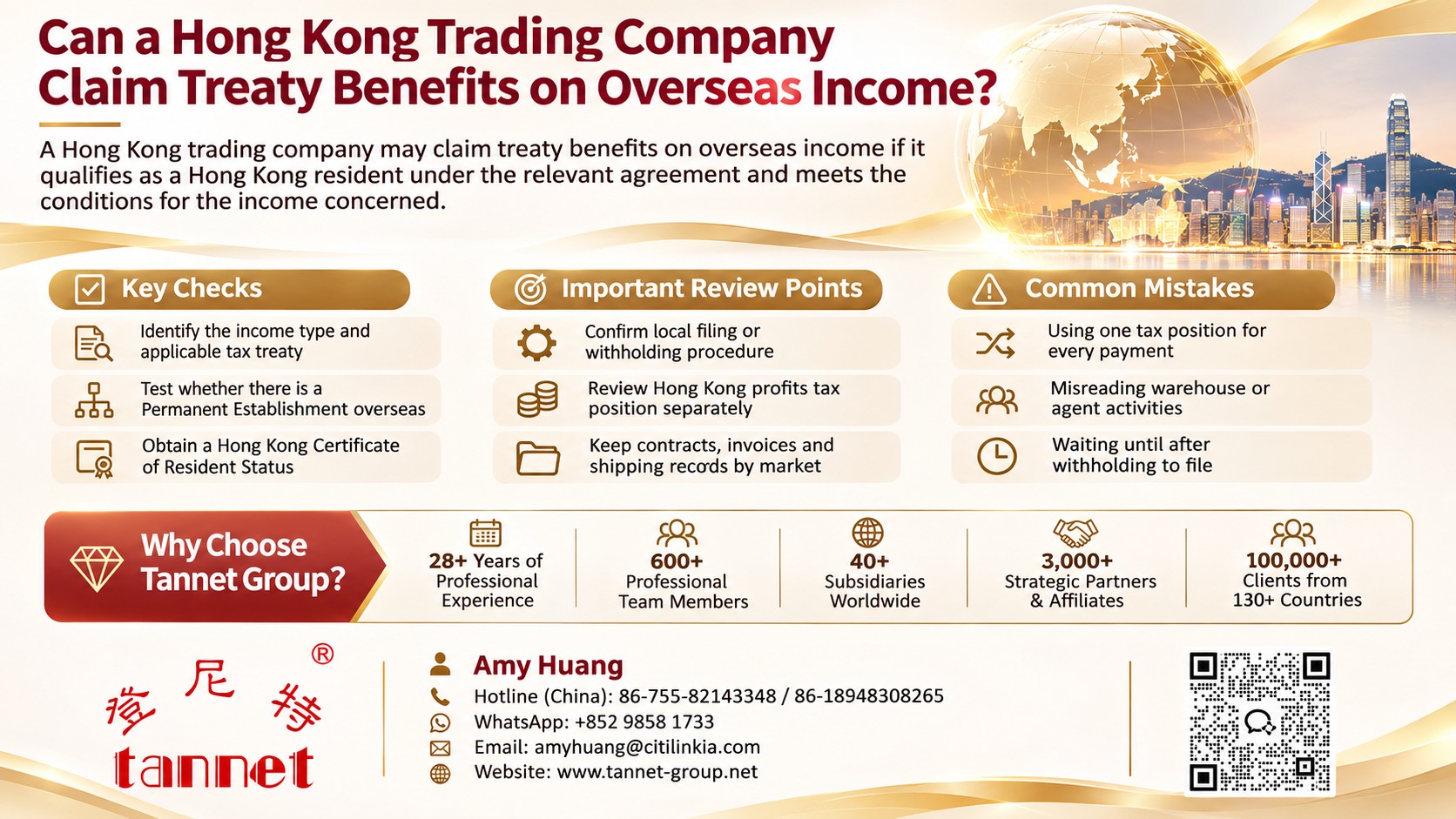
Key Takeaway
Yes. A Hong Kong trading company may claim tax treaty benefits on overseas income if it qualifies as a Hong Kong resident under the applicable agreement and meets the conditions for the income concerned. This matters to importers, exporters and distributors with foreign customers, staff or warehouses.
For ordinary trading profits, the central question is whether the company has a permanent establishment in the other jurisdiction and which profits are attributable to it. A Hong Kong Certificate of Resident Status supports the residence claim. Check the agreement, local filing procedure and Hong Kong profits tax position before relying on relief.
Step 1. Identify the income and the applicable agreement
Start with the transaction and classify each source of income. If the company buys goods and resells them for its own account, the margin will generally fall under the business profits article. A distributor that also earns interest, royalties or service fees should classify each payment separately.
For a bundled contract, read the commercial terms. A machinery sale might include installation, training and the right to use software. Identify what the buyer receives, how the price is allocated and whether the treaty has a specific article for a separate fee.
Use the Inland Revenue Department’s list of comprehensive double taxation agreements to confirm coverage. Check the agreement, protocols and applicable changes under the Multilateral Instrument. Verify the effective date for the relevant tax and period. Signature and entry into force can precede the date when relief applies.
A company must meet the residence definition in the agreement it is using. For example, the UK–Hong Kong agreement includes a company incorporated in Hong Kong in its Hong Kong residence definition. If both jurisdictions treat the company as resident, apply that agreement’s rules for dual residents.
The relevant tax matters. A profits tax treaty allocates taxing rights over covered income. Import duties and value-added tax follow separate rules, so check customs and indirect tax requirements when pricing shipments.
Step 2. Test for a permanent establishment overseas
A permanent establishment, or PE, is a taxable business presence defined by the applicable agreement. Under the UK–Hong Kong agreement, the UK generally may tax a Hong Kong enterprise’s ordinary business profits only if the enterprise operates there through a PE. The UK may then tax the profits attributable to that PE.
A fixed office or branch can create a PE. A warehouse requires closer review. Identify who has the premises at their disposal and what happens there. Storage or delivery alone can fall within a treaty exception. Activities such as sales, returns handling or order processing can change the analysis.
Review local representatives too. Under the UK agreement, a dependent agent who habitually exercises authority to conclude contracts on the company’s behalf may create a PE, subject to the treaty’s conditions. Other agreements can use different language. Check what people do in practice, including who agrees on prices and other material terms.
If the company has a PE, calculate the profits attributable to its activities under the relevant agreement. Document the functions performed, assets used and risks assumed. Reconcile the calculation with the company’s accounts. A schedule of gross sales to customers in that market answers a different question.
Step 3. Obtain the residence certificate and file the claim
The Hong Kong Inland Revenue Department, or IRD, issues a Certificate of Resident Status for treaty purposes. Identify the correct legal entity, partner jurisdiction and period before filing.
The IRD targets a response within 21 working days after receiving a properly completed application. The response may be a certificate, a request for more information or a decision declining the application.
Confirm the process with the payer or the relevant tax authority before the first payment. Ask whether relief can be applied at source, whether a separate application is needed or whether the company must request a refund after withholding. Record the filing deadline and the documents the payer requires.
The certificate supports Hong Kong residence. The treaty partner can examine the applicable income article, the company’s business presence and any anti-abuse rule. Where a principal purpose test applies, relief may be denied if obtaining the benefit was a principal purpose of the arrangement, subject to the treaty’s object and purpose exception.
Build a file for each market. Keep the purchase and sale contracts, invoices, shipping records, agent agreements and written approvals. If the payer withholds tax, obtain the tax certificate or other official evidence. Check that the amounts match the invoices and the bank receipts.
Step 4. Review Hong Kong profits tax separately
Hong Kong generally applies a territorial basis to profits tax. For trading in goods, IRD guidance looks closely at where purchase and sale contracts are effected. That includes negotiation, conclusion and performance. The wider operations that generate the profit can also matter.
For example, a Hong Kong trader may buy from a supplier in the Chinese Mainland and sell to a UK customer. Direct shipment between those locations leaves open where the company carried out its profit-producing operations. Review who negotiated both contracts, where those people worked and how they accepted the orders.
Check separate receipts under Hong Kong’s foreign-sourced income exemption regime where relevant. An overseas dividend, interest payment or royalty earned by a multinational group entity can require its own analysis. If the same income is taxable in two jurisdictions, review the treaty credit rules and retain proof of overseas tax.
For a treaty credit claim, identify the entity that paid the overseas tax and the income on which it was charged. Check the Hong Kong tax attributable to that same income before estimating the credit.
Common Mistakes
Using one tax position for every payment.
Goods sales, licensing and financing can fall under different treaty articles. If the contract covers more than one payment, document what each amount buys and check the applicable local procedure.
Assessing a warehouse by its label.
A logistics agreement may describe a facility as storage while staff process orders or support sales there. Review the work performed and the company’s access to the premises against the actual treaty language.
Waiting until after withholding.
The payer may need the certificate and local forms before payment to apply a reduced rate or exemption at source. Confirm the procedure while negotiating payment terms and keep the refund deadline on file.
Frequently Asked Questions
Q1. Can my Hong Kong company claim relief if it has no office overseas?
Possibly. Check for other forms of PE, including a dependent agent. A supplier or customer address alone gives limited information about your company’s presence. Review the roles of anyone acting for the company in that jurisdiction.
Q2. Can I apply for a residence certificate if I claim offshore trading profits?
You may apply if you meet the relevant treaty’s residence definition. The certificate addresses residence. The offshore claim turns on where the operations that produced the trading profits took place under Hong Kong tax rules.
Q3. Does using an overseas fulfilment provider create a PE?
It depends on access to the premises, the activities performed and the treaty wording. Obtain the fulfilment contract and confirm who handles order acceptance, stock management, returns and customer support before drawing a conclusion.
Q4. What if my overseas customer says withholding is mandatory?
Ask for the legal basis, the income classification and the rate. Check whether the agreement limits that tax and whether local rules offer relief at source or a refund. Request proof of any tax withheld.
Q5. Can I use a certificate issued for another market?
Apply for the certificate that matches the treaty partner and period relevant to your claim.
Q6. What if the customer’s jurisdiction has no effective treaty with Hong Kong?
Review that jurisdiction’s domestic tax and withholding rules. Local relief may still be available. If the payment is also taxable in Hong Kong, check whether any Hong Kong relief applies to that specific income.
How Tannet Can Assist
Tannet can help a Hong Kong trading company prepare its residence certificate application, organise contracts and records by market, and coordinate with tax advisers when foreign withholding, a possible PE or an offshore profits position needs review.
30th Anniversary Offer: Tannet has been established for 28 years, we are offering exclusive limited-time promotional pricing to celebrate Tannet’s 30th anniversary. Slots are limited and available on a first-come, first-served basis. Contact Consultant Amy Huang for details.
Written by: Tannet Business Services Team
Reviewed by: Consultant Amy Huang
First published: 12 Nov. 2026
Last reviewed: 12 Nov. 2026
————————————————Simplifying Business, Empowering Entrepreneurs————————————————