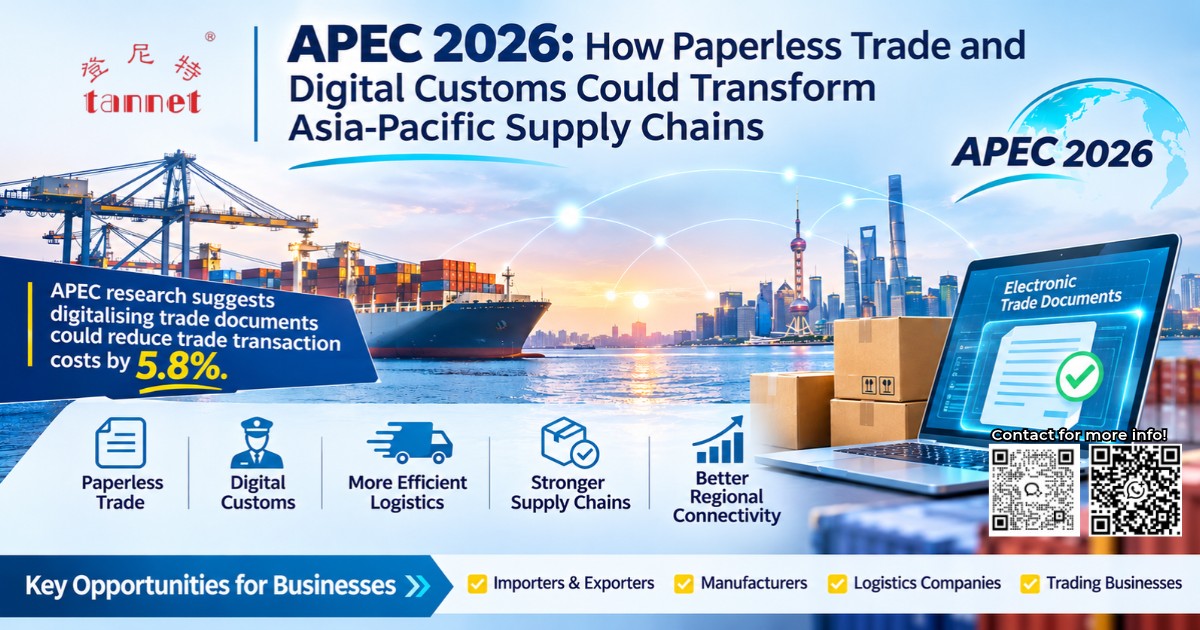
As China hosts APEC 2026, digital trade connectivity and supply chain resilience are receiving renewed attention. For Australian businesses trading with China and other Asia-Pacific economies, these developments could create opportunities to improve operational efficiency, reduce administrative costs and strengthen regional market access.
One particularly important development is the advancement of paperless trade, including electronic documentation, digital customs processes and more connected supply chain systems.
Discover how APEC 2026 Digital Trade and Supply Chains initiatives could reduce trade costs, improve paperless customs and create supply chain opportunities for Australian businesses trading with China.
1. Why APEC Economies Are Accelerating Paperless Trade
International trade involves multiple parties, including exporters, importers, freight forwarders, shipping companies, customs authorities, banks and regulatory agencies.
Each transaction may require several documents, such as:
- Commercial invoices
- Packing lists
- Bills of lading
- Certificates of origin
- Customs declarations
- Import and export permits
When these documents are processed manually, businesses can experience duplicated administrative work, verification delays and additional operational expenses.
APEC economies are therefore encouraging greater adoption of paperless trade systems to improve cross-border connectivity.
Through initiatives such as the APEC Centre of Excellence for Paperless Trade (ACCEPT), governments and businesses are working towards improving the recognition and exchange of electronic trade documents.
The objective is not simply to replace physical paperwork with digital files. It is to establish more compatible systems that allow trade documentation to be exchanged and recognised across different economies.
For businesses, this could mean more efficient trade administration and fewer unnecessary procedural barriers.
2. How Electronic Documentation Could Reduce Cross-Border Trade Costs
Electronic trade documentation can improve efficiency throughout the international supply chain.
For example, traditional shipping documentation may require businesses to prepare, print, courier and manually verify documents between different parties.
With digital documentation, relevant information can potentially be submitted and exchanged electronically, reducing the need for repeated manual processing.
Several areas could benefit:
Faster document processing
Electronic submission can reduce the time required to prepare and transmit trade documents, particularly when businesses work with multiple international partners.
Lower administrative expenses
Reducing printing, courier services, document storage and manual processing can help businesses manage operational costs.
Improved document visibility
Digital systems can provide better access to transaction information, making it easier for businesses to monitor documentation status and identify missing requirements.
Better coordination
Importers, exporters, logistics providers and other stakeholders can work with more consistent information, reducing communication gaps.
However, digital documentation does not automatically eliminate customs inspections, regulatory approvals or mandatory certification requirements. Businesses must still comply with the applicable regulations of each destination market.
3. Digital Logistics and Supply Chain Management: Opportunities for Businesses
Beyond documentation, digital transformation is changing how businesses manage international supply chains.
Companies are increasingly adopting technologies such as artificial intelligence, cloud-based platforms, automated inventory systems and real-time shipment tracking.
These technologies can support several commercial activities.
Supply chain visibility
Businesses can monitor shipment progress, inventory movements and delivery schedules more effectively.
Inventory management
Digital systems can help manufacturers and distributors forecast demand, manage stock levels and coordinate purchasing activities.
Logistics optimisation
Data-driven systems can support route planning, warehouse management and freight coordination.
Risk management
Better access to operational information can help businesses identify potential disruptions and respond more quickly.
For Australian manufacturers and importers working with Chinese suppliers, these capabilities can improve coordination across procurement, production, shipping and distribution.
Businesses that invest in digital supply chain infrastructure may also be better positioned to respond to changing customer demand and regional market conditions.
4. What Improved Regional Trade Connectivity Means for Australian Businesses
Australia maintains significant commercial relationships with Asia-Pacific economies, particularly China.
For Australian importers, exporters and manufacturers, improvements in regional trade connectivity could create opportunities in several areas.
Importing from China
Australian businesses sourcing machinery, components, consumer products and manufacturing materials could benefit from more efficient documentation and shipment coordination.
Exporting to China
Australian exporters in agriculture, food products, resources and other industries may benefit from improved digital coordination with overseas trading partners.
Manufacturing partnerships
Companies working with Chinese manufacturers could improve procurement planning, production monitoring and international logistics management.
Regional distribution
Businesses using China as part of a broader Asia-Pacific distribution strategy could benefit from more integrated logistics and digital trade infrastructure.
Nevertheless, improved digital connectivity does not mean that all APEC economies will adopt identical customs procedures or automatically recognise every electronic document.
Businesses must understand the specific regulatory requirements of each market they operate in.
5. What Foreign Companies Should Prepare for When Trading with China
For Australian companies considering China as a sourcing, manufacturing or sales destination, preparation should extend beyond identifying suppliers.
Businesses should establish a suitable operational and compliance structure before commencing cross-border activities.
Key considerations include:
1. Establishing the appropriate business entity
Companies should assess whether they need a locally registered Chinese entity, a representative office, a distribution arrangement or another suitable business structure.
The appropriate option depends on the company’s commercial activities and operational requirements.
2. Understanding import and export regulations
Businesses should identify the applicable customs procedures, product classifications, import and export requirements and relevant industry-specific permits.
3. Reviewing product compliance
Certain products may require additional certifications, registrations, labelling approvals or regulatory assessments before entering the Chinese market.
4. Preparing tax and accounting arrangements
Companies should understand their tax obligations, invoicing requirements, bookkeeping responsibilities and ongoing compliance obligations.
5. Reviewing digital trade readiness
Businesses should assess whether their internal systems can support electronic documentation, digital recordkeeping and communication with logistics partners and relevant authorities.
A well-prepared business structure can help reduce operational uncertainty when entering a new market.
6. How TANNET Supports Businesses Expanding into China
As regional trade becomes increasingly connected, foreign companies need more than logistics arrangements to establish sustainable cross-border operations.
They also need reliable support with company registration, business licensing, regulatory compliance and ongoing corporate administration.
TANNET provides international business services to companies exploring overseas expansion and cross-border commercial opportunities.
For businesses entering China or establishing trading relationships with Chinese partners, our services include:
- China company registration and business setup advisory.
- Import and export business licensing support.
- Industry-specific licence and regulatory application coordination.
- Trademark and intellectual property registration support.
- Accounting, taxation and corporate compliance services.
- Cross-border business expansion and market-entry advisory.
The appropriate services depend on the company’s business model, industry and intended activities.
Conclusion: Preparing for the Future of Asia-Pacific Trade
APEC 2026 is bringing greater attention to digital trade, paperless documentation and regional supply chain connectivity.
Although regulatory differences and technical interoperability challenges remain, the direction is clear: businesses will increasingly need to adopt digital processes to remain competitive in international trade.
For Australian companies working with Chinese suppliers, manufacturers and distributors, this is an opportunity to review existing supply chain operations and prepare for a more digitally connected trading environment.
The companies that combine digital readiness with proper market-entry planning, regulatory compliance and operational infrastructure will be better positioned to participate in the next phase of Asia-Pacific trade development.
Planning to expand into China?
Contact TANNET to explore company registration, import and export licensing, business compliance and cross-border expansion support.
📞 Free 1-on-1 Consultation Now,
Official Service Hotline: +86-755-82148419
Cell: +86-13823131503;+60 19-309 2363
WeChat ID: 13823131503;
WhatsApp:+86-13823131503;+60 19-309 2363
Email: mytannet08@gmail.com; susiehu@citilinkia.com