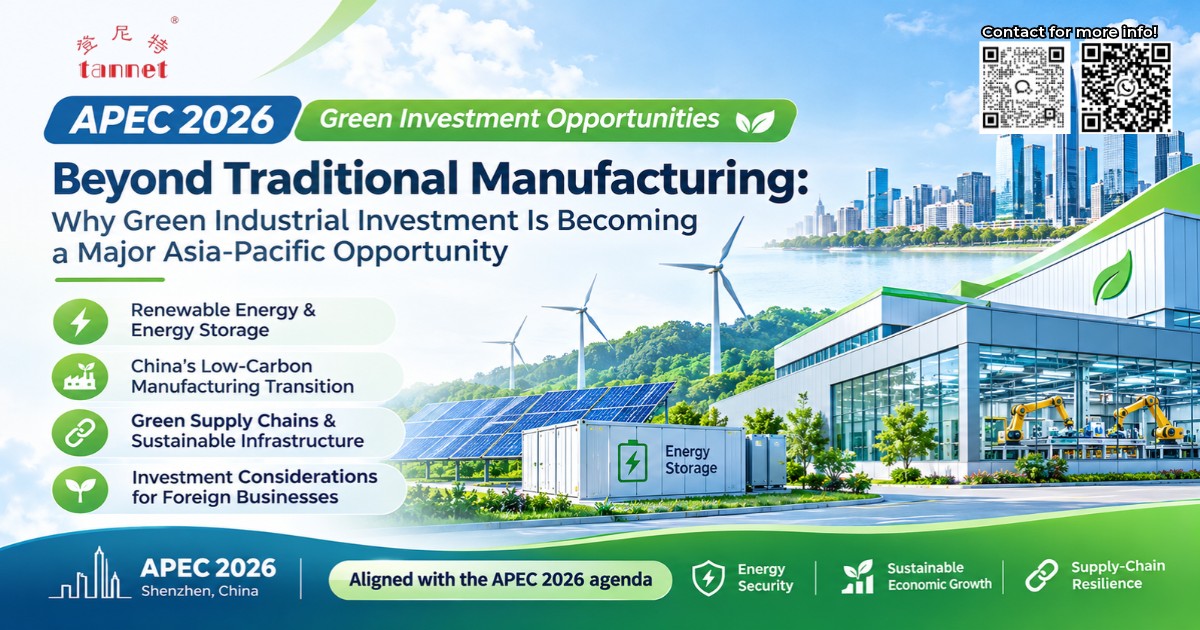
The manufacturing industry is entering a new phase. Production capacity, labour costs and supply chain efficiency remain important, but businesses are increasingly evaluating another factor: sustainability.
Across the Asia-Pacific region, the transition towards renewable energy, energy-efficient production and low-carbon supply chains is creating new investment opportunities. For Australian manufacturers, infrastructure companies and international investors, China is an important market to watch.
With China hosting APEC 2026 in Shenzhen, discussions surrounding regional economic cooperation, sustainable development and supply chain resilience provide an important context for businesses assessing their next expansion opportunities.
Explore APEC 2026 green investment opportunities, China’s renewable energy sector, sustainable manufacturing and market-entry considerations for Australian investors.
1. Why Green Investment Matters for APEC 2026
The Asia-Pacific region is experiencing significant changes in its industrial and energy landscape. Governments and businesses are under increasing pressure to improve energy efficiency, strengthen energy security and reduce environmental impacts.
These developments are influencing investment decisions across manufacturing, infrastructure, logistics and technology.
For businesses operating across APEC economies, sustainability is becoming more than a corporate responsibility initiative. It is increasingly connected to operational competitiveness, supply chain requirements and long-term business resilience.
APEC 2026 provides an opportunity to examine how regional economic cooperation, trade facilitation and sustainable development can support future business opportunities.
For Australian companies, this creates a reason to reassess their regional strategies, particularly when considering partnerships, suppliers and investment opportunities in China.
2. Renewable Energy and Energy Storage: Emerging Investment Areas
One of the most significant areas of green industrial investment is renewable energy.
Solar power, wind energy and energy storage technologies are becoming increasingly important as businesses seek more reliable and efficient energy solutions.
Energy storage is particularly relevant because renewable energy generation can fluctuate depending on weather conditions and demand. Battery storage systems and other energy management technologies can help improve electricity reliability and support industrial operations.
China has developed substantial capabilities across solar manufacturing, battery production and electric vehicle supply chains. This industrial ecosystem creates potential opportunities for international businesses interested in technology partnerships, component sourcing and manufacturing collaboration.
Australian investors and manufacturers may explore opportunities in:
- Renewable energy equipment and components.
- Battery technology and energy storage systems.
- Industrial energy management solutions.
- Solar and wind project supply chains.
- Energy-efficient manufacturing equipment.
However, investors should evaluate market demand, technology standards, competition and regulatory requirements before entering these sectors.
3. China’s Transition Towards Low-Carbon Manufacturing
China’s manufacturing sector is undergoing structural changes as industrial upgrading and environmental objectives become increasingly important.
Traditional manufacturing models are gradually incorporating energy-efficient machinery, intelligent production systems, cleaner energy sources and improved resource management.
This transition is relevant to international manufacturers because sustainability requirements increasingly influence supplier selection and production decisions.
For example, businesses supplying international markets may need to demonstrate better energy management, traceability and environmental performance throughout their production processes.
Opportunities are emerging in several areas:
Smart manufacturing: Digital production systems, automation and industrial monitoring can improve operational efficiency and reduce resource waste.
Energy-efficient equipment: Manufacturers may invest in machinery that reduces electricity consumption and improves production performance.
Industrial environmental technology: Wastewater treatment, emissions control, recycling and resource recovery solutions are important components of industrial upgrading.
Low-carbon materials: Sustainable materials and more efficient production processes can help businesses respond to changing customer and supply chain expectations.
For Australian companies, partnerships with Chinese manufacturers and technology providers may offer access to established industrial capabilities and regional supply networks.
4. Green Supply Chains and Sustainable Industrial Infrastructure
Green investment extends beyond renewable energy generation. It also includes the infrastructure and business systems required to support sustainable industrial development.
Manufacturers are increasingly evaluating the environmental performance of their suppliers, logistics providers and production partners.
This creates opportunities across several parts of the supply chain, including:
- Sustainable industrial parks and infrastructure.
- Green logistics and transportation solutions.
- Industrial waste management and recycling.
- Energy-efficient warehousing and distribution.
- Carbon monitoring and environmental management systems.
China’s Greater Bay Area, which connects Shenzhen with other major manufacturing and commercial centres, is particularly relevant for companies exploring technology collaboration, manufacturing partnerships and regional market access.
Australian businesses can consider using the region as a starting point for evaluating suppliers, distributors, technology partners and potential joint investment projects.
Nevertheless, commercial feasibility should be assessed individually. Access to an established industrial ecosystem does not automatically guarantee market demand or investment returns.
5. What Foreign Investors Should Consider Before Entering China’s Green Technology Sector
Although China’s green technology sector presents significant opportunities, foreign investors should understand the regulatory and commercial environment before committing capital.
Several considerations are particularly important.
Company structure and incorporation
Foreign investors should assess the appropriate business structure based on their activities, ownership arrangements and operational requirements. Depending on the investment, a foreign-invested enterprise or other suitable business arrangement may be considered.
Environmental and industry approvals
Certain manufacturing and industrial activities may require environmental impact assessment procedures, environmental approvals, permits or other sector-specific compliance arrangements.
Requirements depend on the nature, location and scale of the proposed project.
Business licensing and operational compliance
Investors should identify the relevant business scope, industry qualifications and local registration requirements before commencing operations.
Technology partnerships and intellectual property
Businesses entering China’s green technology market should conduct due diligence on potential partners, technology ownership, licensing arrangements and intellectual property protection.
Market research and investment feasibility
Investors should evaluate local competition, customer demand, supply chain costs, government policies and commercial risks before establishing operations.
Understanding these factors early can help reduce market-entry uncertainty and support more sustainable investment decisions.
6. How TANNET Supports International Businesses Entering China
Entering China’s green technology and sustainable manufacturing sectors requires more than identifying an investment opportunity. Businesses also need a practical understanding of company establishment, regulatory requirements and ongoing compliance.
TANNET provides cross-border corporate services and business advisory support to international companies exploring opportunities in China and other Asia-Pacific markets.
Our services include:
- China company incorporation and business registration.
- Environmental licensing and regulatory advisory coordination.
- Corporate compliance and ongoing business administration.
- Cross-border investment and market-entry support.
- Business partner and professional service coordination.
For Australian manufacturers, renewable energy investors and international industrial groups, understanding the regulatory and operational requirements before entering China can help establish a stronger foundation for expansion.
Conclusion: Green Manufacturing Is Becoming a Strategic Investment Consideration
The future of Asia-Pacific manufacturing will not be determined by production capacity alone. Energy efficiency, environmental performance, technology integration and supply chain resilience are becoming increasingly important competitive factors.
APEC 2026 offers an opportunity for businesses to examine how regional cooperation and sustainable economic development may influence future investment decisions.
For Australian companies considering China, the opportunity is not simply about entering another manufacturing market. It is about identifying the right technology partners, building compliant operations and participating in the evolution of sustainable industrial supply chains.
Looking to explore green manufacturing or investment opportunities in China? Contact TANNET to discuss company incorporation, environmental regulatory advisory, business compliance and cross-border investment support.
📞 Free 1-on-1 Consultation Now,
Official Service Hotline: +86-755-82148419
Cell: +86-13823131503;+60 19-309 2363
WeChat ID: 13823131503;
WhatsApp:+86-13823131503;+60 19-309 2363
Email: mytannet08@gmail.com; susiehu@citilinkia.com