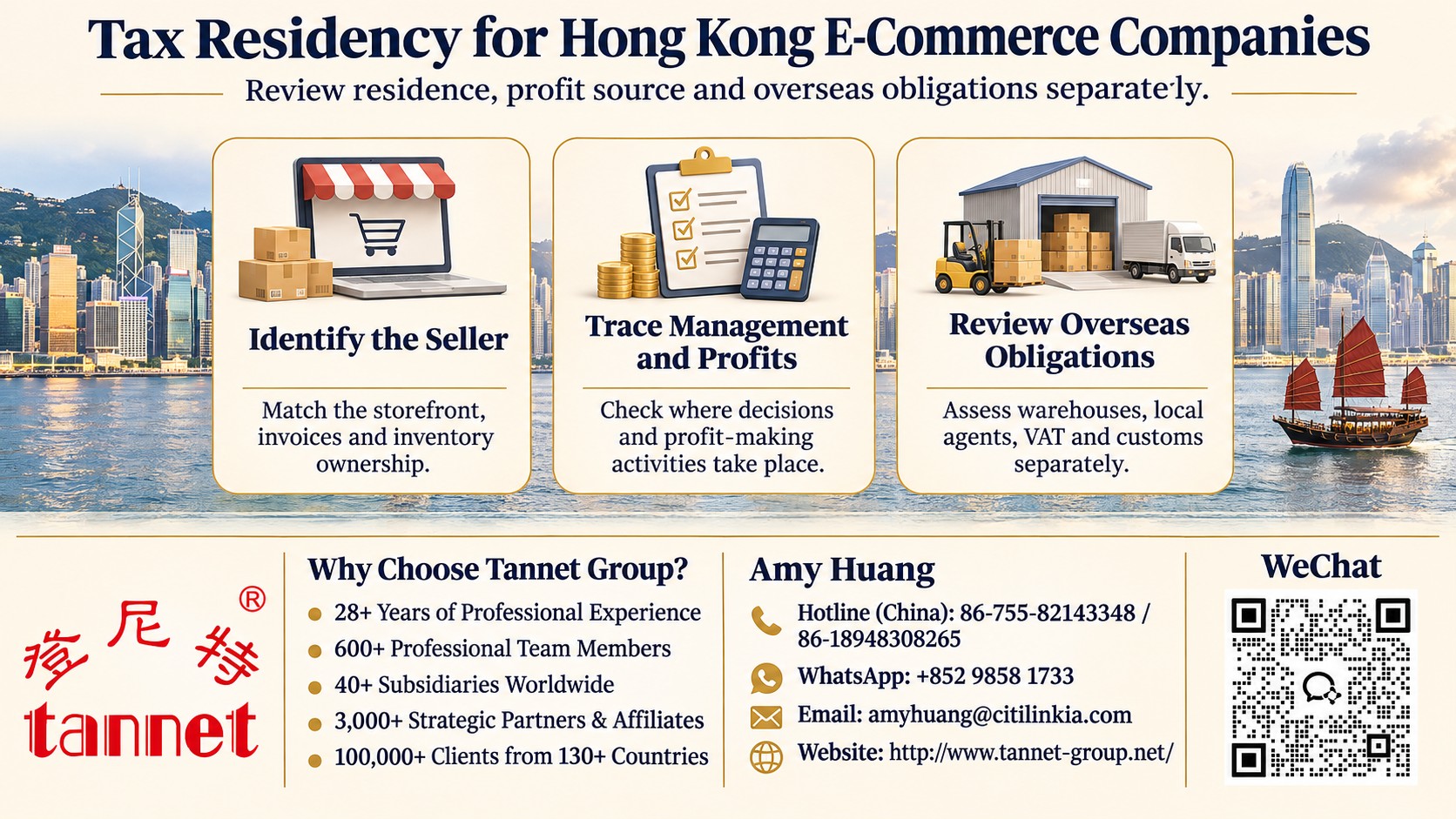
Key Takeaway
A Hong Kong e-commerce company should assess tax residence separately from where its sales profits arise, where it has a taxable business presence and where it must collect indirect taxes. Hong Kong incorporation can support residence under an applicable treaty. It does not make all overseas sales tax free or prevent another jurisdiction from applying its own residence rules.
This matters for marketplace sellers, direct online retailers and groups with overseas stock or managers. Start with the selling entity and how it operates. Then check residence, profit source, permanent establishment and VAT or sales tax market by market before filing.
Step 1 Identify the seller for each channel
Read the storefront terms, marketplace agreement and customer invoice together. Identify which company sells the goods, owns stock and bears refunds. The company receiving net marketplace payouts is not necessarily the seller in every channel.
Distinguish a marketplace that facilitates sales from a distributor that buys and resells goods. An indirect tax rule can also treat a platform as the supplier for a particular purpose. Do not assume that treatment changes who earns the trading profit for corporate income tax.
Create a short record for each sales channel. Include the contracting entity, fulfilment method, inventory location and importer of record. Capture when a new fulfilment programme starts. These dates help separate earlier direct shipments from later sales made from local stock.
Step 2 Check residence where the company is managed
Use each relevant jurisdiction’s domestic rules and the residence article of the applicable Hong Kong treaty. Hong Kong incorporation can be relevant under the treaty definition. Some foreign jurisdictions also look at where the company is managed. Foreign customers alone do not show that management has moved.
Look at who sets prices, approves budgets and takes major inventory or financing decisions. Establish where decision makers actually act. Day to day warehouse instructions are different from strategic decisions for the company as a whole. Board minutes should match the actual allocation of authority.
If two jurisdictions treat the company as resident, read the applicable treaty rule. Some agreements require competent authorities to seek agreement. Do not assume that the place named in the articles, or a single meeting held in Hong Kong, resolves dual residence.
The Hong Kong IRD explains that a Certificate of Resident Status supports claims under an effective treaty. It does not bind the treaty partner on other eligibility conditions. Verify whether you need it for a particular claim, which company should apply and which period it should cover.
Step 3 Determine the source of trading profits
The IRD’s guide to territorial source taxation focuses on what the taxpayer did to earn its profits and where those activities took place. For a trading business, examine where purchase and sale contracts were effected and the other operations relevant to producing the profits.
Automated order acceptance does not make the location of the website the answer. Identify who negotiated supplier terms, set customer terms and ran the sales operation. Review actual transaction records and management processes rather than deciding by bank account, settlement currency or domain name.
Distinguish trading income from other receipts. A group may also earn licensing income, interest or dividends. Check whether Hong Kong’s foreign-sourced income exemption regime applies to any specified income received in Hong Kong by a covered multinational entity. Do not apply the regime to every overseas sales receipt.
Step 4 Review foreign warehouses and local personnel
Assess permanent establishment, or PE, under host law and any applicable treaty. A fulfilment warehouse can raise a fixed place question. Review who controls the space, which activities occur there and whether any storage or delivery exception applies to the actual arrangement.
Using an independent logistics provider is not the same as operating a warehouse at the company’s disposal. Do not assume either outcome from the contract label. Check access rights, dedicated areas and whether the local functions are limited to storage or form part of the core business.
Review local employees and agents separately. Someone who habitually concludes contracts, or plays a principal role leading to their conclusion where the applicable treaty uses that test, can raise a different PE question. Review practice as well as written authority.
If the market identifies a PE, determine the profits attributable to it under the treaty and host law. A PE does not itself make the company locally resident. Keep branch and head office records consistent, and review whether relief is available if the same profits are taxed twice.
Step 5 Separate indirect tax and customs
VAT, GST, sales tax and customs can apply even where the seller is not resident and has no income tax PE. Check the destination market’s rules for stock location, consignments and marketplace sales. Also confirm who imports the goods and whether the company can recover import tax.
UK HM Revenue & Customs guidance illustrates the difference. The treatment of some goods sold directly to UK customers depends on where goods are located at sale and the consignment value. Marketplace transactions can follow different rules. Do not transfer one market’s threshold or procedure to another.
Reconcile platform tax reports to the company’s records. Keep gross sales, fees, tax, refunds and net remittances separately identifiable. A platform may collect tax for some sales while the company remains responsible for others. Confirm what happens when customers buy through your own website instead.
Build an evidence file before expanding
Keep marketplace terms, supplier agreements and fulfilment contracts. Add inventory movement reports, import declarations and invoices. For residence, keep decision papers and approvals that show who made significant decisions and where. Use dated versions so the evidence matches the relevant period.
When moving stock into a new warehouse, record who owned the goods during transport and who cleared them at the border. Match import entries to dated inventory receipts. This helps explain the sales flow during a review.
For each new market, record whether the company must register, file or appoint a local representative. Distinguish legal obligations from documents the platform requests to open an account. Review this file when stock moves, local staff gain authority or another company takes over the storefront.
Common mistakes
Do not equate an overseas marketplace or payment account with offshore profits. The source inquiry concerns the operations that earn the profits. Do not assume that Hong Kong treaty residence removes local indirect tax obligations.
Do not treat a VAT number as proof of corporate residence or a warehouse as automatic proof of a PE. They answer different questions. Review each legal test and preserve the actual facts.
Do not record platform payouts as if they were gross sales. Reconcile deductions and stock movements. Incomplete records can obscure who sold the goods and which transactions require local filings.
Frequently asked questions
Q1 Are overseas marketplace sales automatically offshore for Hong Kong tax?
No. Review where the company’s profit producing activities occur. Customer addresses and settlement accounts do not decide the result.
Q2 Does a foreign warehouse change my company’s tax residence?
Not by itself. Check management and domestic residence rules separately. Assess whether the warehouse creates a PE under the applicable rules.
Q3 Can I still claim Hong Kong treaty residence if I have a foreign PE?
Possibly. The PE concerns a local taxable presence. Check residence and dual residence independently, and analyse which profits are attributable to the PE.
Q4 Do I need a residence certificate for every marketplace?
No general rule requires that. Ask what the marketplace needs and whether the company is making a treaty claim for a specific jurisdiction and period.
Q5 If the marketplace collects VAT, can I ignore direct sales?
No. Check your own website sales separately. The platform’s collection obligations may cover only sales it facilitates.
Q6 Does a foreign subsidiary automatically create a PE for its Hong Kong parent?
No. A subsidiary is a separate entity. Examine what it does for the parent and whether it satisfies a fixed place or agency test.
Q7 What if the founders run everything from another jurisdiction?
Document where major decisions actually occur. Obtain advice on that jurisdiction’s residence rules and the treaty before making inconsistent declarations to authorities or counterparties.
Where Tannet can assist
Tannet can help map the selling entities, organise governance and fulfilment records, and assist with a Hong Kong residence certificate application. Seek qualified local advice for residence disputes, warehouse PE questions and indirect tax registration.
Written by: Tannet Business Services Team
Reviewed by: Consultant Amy Huang
First published: 11 Nov. 2026
Last reviewed: 11 Nov. 2026
30th Anniversary Offer: Tannet has been established for 28 years, we are offering exclusive limited-time promotional pricing to celebrate Tannet’s 30th anniversary. Slots are limited and available on a first-come, first-served basis. Contact Consultant Amy Huang for details.
————————————————Simplifying Business, Empowering Entrepreneurs————————————————