Key Takeaway
A Hong Kong software as a service company can claim tax treaty benefits if it qualifies under an effective agreement and meets the conditions for the specific payment. A subscription for hosted access may be treated as business profits. Fees for exploiting software copyright may instead fall under the royalties article. Some agreements also cover technical services.
Founders and finance teams should review each customer contract before agreeing a net price or instructing a payer to reduce withholding. The Hong Kong Inland Revenue Department’s Certificate of Resident Status supports a residence claim. It does not determine how the foreign jurisdiction classifies the payment or whether it grants relief.
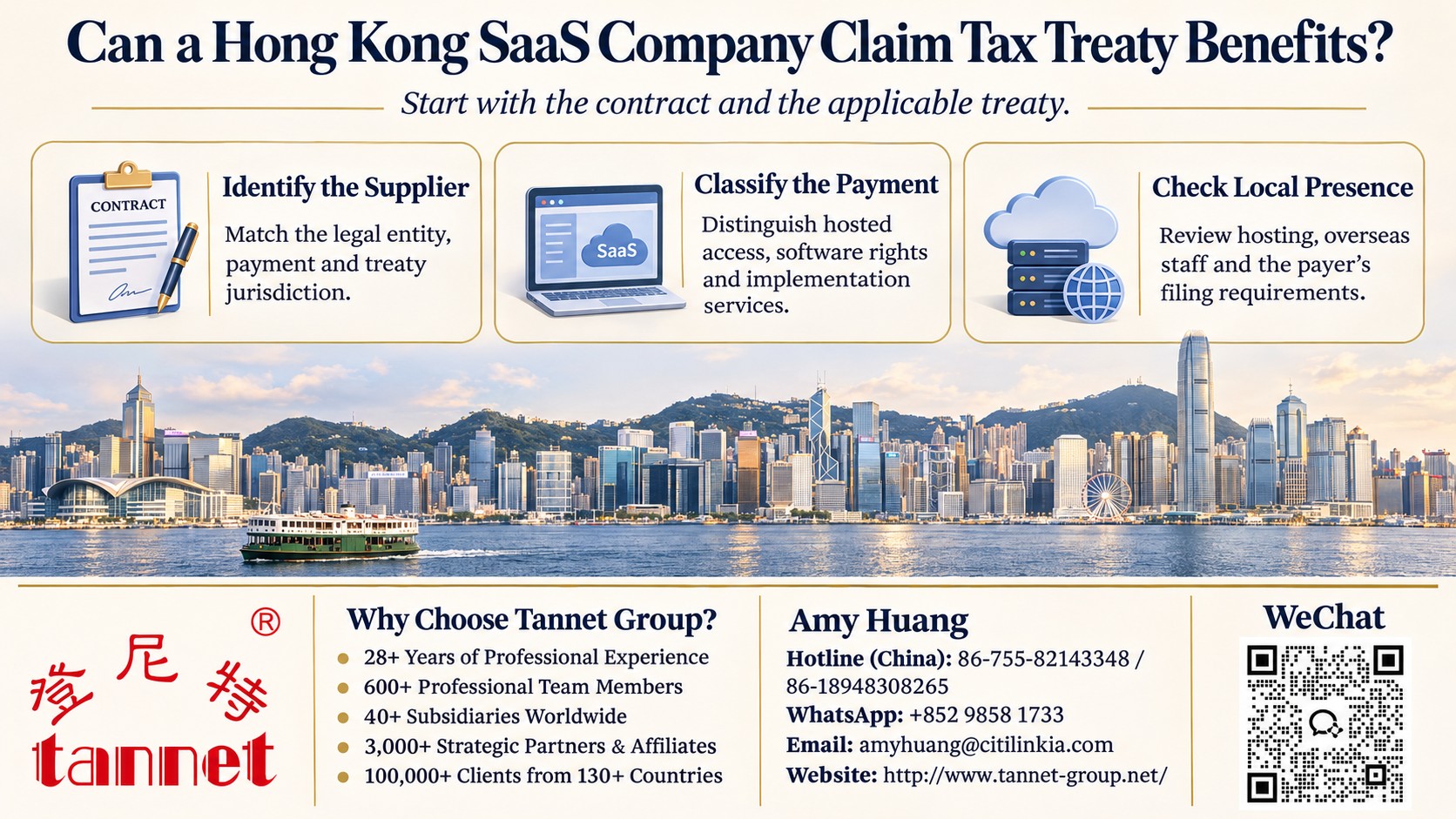
Step 1 Identify the company and the agreement
Start with the legal entity that earns the income. Compare the contract, invoice, payment instructions and accounting records. A payment processor may collect for the supplier. A reseller may instead buy and sell in its own name. These arrangements can change whose payment and treaty position you need to assess.
Identify the jurisdiction that may tax the payment and the relevant tax period. Check whether it has an effective agreement with Hong Kong. Read any protocol or applicable multilateral modifications. A treaty in force may have different effective dates for withholding and other taxes.
Read the residence article for the actual supplier. If another jurisdiction also treats the company as resident, check the treaty’s dual residence rule. For example, senior executives who run the company from abroad can raise a separate residence question. A Hong Kong registration address cannot resolve that question on its own.
Step 2 Classify what the customer buys
For hosted access, the supplier runs the application and the customer uses its features. If the contract does not transfer rights to exploit copyright, business profits may be the relevant treaty category. Verify the payment under source jurisdiction law and the exact treaty definition before treating it that way.
A licence that lets the customer commercially reproduce, distribute or adapt software can raise a royalty question. The IRD’s practice note on electronic commerce distinguishes rights to exploit copyright from rights needed to use a digital product. The word licence alone does not determine which rights were granted.
Implementation, training, migration and custom development can raise different issues from the subscription itself. Check whether the agreement covers technical service fees separately. If a contract bundles services and software rights, determine whether to analyse components separately or follow the character of the principal supply under the relevant rules.
Check the contract against the product in use. A customer that receives a copy for internal deployment does not necessarily obtain a right to commercially reproduce it. Keep the signed terms, product specifications and any schedules that describe customer rights.
For example, an annual subscription may cover remote access and routine updates, while a separate reseller agreement permits commercial reproduction. Review the two agreements independently. Compare the invoiced amounts with the rights and services actually delivered, particularly if a single overseas payer settles both charges.
Step 3 Check the relevant taxing rule
Under the business profits article of many agreements, the source jurisdiction generally cannot tax the supplier’s business profits unless it carries on business there through a permanent establishment, or PE. If a PE exists, the treaty may permit taxation of the profits attributable to it. Check for other articles that govern the payment first.
A royalty article may permit source taxation at a capped rate if its conditions are met. For example, Article 12 of the UK and Hong Kong agreement sets a three percent ceiling on gross royalties where the beneficial owner is a resident of the other party, subject to applicable conditions.
That ceiling is not a standard SaaS rate. It does not turn a hosted subscription into a royalty. It also does not impose a tax that domestic law would not otherwise charge. Review the currently effective treaty text, including applicable modifications, before advising the payer.
For a royalty claim, establish who can use and enjoy the income. An obligation to pass it to an upstream licensor may be relevant. Also check anti-abuse provisions, such as an applicable principal purpose test. Document the business reasons for the structure and the functions each entity actually performs.
Step 4 Map hosting and overseas personnel
Identify where staff sell, negotiate and implement the product. Look at offices, local representatives and contract authority. If the agreement includes a service PE provision, review project duration and personnel activity under its wording. A remote delivery model does not rule out all PE exposure.
The OECD Model Tax Convention commentary distinguishes a website from the equipment hosting it. A server may qualify as a fixed place of business if it is at the enterprise’s disposal and the other conditions are met. Ordinary shared hosting usually differs from leasing and operating a dedicated server.
Review what the company controls under the hosting contract. A selected cloud region does not by itself show that a particular server is at its disposal. Conversely, if the company operates equipment abroad, check what functions take place there and whether any treaty exception applies.
Step 5 Prepare the relief file before payment
Ask the payer which local form, certificate and deadline apply. If needed, apply to the Hong Kong IRD for a Certificate of Resident Status for the relevant agreement and period. Keep a copy of any declaration made to the payer and verify that it describes the actual supplier and income.
If tax has already been withheld, get the withholding statement and payment evidence. Check whether the source jurisdiction allows a refund, who applies and when the time limit expires. For an unresolved treaty dispute, check domestic review procedures and whether the agreement offers a Mutual Agreement Procedure.
If no treaty applies for the period, review the source jurisdiction’s domestic withholding rules. Ask whether domestic relief is available and separately assess any Hong Kong relief for foreign tax. Do not submit a treaty form for a different market.
Review Hong Kong Profits Tax separately. A treaty decision abroad does not establish where the SaaS profits arise for Hong Kong purposes. Consider the activities that generate the income and check any relevant deeming or foreign-sourced income rules for the actual receipt.
Common mistakes
Do not use a single withholding code for every software invoice. Hosted access, sublicensing rights and onsite implementation can require different treatment. An invoice description cannot override the contract and actual delivery.
Do not promise zero withholding before checking the customer’s rules. Confirm who bears any withholding under the contract. Review a proposed gross-up against the local filing and payment procedure.
Do not reuse an earlier analysis after moving infrastructure, appointing a local salesperson or adding reseller rights. Record the effective date and assess the affected contracts before the next renewal or payment.
Frequently asked questions
Q1 Are SaaS subscription fees automatically royalties?
No. Examine what the customer can do with the software and the relevant legal definitions. Hosted access alone does not establish an exploitation right.
Q2 Will the payer accept a Hong Kong incorporation certificate instead?
Do not assume so. Ask what the source jurisdiction requires. A Certificate of Resident Status is issued for a treaty claim; incorporation papers serve a different purpose.
Q3 Does overseas cloud hosting create a PE?
Not automatically. Check whether equipment is at the company’s disposal, its location and functions, and the terms of the effective treaty.
Q4 What if my reseller has the right to distribute copies?
Review the actual copyright rights granted and who pays whom. The reseller agreement may need different treatment from end customer subscriptions.
Q5 Can I apply the royalty cap to implementation charges?
Only if the relevant rules support that treatment. Review the service scope, pricing and whether a separate technical fees or business profits provision applies.
Q6 Can a certificate get previously withheld tax back?
It may support an application, but does not trigger a refund. Verify local eligibility, evidence and deadlines.
Q7 Does a foreign withholding exemption make the income tax free in Hong Kong?
No. Assess Hong Kong tax treatment independently, including the source of profits and any applicable statutory rules.
Where Tannet can assist
Tannet can help organise SaaS contracts, residency records and payer requirements, and assist with a Certificate of Resident Status application. For a disputed classification, overseas PE or withholding refund, coordinate with qualified tax advisers in the relevant jurisdictions.
Written by: Tannet Business Services Team
Reviewed by: Consultant Amy Huang
First published: 11 Nov. 2026
Last reviewed: 11 Nov. 2026
30th Anniversary Offer: Tannet has been established for 28 years, we are offering exclusive limited-time promotional pricing to celebrate Tannet’s 30th anniversary. Slots are limited and available on a first-come, first-served basis. Contact Consultant Amy Huang for details.
————————————————Simplifying Business, Empowering Entrepreneurs————————————————