Key Takeaway
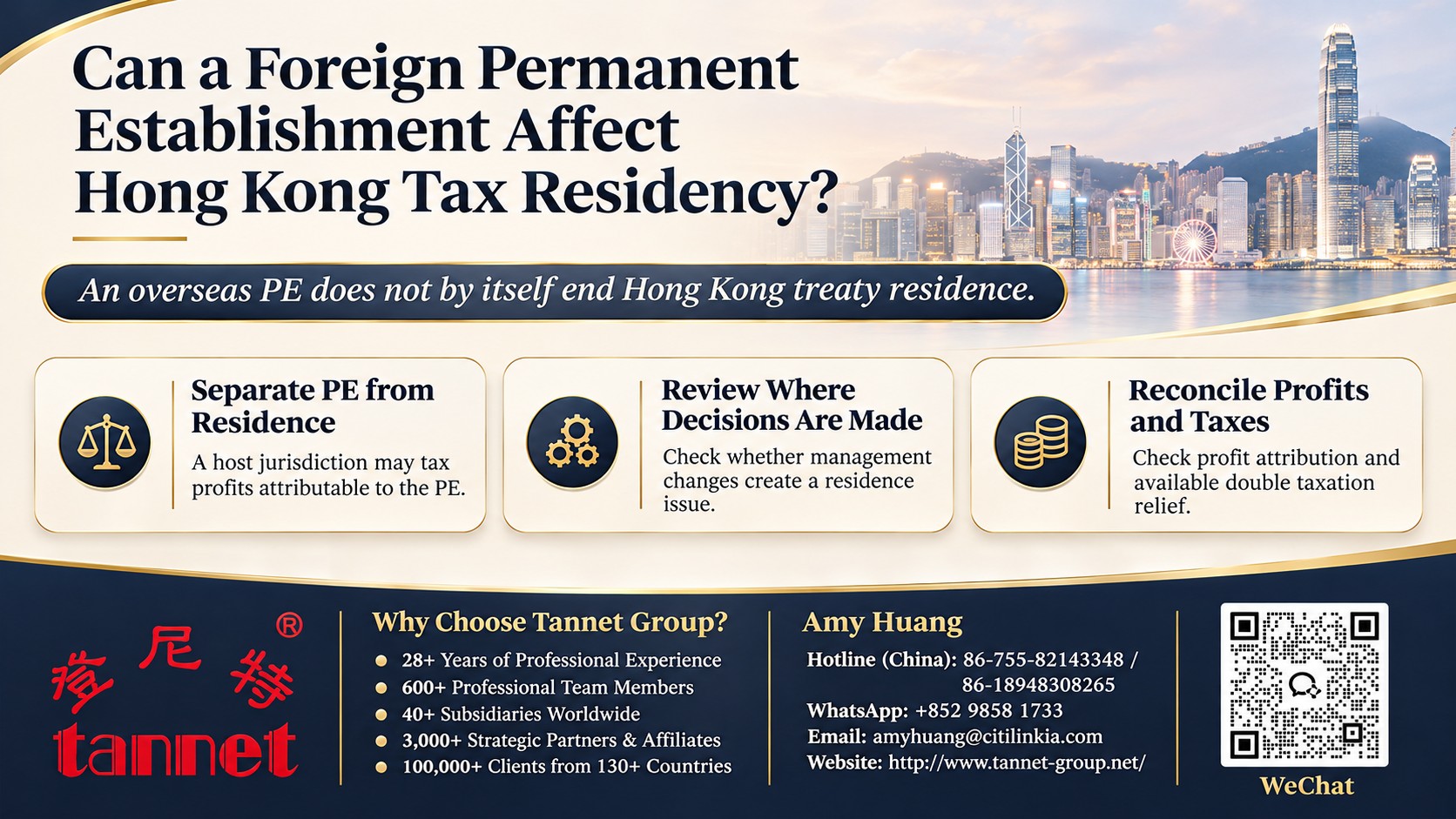
A foreign permanent establishment does not, by itself, make a Hong Kong company a tax resident of the host jurisdiction or end its Hong Kong treaty residence. It generally gives the host jurisdiction a basis under the treaty to tax profits attributable to the local business presence, subject to domestic law.
The same facts may still raise a separate residence question. This matters when an overseas branch begins making strategic decisions or a host authority asserts residence as well as branch taxation. Check domestic residence rules, the treaty’s residence and permanent establishment articles, and any dual residence procedure before filing.
Separate residence from the right to tax branch profits
Tax residence concerns the company itself. Start with the law of each relevant jurisdiction and the definition in the applicable agreement. Incorporation or where management takes place may matter, depending on the rule. Do not infer residence from a foreign tax number.
A permanent establishment, or PE, concerns a business presence in another jurisdiction. A fixed office through which the enterprise conducts business is a common example. Some treaties also cover specified service activities, construction projects or dependent agents. The wording and factual thresholds vary.
A Hong Kong company can be a treaty resident of Hong Kong and have a PE abroad. In that situation, the treaty can allow the host jurisdiction to tax the profits attributable to the PE. The existence of a PE alone does not allocate all company profits to that jurisdiction.
When foreign operations raise a residence question
Look for changes in who makes decisions for the company as a whole. A branch manager approving local delivery schedules is different from executives abroad deciding group strategy, approving major financing or controlling investments for the Hong Kong company.
Check actual decision making. Minutes may record a Hong Kong meeting, but other documents may show that the participants merely ratified a decision already made abroad. Review where material proposals were debated and who had authority to accept or reject them.
If both jurisdictions treat the company as resident under the relevant treaty definition, read the applicable tie-breaker. Do not assume the place of effective management automatically decides every case. Some treaties require the competent authorities to seek agreement and may limit relief if they do not agree.
The Fifth Protocol to the Hong Kong arrangement with the Chinese Mainland illustrates this approach. For a dual resident company, the authorities seek agreement for treaty purposes, taking account of effective management, incorporation and other relevant factors. Without agreement, relief is generally unavailable except as the authorities agree.
Step 1 Establish the facts of the overseas presence
Identify the legal structure. A branch is part of the same company. An overseas subsidiary is a separate entity. Ownership of that subsidiary does not itself establish a PE of the parent, although the subsidiary’s activities could create one if the treaty test is met.
Map premises, staff, projects and contract activity. Record who can bind the company and who actually negotiates terms. Determine whether an exception applies. Do not assume that a service duration threshold answers a separate question about a fixed office or dependent agent.
The arrangement with the Chinese Mainland illustrates why the exact text matters. Its service provision can cover the same or connected projects exceeding 183 days within a twelve month period. That threshold is not a universal PE rule or a corporate residence test.
Step 2 Determine whether the host asserts residence
Ask the local adviser whether the company is assessed as a nonresident carrying on business through a PE or as a resident taxpayer. Obtain the assessment or registration basis. A branch return can establish a filing obligation without resolving the company’s residence.
Compare dates. The branch may have existed for years before senior management moved. A new residence issue should not automatically be assumed to apply to the earlier periods. Identify when authority and practice changed and what local law says about the relevant tax period.
Step 3 Attribute the profits and review connected income
Identify which activities the foreign establishment performs, what assets it uses and what risks are relevant. Keep branch accounts and reconcile them with the company’s books. Local invoices and bank deposits are evidence, but they do not alone determine attributable profits.
Use the governing treaty and host law for the attribution method. The Hong Kong IRD’s Departmental Interpretation and Practice Notes No. 60 discuss attribution to PEs in Hong Kong. They do not prescribe how a foreign authority must assess a PE in its jurisdiction.
If the company receives royalties or interest from the host jurisdiction, check whether the relevant right or debt claim is effectively connected with the PE. Some treaties then direct the income to the business profits article instead of applying the ordinary interest or royalty rules.
For example, a foreign service branch may support local customers while the Hong Kong company also earns interest on an unrelated loan. The existence of the branch does not determine the treatment of the interest. Examine the loan’s factual connection to the branch.
Step 4 Check relief from double taxation
Confirm whether the same profits are taxed in both places and whether the taxes are covered. Review the treaty’s relief article and applicable domestic provisions. A credit or exemption depends on the relevant rules. Foreign payment of tax does not automatically produce a Hong Kong credit.
Keep foreign assessments, payment evidence, computations and exchange rates. Reconcile the amount taxed abroad to the amount included in any Hong Kong assessment. Document timing differences before comparing the figures or estimating possible relief.
If the authorities disagree on residence or attribution, check the applicable treaty route. The Hong Kong IRD describes the Mutual Agreement Procedure as a way to address taxation inconsistent with a treaty. Track its deadline separately from local objections and appeals.
An overseas operation can create compliance duties even while residence remains unchanged. Ask the local adviser to identify registration, return and payment deadlines independently of the residence review.
If the branch closes, record its last trading date and how open contracts were completed. Check whether a final return or assessment is still needed in the host jurisdiction.
Common mistakes
Do not treat foreign branch registration as a residence ruling. Identify the precise basis on which the host taxes the company.
Do not use the residence certificate to conclude that no PE exists. It supports residence for the relevant treaty claim. The PE analysis depends on activities in the host jurisdiction and the governing rules.
Do not use a separate branch ledger as conclusive proof of profit attribution. Check who performed the work and what the records support. Nor should you treat the entire enterprise’s income as connected with the branch without analysing each material stream.
Frequently asked questions
Q1 Does opening an overseas branch end Hong Kong treaty residence?
No, not by itself. Apply the relevant residence definition. Review whether the company’s actual management or other residence facts have changed.
Q2 Can a company be Hong Kong resident and pay tax on PE profits abroad?
Yes. A treaty can permit the host to tax attributable profits without treating the company as resident there.
Q3 Does having a foreign subsidiary automatically create a PE?
No. Examine whether the parent carries on business through a local place or through activities that meet another applicable PE test.
Q4 What if all senior decisions move overseas?
Review the host’s domestic residence rules and the treaty residence article promptly. If both jurisdictions claim residence, check the treaty’s tie-breaker and competent authority process.
Q5 Does the branch make all local interest and royalties taxable as business profits?
No. Check the wording of the treaty and whether the debt claim or rights are effectively connected with the PE.
Q6 Which evidence is most useful when management location is disputed?
Keep decision papers, approval logs, delegations of authority and records of who made material decisions. Match them to the dates under review.
Q7 Can a Hong Kong residence certificate settle a dual residence dispute?
No. A certificate is evidence of Hong Kong residence. Apply the applicable tie-breaker and seek competent authority assistance where the treaty provides for it.
Where Tannet can assist
Tannet can help assemble branch records, governance evidence and documents for a residence certificate application. Engage local tax advisers to assess foreign residence, PE exposure, attribution or a treaty dispute before taking a filing position.
Written by: Tannet Business Services Team
Reviewed by: Consultant Amy Huang
First published: 10 Nov. 2026
Last reviewed: 10 Nov. 2026
30th Anniversary Offer: Tannet has been established for 28 years, we are offering exclusive limited-time promotional pricing to celebrate Tannet’s 30th anniversary. Slots are limited and available on a first-come, first-served basis. Contact Consultant Amy Huang for details.
————————————————Simplifying Business, Empowering Entrepreneurs————————————————