Key Takeaway
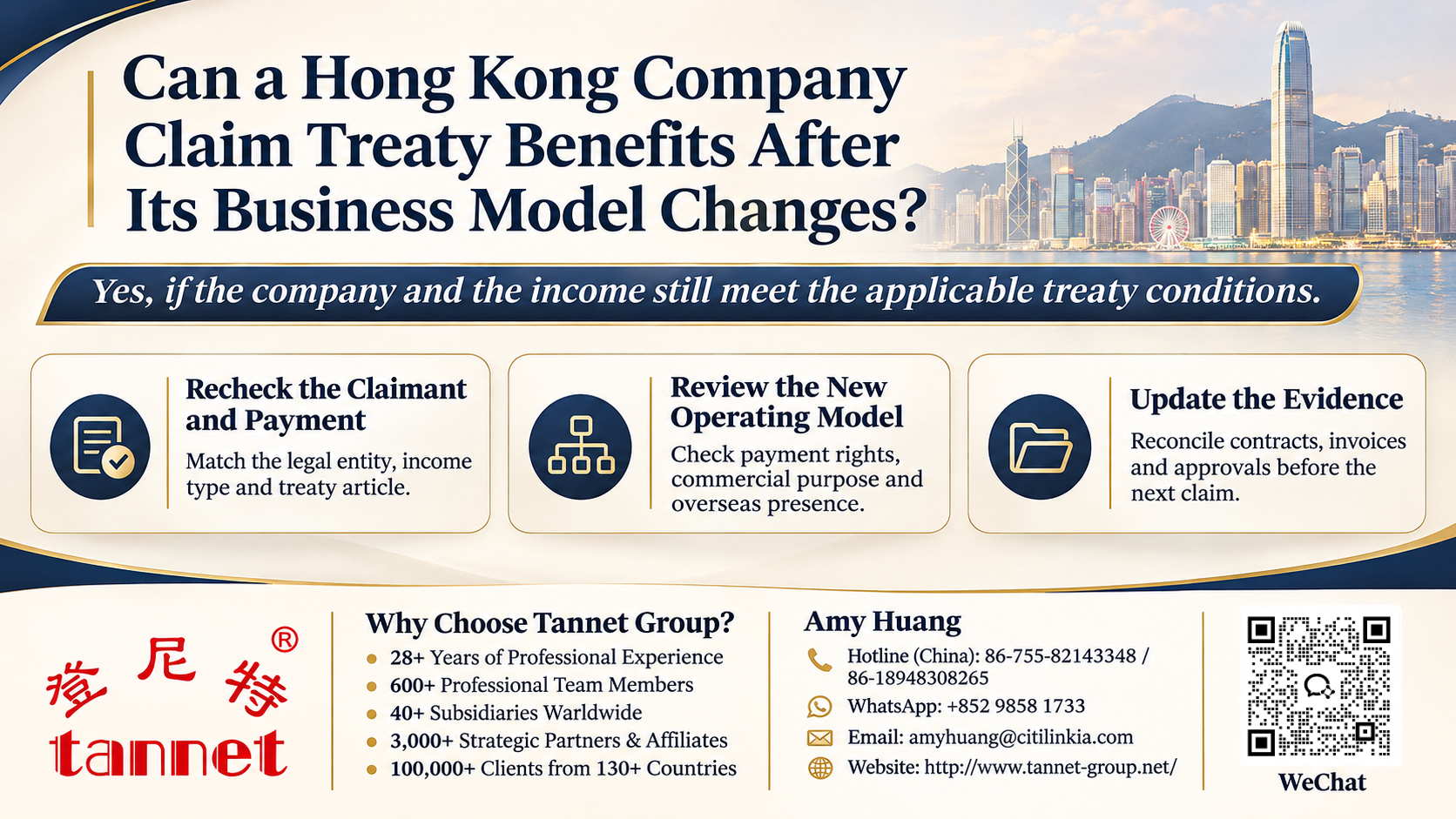
A Hong Kong company can still claim tax treaty benefits after changing its business model if the company and the relevant income continue to meet the applicable conditions. The change itself does not cancel eligibility. It can, however, change who earns the income, which treaty article applies, or how the payer must claim relief.
This matters when a distributor becomes a commission agent, a service company begins licensing software, or a group transfers contracts to another entity. Reassess the claim from the effective date. A Hong Kong Certificate of Resident Status supports residence; it does not confirm that the new payment qualifies.
Identify what the business change actually did
Start with the operating facts. Record the date the new contract took effect and when staff began working under it. Those dates can differ. Compare who signs contracts, performs the work, bears losses and receives each payment before and after the change.
A new trading name or invoice layout may leave the transaction unchanged. Reassigning contracts, transferring intellectual property or moving decision authority can change the analysis. Describe the underlying change rather than relying on how the project was named internally.
Check whether the same legal entity remains entitled to the income. If a subsidiary takes over contracts, it may be the new claimant. An existing certificate for the Hong Kong parent cannot establish the subsidiary’s residence.
Step 1 Match the payment to the applicable treaty
List the payer, claimant, source jurisdiction, payment type and relevant dates. Check the operative agreement and protocols. Where a multilateral modification applies, verify that it took effect for the tax and period in question.
Identify the relief sought. A lower withholding rate on royalties is different from a claim that business profits are taxable only in the residence jurisdiction because the enterprise has no permanent establishment in the source jurisdiction. Each claim needs evidence tied to its own provision.
Start with the facts that determine the character of the payment. A customer may pay for access to hosted software, a right to reproduce it, or support services. The agreement and actual rights matter more than a description such as technology fee.
Step 2 Recheck residence and certificate coverage
Read the residence article for the actual claimant. Where another jurisdiction also treats the company as resident, check the agreement’s rule for dual residence. A change in where senior decisions are made can matter, even when the company keeps its Hong Kong registration and bank account.
The Hong Kong Inland Revenue Department distinguishes residence certification from the treaty partner’s decision to grant foreign tax relief. Check that the certificate relates to the correct company, agreement and period. Ask whether any information previously given to the payer or authority needs updating.
The IRD describes a specific arrangement for the Chinese Mainland. A certificate generally serves as residence evidence for the stated calendar year and the next two. The IRD says it stops serving as such proof after a change that causes the applicant to cease meeting the conditions for benefits under that arrangement.
That treatment does not apply automatically to other treaty partners. Nor does a change in operations always require a new certificate. Review the new facts and the applicable procedure before relying on an existing document or requesting another one.
Step 3 Test payment rights and commercial purpose
For articles that require beneficial ownership, review who may use and enjoy the income. Look for obligations to forward it, including restrictions created by linked agreements. Receiving cash into a Hong Kong account does not settle that test.
Consider a Hong Kong company that starts sublicensing technology. Review what it can negotiate, who controls collections, and whether the Hong Kong company must remit receipts under the upstream licence. Document the actual rights and cash flows alongside the terms used to set the royalty.
Check anti-abuse provisions separately. Under the Fifth Protocol to the arrangement with the Chinese Mainland, relief may be denied if obtaining the benefit was one of the principal purposes of the arrangement or transaction, unless relief is consistent with the object and purpose of the relevant provisions.
Keep contemporaneous records explaining the commercial decision. For example, management might move order processing to a distributor to reduce delivery delays. Preserve the alternatives, cost assumptions and implementation records. The reason for the change should be visible in how the business subsequently operated.
Step 4 Review the source jurisdiction footprint
If the new model puts staff, premises or agents in the payer’s jurisdiction, examine permanent establishment risk under the applicable rules. A change from direct exports to local installation and servicing can alter the activities carried on there. Check contract authority, project duration and the role of each location.
If a permanent establishment exists, review which profits are attributable to it. For interest or royalties, check whether the relevant debt claim or right is effectively connected with that establishment under the treaty. The connection may change the article that governs the income.
Step 5 Update the file before the next claim
Prepare a dated comparison of the old and new models. Attach signed contracts and amendments, relevant approvals, invoices and payment records. Where the entities are related, retain pricing support and explain how the allocation of functions and risks changed.
Separate payments that belong to different periods. An invoice raised after a change may relate to services completed earlier. Check when the treaty and source jurisdiction treat the relevant payment as made or the income as arising.
Confirm the payer’s process and deadlines. Ask whether a new declaration, certificate or supporting explanation is needed. If relief at source cannot be supported in time, check whether domestic withholding followed by a refund claim is available and who must make it.
Keep the old claim file intact. Record which payments were reviewed, who approved the revised treatment and when the payer received the updated withholding instructions.
Schedule a further check after implementation. The signed transition documents may describe a change that staff or customers have not yet put into practice.
Common mistakes
Do not copy last year’s treaty analysis into the new file. A different contracting entity or income stream can produce a different result despite an unchanged group structure.
Do not treat commercial substance as a substitute for every other condition. A real business can still use the wrong treaty article or miss a procedural deadline.
Do not silently correct a previous declaration by changing a later invoice. If earlier claims may be affected, identify the payments and ask whether the source jurisdiction requires notification, correction or an amended filing.
Frequently asked questions
Q1 Does a new business activity cancel existing treaty benefits?
No. Review the conditions for the affected income. A new activity may leave other payments unchanged, but evidence for the earlier claim should remain available.
Q2 Can I use the same residence certificate after changing activities?
Possibly. Check the claimant, treaty and period, and whether the facts still support the claim. Ask about any updated document requirements before instructing the payer.
Q3 We changed from selling products to earning commission. What should we check first?
Identify who contracts with customers, whose goods are sold and what the Hong Kong company actually does. Then review income classification and any local agency exposure.
Q4 Does a new royalty stream need its own treaty analysis?
Yes. Review the rights granted, the claimant’s entitlement to the royalty, any permanent establishment connection and conditions specific to the applicable royalties article.
Q5 Should we tell the payer if a contract moves to another group company?
Yes. The payer needs accurate claimant information to apply the correct withholding procedure. Confirm when the transfer took effect and which entity earned each payment.
Q6 Can we recover tax withheld while the new claim was being reviewed?
That depends on the source jurisdiction. Check the refund procedure, eligible applicant, evidence and deadline. Do not assume that a certificate requires the payer to refund tax.
Q7 What if a treaty partner denies relief after the change?
Obtain the reasons in writing. Check local review deadlines and whether the treaty’s Mutual Agreement Procedure is available. The IRD describes that procedure as additional to domestic objection and appeal rights.
Where Tannet can assist
Tannet can help organise the change timeline, contracts, corporate records and certificate application documents. For a revised withholding position or potential overseas permanent establishment, coordinate the review with qualified advisers in the relevant jurisdictions.
Written by: Tannet Business Services Team
Reviewed by: Consultant Amy Huang
First published: 10 Nov. 2026
Last reviewed: 10 Nov. 2026
30th Anniversary Offer: Tannet has been established for 28 years, we are offering exclusive limited-time promotional pricing to celebrate Tannet’s 30th anniversary. Slots are limited and available on a first-come, first-served basis. Contact Consultant Amy Huang for details.
————————————————Simplifying Business, Empowering Entrepreneurs————————————————