Malaysia has become an increasingly attractive destination for international businesses seeking to establish a presence in Southeast Asia. Its strategic location, established manufacturing capabilities, developed infrastructure, multilingual workforce and access to regional markets make it a practical base for foreign investors.
For Australian companies, international manufacturers and regional SMEs, entering Malaysia presents opportunities to expand distribution networks, establish production facilities, access regional suppliers and develop a presence in the ASEAN market.
However, choosing the right location is an important part of the investment decision.
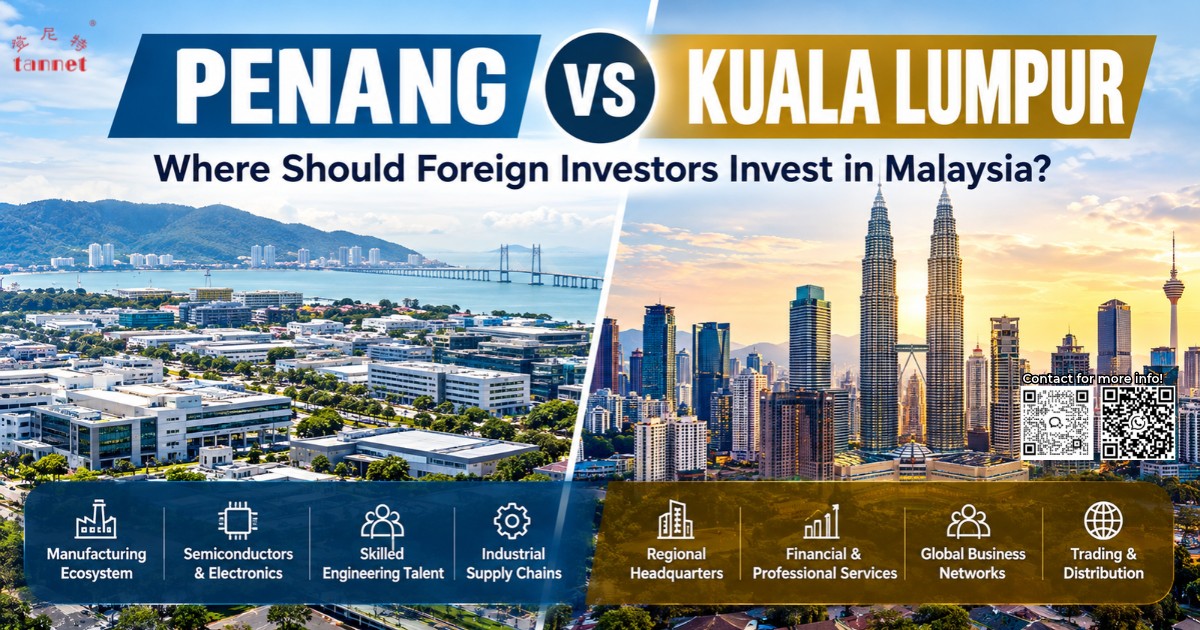
Two destinations frequently considered by foreign investors are Penang and Kuala Lumpur. Both offer established business environments, but their economic strengths, industrial ecosystems, talent availability and operating requirements differ.
Penang is widely recognised for its electrical and electronics (E&E) manufacturing ecosystem, semiconductor industry and industrial supply chains. Kuala Lumpur, together with the wider Greater Kuala Lumpur region, offers a stronger concentration of corporate headquarters, professional services, financial institutions and regional business operations.
So, when setting up a company in Malaysia, should foreign investors choose Penang or Kuala Lumpur?
The answer depends on the nature of the business, its operational requirements and its long-term investment strategy.
1. Penang: A Strategic Location for Manufacturing and Industrial Investment
Penang is one of Malaysia’s most established manufacturing destinations, particularly for businesses involved in electronics, semiconductors, precision engineering, medical devices and industrial equipment.
The state has developed a mature industrial ecosystem supported by multinational corporations (MNCs), local manufacturers, engineering companies and specialised suppliers.
According to InvestPenang, Penang recorded RM358.1 billion in electrical and electronics exports in 2024, accounting for approximately 60% of Malaysia’s total E&E exports. Its industrial network also includes more than 6,500 SMEs supporting different manufacturing and supply chain activities.
This makes Penang particularly attractive to foreign manufacturers looking to integrate into an established industrial ecosystem.
Key industries in Penang include:
- Electrical and electronics manufacturing
- Semiconductor assembly, testing and packaging
- Medical devices and healthcare equipment
- Precision engineering and machinery
- Industrial automation and manufacturing technology
- Aerospace and related engineering services
For Australian companies supplying industrial components, manufacturing equipment, engineering solutions or technology products, Penang may provide access to established industry networks and potential business partners.
Another advantage is its industrial infrastructure. Locations such as Bayan Lepas and Batu Kawan offer established industrial parks and manufacturing facilities, while Penang’s international airport and port infrastructure support international business operations.
Nevertheless, investors should consider industrial land availability, factory specifications, logistics arrangements and the availability of specialised workers before selecting a site.
Penang’s manufacturing ecosystem is highly developed, but competition for experienced engineering and technical talent can also be significant.
2. Kuala Lumpur: A Business Hub for Regional Headquarters and Professional Services
Kuala Lumpur is Malaysia’s commercial and financial centre. For foreign investors entering the Malaysian market through regional management, distribution, consulting or professional services, it offers a different set of advantages.
The wider Greater Kuala Lumpur region provides access to financial institutions, corporate service providers, legal and accounting firms, technology companies, government agencies and international business networks.
InvestKL, the investment promotion agency for Greater Kuala Lumpur, focuses on attracting multinational companies establishing regional business hubs, innovation centres and high-value services operations.
Key industries and business activities in Kuala Lumpur include:
- Regional headquarters and management operations
- Financial and professional services
- Information technology and digital businesses
- Consulting and business advisory
- Trading, distribution and regional procurement
- Global business services (GBS)
- Engineering and technology services
For Australian companies planning to manage their Malaysian operations, coordinate ASEAN business activities or establish a regional sales and distribution office, Kuala Lumpur can provide a more convenient corporate environment.
Its established business districts, international connectivity and access to a multilingual workforce are additional advantages.
Kuala Lumpur also provides access to a wider commercial ecosystem, making it easier for companies to connect with banks, professional advisers, suppliers and potential business partners.
However, companies planning large-scale manufacturing should look beyond the city centre. Industrial operations may be better located in surrounding areas such as Selangor, where industrial parks, warehouses and manufacturing facilities are available.
Therefore, foreign investors should distinguish between Kuala Lumpur as a corporate headquarters location and Greater Kuala Lumpur as a broader business and industrial region.
3. Penang vs Kuala Lumpur: Comparing Business Costs and Infrastructure
Business costs are an important consideration when establishing a Malaysian company.
However, there is no single location that is automatically cheaper for every business. Actual operating costs depend on the type of premises, workforce requirements, business activities and supply chain arrangements.
Industrial and commercial premises
Penang offers established manufacturing locations, including Bayan Lepas and Batu Kawan. Businesses can benefit from industrial clustering and proximity to suppliers.
Kuala Lumpur offers a wider selection of commercial offices, business centres and corporate facilities. However, manufacturing companies may need to consider industrial premises outside the city centre, particularly in Selangor.
Workforce and talent availability
Penang has a strong engineering and technical workforce supported by its manufacturing ecosystem. It is particularly relevant for businesses requiring semiconductor, electronics, production and precision engineering expertise.
Kuala Lumpur offers a broader concentration of corporate, financial, administrative, professional and digital talent. Its multilingual workforce can also support international customer service and regional management functions.
Infrastructure and connectivity
Both destinations provide established infrastructure, international connectivity and access to Malaysia’s national transportation networks.
Penang is particularly suitable for manufacturing operations that depend on industrial suppliers and international cargo movement.
Kuala Lumpur provides convenient access to international flights, financial institutions, corporate networks and regional business activities.
Ultimately, companies should evaluate their total operating costs rather than comparing rental rates alone. Logistics, labour, utilities, regulatory requirements and supply chain efficiency can significantly affect the overall investment decision.
4. Foreign Ownership: Can Foreign Investors Own 100% of a Malaysian Company?
One of the most common questions from international investors is whether foreigners can establish and own a Malaysian company without a local business partner.
In many sectors, foreign investors can establish a Malaysian private limited company, commonly known as a Sdn. Bhd., with foreign shareholders.
Malaysia permits 100% foreign equity participation in new manufacturing projects, as well as expansion and diversification projects in the manufacturing sector, subject to applicable requirements and regulatory conditions.
However, investors should not assume that every business activity has identical foreign ownership rules.
Certain regulated sectors, including financial services, telecommunications and other licensed activities, may be subject to specific ownership conditions, approvals or local participation requirements.
The applicable requirements should therefore be checked against the company’s actual business activities before incorporation.
For foreign manufacturers, another important consideration is the manufacturing licence.
Under the Industrial Co-ordination Act 1975, manufacturing companies with shareholders’ funds of RM2.5 million or more, OR employing 75 or more full-time paid employees, are generally required to apply for a manufacturing licence through the Malaysian Investment Development Authority (MIDA).
Companies below both thresholds may apply for an exemption from the manufacturing licence, subject to eligibility and approval.
These requirements apply regardless of whether the company operates in Penang or Kuala Lumpur.
5. How to Set Up a Sdn. Bhd. in Malaysia as a Foreign Investor
For international businesses planning to establish a Malaysian presence, incorporating a Sdn. Bhd. is a common market-entry structure.
The process generally involves several important steps.
Step 1: Determine the Business Structure
Investors should first identify the appropriate legal structure based on their intended activities, ownership arrangements and operational plans.
A Malaysian Sdn. Bhd. is a separate legal entity and is commonly used by foreign businesses establishing a local subsidiary.
Alternatively, an overseas company may consider registering a foreign company or branch, depending on its business requirements.
Step 2: Confirm Foreign Ownership and Business Activity Requirements
Before incorporation, investors should identify the company’s proposed business activities and determine whether any sector-specific approvals, licences or foreign equity restrictions apply.
Manufacturing, trading, financial services and other regulated activities may have different regulatory requirements.
Step 3: Prepare the Incorporation Documents
Company incorporation is administered by the Companies Commission of Malaysia (SSM) under the Companies Act 2016.
A private company generally requires at least one shareholder and one director who ordinarily resides in Malaysia.
Foreign individuals or overseas corporate entities may hold shares, subject to applicable legal and regulatory requirements.
Step 4: Complete Company Incorporation
The proposed company name and incorporation particulars must be submitted to SSM.
Following successful incorporation, the company should arrange its statutory records, registered office and appointment of a qualified company secretary.
Step 5: Arrange Post-Incorporation Compliance
After incorporation, companies may need to arrange corporate bank account opening, tax registration, accounting and bookkeeping, statutory filings and relevant business licences.
Companies employing foreign professionals may also need to consider applicable expatriate employment and immigration requirements.
The exact requirements depend on the company’s activities, ownership structure and operational plans.
6. Which Location Should Foreign Investors Choose?
There is no universal answer to whether Penang or Kuala Lumpur is the better investment destination.
The right choice depends on what the company intends to achieve in Malaysia.
Penang may be more suitable for:
- Australian manufacturers establishing production facilities.
- Semiconductor and electronics businesses.
- Companies requiring engineering and industrial suppliers.
- Medical device and precision engineering manufacturers.
- Businesses seeking access to an established manufacturing ecosystem.
Kuala Lumpur and Greater Kuala Lumpur may be more suitable for:
- Foreign companies establishing regional headquarters.
- International SMEs entering the Malaysian market.
- Trading and distribution businesses.
- Professional services and consulting firms.
- Technology companies and regional management operations.
- Businesses requiring access to financial institutions and corporate networks.
Companies with more complex operations may also consider a multi-location strategy. For example, a foreign investor could establish its corporate headquarters in Kuala Lumpur while operating a manufacturing facility in Penang.
This approach allows businesses to separate corporate management from production activities while maintaining a presence in both commercial and industrial ecosystems.
7. Plan Your Malaysia Market Entry Before Incorporation
Choosing between Penang and Kuala Lumpur is only one part of establishing a successful business presence in Malaysia.
Foreign investors should also evaluate their intended business activities, ownership structure, incorporation requirements, licensing obligations, tax responsibilities and ongoing corporate compliance.
A company registered in Malaysia does not automatically receive approval to conduct every type of business. Certain activities require additional licences, sector-specific approvals or regulatory clearances before operations can commence.
Malaysia’s National Investment Framework (NIF), implemented for the manufacturing sector from 1 March 2026, also places greater emphasis on measurable investment outcomes, including high-value employment, domestic supply chain development, economic complexity and sustainability.
Investors considering eligible manufacturing or services projects should therefore assess available investment incentives based on their proposed activities and applicable criteria.
Conclusion: Establish Your Malaysian Business with the Right Strategy
Penang and Kuala Lumpur both offer compelling opportunities for foreign investors, but their strengths serve different business objectives.
Penang stands out for its established manufacturing ecosystem, engineering capabilities and industrial supply chains. Kuala Lumpur offers a more comprehensive corporate environment for regional management, professional services, trading and business development.
For Australian companies and international SMEs, the most effective market-entry strategy begins with understanding the business model, selecting the appropriate location and ensuring that the company is structured correctly from the beginning.
TANNET provides Malaysia company incorporation, business advisory and corporate secretarial services to support foreign investors entering the Malaysian market. From selecting a suitable business structure and preparing incorporation documents to understanding regulatory requirements and ongoing compliance, professional guidance can help businesses establish their Malaysian presence with greater clarity and confidence.
If you are considering setting up a company in Malaysia, choosing the right location and corporate structure is an important first step towards building a sustainable regional operation.
📞 Free 1-on-1 Consultation Now,
Official Service Hotline: +86-755-82148419
Cell: +86-13823131503;+60 19-309 2363
WeChat ID: 13823131503;
WhatsApp:+86-13823131503;+60 19-309 2363
Email: mytannet08@gmail.com; susiehu@citilinkia.com